If you have any questions, you are always welcome to contact us. We'll get back to you as soon as possible, withing 24 hours on weekdays.
Customer service
All questions about your order, return and delivery must be sent to our customer service team by e-mail at yourstore@yourdomain.com
Sale & Press
If you are interested in selling our products, need more information about our brand or wish to make a collaboration, please contact us at press@yourdomain.com
Help
If you have any questions, you are always welcome to contact us. We'll get back to you as soon as possible, withing 24 hours on weekdays.
Customer service
All questions about your order, return and delivery must be sent to our customer service team by e-mail at yourstore@yourdomain.com
Sale & Press
If you are interested in selling our products, need more information about our brand or wish to make a collaboration, please contact us at press@yourdomain.com
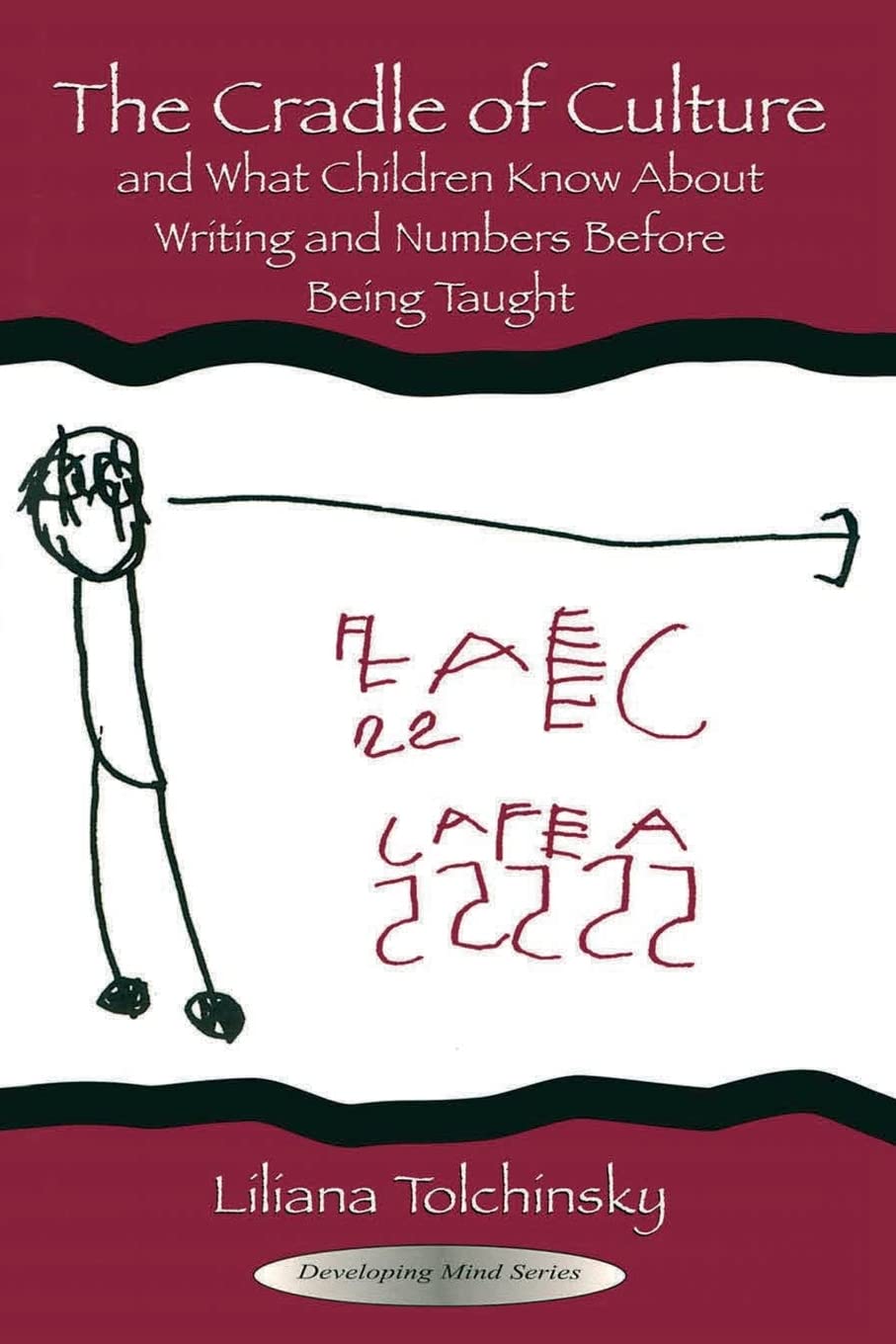
This book provides a thrilling description of preliterate children's developing ideas about writing and numerals, and it illustrates well the many ways in which cultural artifacts influence the mind and vice versa. Remarkably, children treat writing and numerals as distinct even before they have received any formal training on the topic, and well before they learn how to use writing to represent messages and numerals to represent quantities.In this revolutionary new book, Liliana Tolchinsky argues that preliterate children's experiences with writing and numerals play an essential and previously unsuspected role in children's subsequent development. In this view, learning notations, such as writing is not just a matter of acquiring new instruments for communicating existing knowledge. Rather, there is a continual interaction between children's understanding of the features of a notational system and their understanding of the corresponding domain of knowledge. The acquisition of an alphabetic writing system transforms children's view of language, and the acquisition of a formal system of enumeration transforms children's understanding of numbers.Written in an engaging narrative style, and richly illustrated with historical examples, case studies, and charming descriptions of children's behavior, this book is aimed not only at cognitive scientists, but also at educators, parents, and anyone interested in how children develop in a cultural context.
⚠️ WARNING (California Proposition 65):
This product may contain chemicals known to the State of California to cause cancer,
birth defects, or other reproductive harm.
For MAP (Minimum Advertised Price) violations and Intellectual Property (IP) or Trademark concerns, please contact:
support@ergodebooks.com
⚠️ California Proposition 65 Warning: Some products sold on this website may expose you to chemicals known to the State of California to cause cancer, birth defects, or other reproductive harm. For more information, visit www.P65Warnings.ca.gov.