
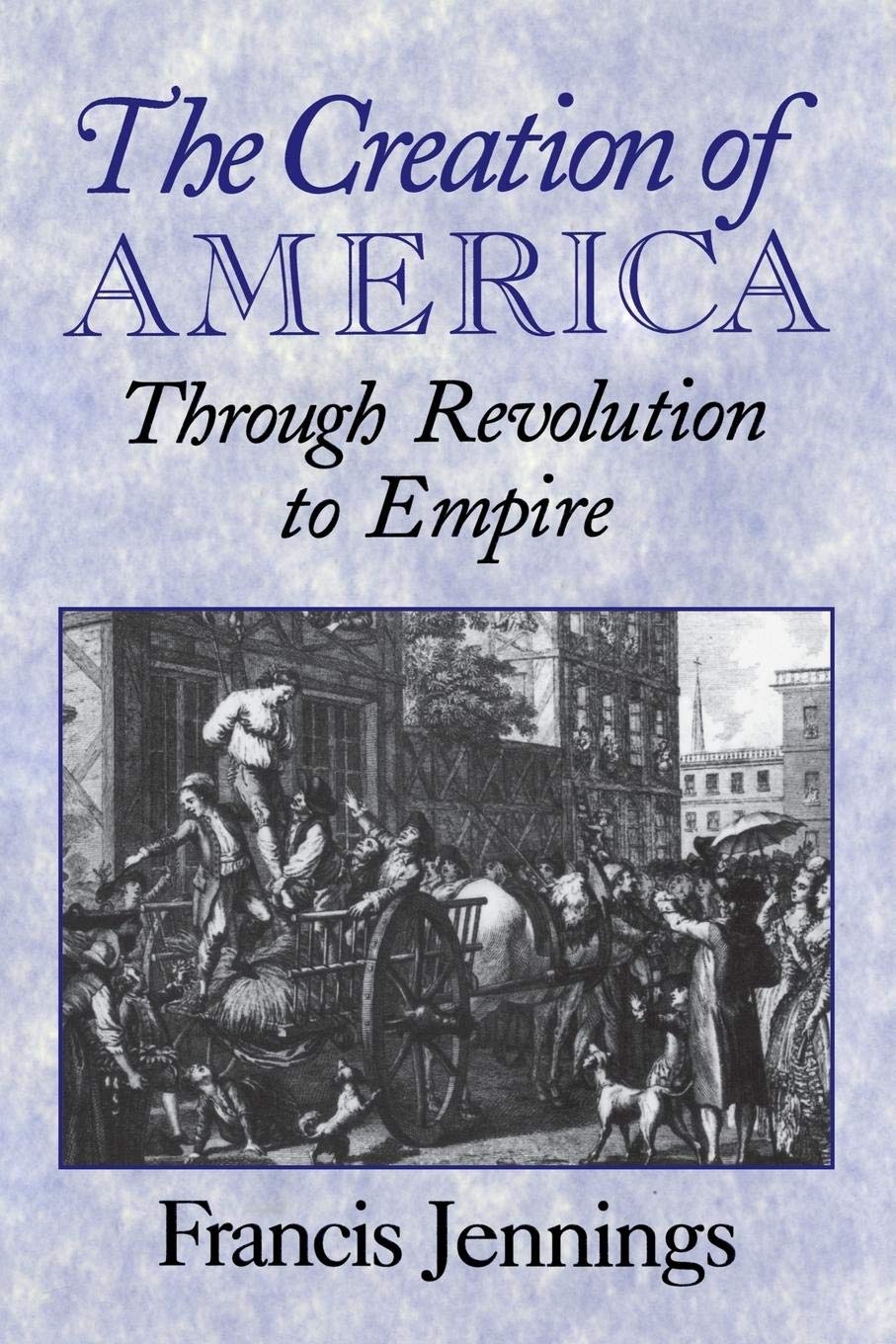
Title
The Creation of America: Through Revolution To Empire,Used
Sold by Ergodebooks, an authorized reseller.
Returns accepted within 30 days | support@ergodebooks.com
Shipping Information
- Free Standard Shipping — United States only
- Processing Time: 3–5 business days
- Estimated Delivery: 6–10 business days after dispatch
- Double-boxed, fully insured & discreetly packaged
- Tracking number sent via email once dispatched
Returns & Refund
Returns accepted within 30 days of delivery.
Damaged or Defective Item
Free return shipping + replacement or full refund
Wrong Item Received
Free return shipping + replacement or full refund
Change of Mind
Return shipping at customer's expense · 25% restocking fee applies
Payment Option

In the standard presentation of the American Revolution, a ragtag assortment of revolutionaries, inspired by the ideals of liberty and justice, rise to throw off the yoke of the British empire and bring democracy to the New World. It makes a pretty story. Now, in place of this fairytale standing in for history, Francis Jennings presents a realistic alternative: a privileged elite, dreaming of empire, clone their own empire from the British. Jennings shows that colonies were extensions from Britain intended from the first to conquer American Indians. Though subordinate to the British crown, in the opposite direction they ruled over beaten native peoples. Adding to this dual nature, some colonists bought Africans as slaves and rigidly ruled over them within their colonies. To justify conquests and oppression, they invented the concept of racial gradation in a system of social castes. We live with it still. In this full scale reconception, the experience of tribal Indians and enslaved Blacks is brought into the whole picture. The colonists were enraged by efforts of crown and Parliament to forbid settlement in tribal territories. Especially Virginians rose under great speculator George Washington to seize the western lands in defiance of the crown's orders. We witness the founders' invasion and attempted conquest of Canada and the 'conquest' of Pennsylvania as Quakers and German pietists were deprived of citizenship rights and despoiled of property through armed force and legal trickery. British sympathies were so strong that George III had to hire Hessians as soldiers because he could not trust his own people. And Britain also had movements for reform that won freedom of the press and refusal to legislate slavery while the Revolutionaries tarred and feathered their opponents and strengthened the slavery institution. Revolutionary rhetoric about liberty and virtue is revealed as war propaganda. Illegal 'committees' and 'conventions' functioned like soviets of the later Russian revolution. The U.S. Constitution was the fulfillment of the Revolution rather than its 'Thermidor.' The work is meticulously documented and detailed. By including the whole population in its history, Jennings provides an eloquent explanation for a host of anomalies, ambiguities, and iniquities that have followed in the Revolution's wake.
⚠️ WARNING (California Proposition 65):
This product may contain chemicals known to the State of California to cause cancer, birth defects, or other reproductive harm.
For more information, please visit www.P65Warnings.ca.gov.
- Q: How many pages does this book have? A: The book has three hundred fifty-four pages. This length provides an in-depth exploration of the American Revolution and its complexities.
- Q: What is the binding type of this book? A: The book is paperback bound. This makes it lightweight and flexible, ideal for reading and carrying.
- Q: Who is the author of this book? A: The author is Francis Jennings. He provides a critical examination of American history from a unique perspective.
- Q: What is the main theme of this book? A: The main theme is a realistic retelling of the American Revolution. It challenges traditional narratives by focusing on colonial ambitions and social hierarchies.
- Q: Is this book suitable for high school students? A: Yes, the book is suitable for high school students. It offers critical insights that can enhance their understanding of American history.
- Q: Can this book be used as a reference for college papers? A: Yes, this book can be used as a reference for college papers. It is meticulously documented and includes extensive historical analysis.
- Q: What should I do to keep this book in good condition? A: To keep this book in good condition, store it in a dry place away from direct sunlight. This helps prevent fading and damage to the pages.
- Q: How do I clean this book if it gets dirty? A: If the book gets dirty, gently wipe the cover with a soft, dry cloth. Avoid using water or cleaning solutions that could damage the material.
- Q: Is there a warranty for this book? A: No, there is no warranty for this book. However, if it arrives damaged, you can contact the seller for a return or exchange.
- Q: What if I receive a damaged copy of this book? A: If you receive a damaged copy, you should reach out to the seller for a return or exchange. They will provide instructions for the process.
- Q: Is this book a good choice for someone interested in colonial history? A: Yes, this book is an excellent choice for those interested in colonial history. It offers a comprehensive view of the events leading to the American Revolution.
- Q: How does this book compare to other history books on the same topic? A: This book offers a distinct perspective compared to other history books. It emphasizes the role of social hierarchies and colonial ambitions rather than just revolutionary ideals.
- Q: Are there any illustrations or maps in this book? A: No, this book does not contain illustrations or maps. It focuses on text-based analysis and historical documentation.
- Q: Is this book considered a scholarly work? A: Yes, this book is considered a scholarly work. It is well-researched and includes extensive citations to support its claims.
- Q: What is the target audience for this book? A: The target audience includes historians, students, and anyone interested in a deeper understanding of American history. Its critical approach appeals to a wide readership.