
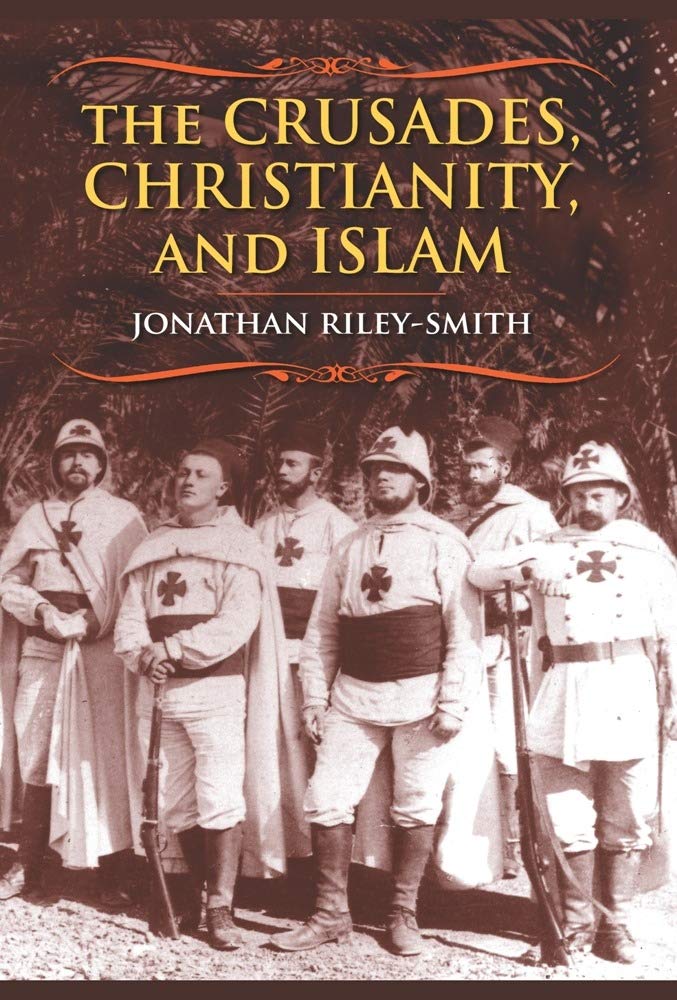
Title
The Crusades, Christianity, and Islam (Bampton Lectures in America),New
Sold by Ergodebooks, an authorized reseller.
Returns accepted within 30 days | support@ergodebooks.com
Shipping Information
- Free Standard Shipping — United States only
- Processing Time: 3–5 business days
- Estimated Delivery: 6–10 business days after dispatch
- Double-boxed, fully insured & discreetly packaged
- Tracking number sent via email once dispatched
Returns & Refund
Returns accepted within 30 days of delivery.
Damaged or Defective Item
Free return shipping + replacement or full refund
Wrong Item Received
Free return shipping + replacement or full refund
Change of Mind
Return shipping at customer's expense · 25% restocking fee applies
Payment Option

The Crusades were penitential warpilgrimages fought in the Levant and the eastern Mediterranean, as well as in North Africa, Spain, Portugal, Poland, the Baltic region, Hungary, the Balkans, and Western Europe. Beginning in the eleventh century and ending as late as the eighteenth, these holy wars were waged against Muslims and other enemies of the Church, enlisting generations of laymen and laywomen to fight for the sake of Christendom.Crusading features prominently in today's religiopolitical hostilities, yet the perceptions of these wars held by Arab nationalists, panIslamists, and many in the West have been deeply distorted by the language and imagery of nineteenthcentury European imperialism. With this book, Jonathan RileySmith returns to the actual story of the Crusades, explaining why and where they were fought and how deeply their narratives and symbolism became embedded in popular Catholic thought and devotional life.From this history, RileySmith traces the legacy of the Crusades into modern times, specifically within the attitudes of European imperialists and colonialists and within the beliefs of twentiethcentury Muslims. Europeans fashioned an interpretation of the Crusades from the writings of Walter Scott and a French contemporary, JosephFranois Michaud. Scott portrayed Islamic societies as forwardthinking, while casting Christian crusaders as culturally backward and often morally corrupt. Michaud, in contrast, glorified crusading, and his followers used its imagery to illuminate imperial adventures.These depictions have had a profound influence on contemporary Western opinion, as well as on Muslim attitudes toward their past and present. Whether regarded as a valid expression of Christianity's divine enterprise or condemned as a weapon of empire, crusading has been a powerful rhetorical tool for centuries. In order to understand the preoccupations of Islamist jihadis and the character of Western discourse on the Middle East, RileySmith argues, we must understand how images of crusading were formed in the nineteenth and twentieth centuries.
⚠️ WARNING (California Proposition 65):
This product may contain chemicals known to the State of California to cause cancer, birth defects, or other reproductive harm.
For more information, please visit www.P65Warnings.ca.gov.
- Q: How many pages are in this book? A: This book contains one hundred thirty-six pages. It is a concise examination of the Crusades and their historical significance.
- Q: What is the binding type of this book? A: This book is a hardcover edition. The hardcover binding provides durability for frequent handling and reading.
- Q: Who is the author of this book? A: The author of this book is Jonathan Riley-Smith. He is known for his expertise in medieval history and the Crusades.
- Q: What is the size of this book? A: The dimensions of this book are five point seven one inches in length, zero point seven one inches in width, and eight point three one inches in height. This size makes it easy to handle and store.
- Q: What category does this book fall under? A: This book falls under the category of Europe. It specifically addresses the historical context of the Crusades within European history.
- Q: Is this book suitable for beginners in history? A: Yes, this book is suitable for beginners. It offers a clear and accessible exploration of the Crusades without requiring prior knowledge.
- Q: What themes are explored in this book? A: This book explores themes of religious conflict, cultural interpretation, and the historical legacy of the Crusades. It delves into how these themes affect contemporary views.
- Q: How can I read this book? A: You can read this book by purchasing it or borrowing it from a library. It is designed for individual reading and study.
- Q: Is this book appropriate for children? A: No, this book is not specifically aimed at children. It discusses complex historical conflicts that may not be suitable for younger audiences.
- Q: How should I care for this hardcover book? A: To care for this hardcover book, keep it in a dry place and avoid exposure to direct sunlight. This will help maintain its condition.
- Q: What if my book arrives damaged? A: If your book arrives damaged, you should contact the seller for a return or replacement. Most sellers have policies in place for such issues.
- Q: Is there a warranty on this book? A: No, books typically do not come with a warranty. However, check with the retailer for their specific return policy.
- Q: Can I return the book if I change my mind? A: Yes, you can usually return the book if you change your mind, subject to the retailer's return policy. Be sure to check their terms.
- Q: What is the historical context of the Crusades discussed in this book? A: The book discusses the Crusades as penitential war-pilgrimages fought against various enemies of the Church. It examines their impact on modern religious and political landscapes.
- Q: How does this book compare to other historical accounts of the Crusades? A: This book provides a fresh perspective by addressing distortions in historical narratives. It contrasts with other works that may glorify or vilify the Crusades.