
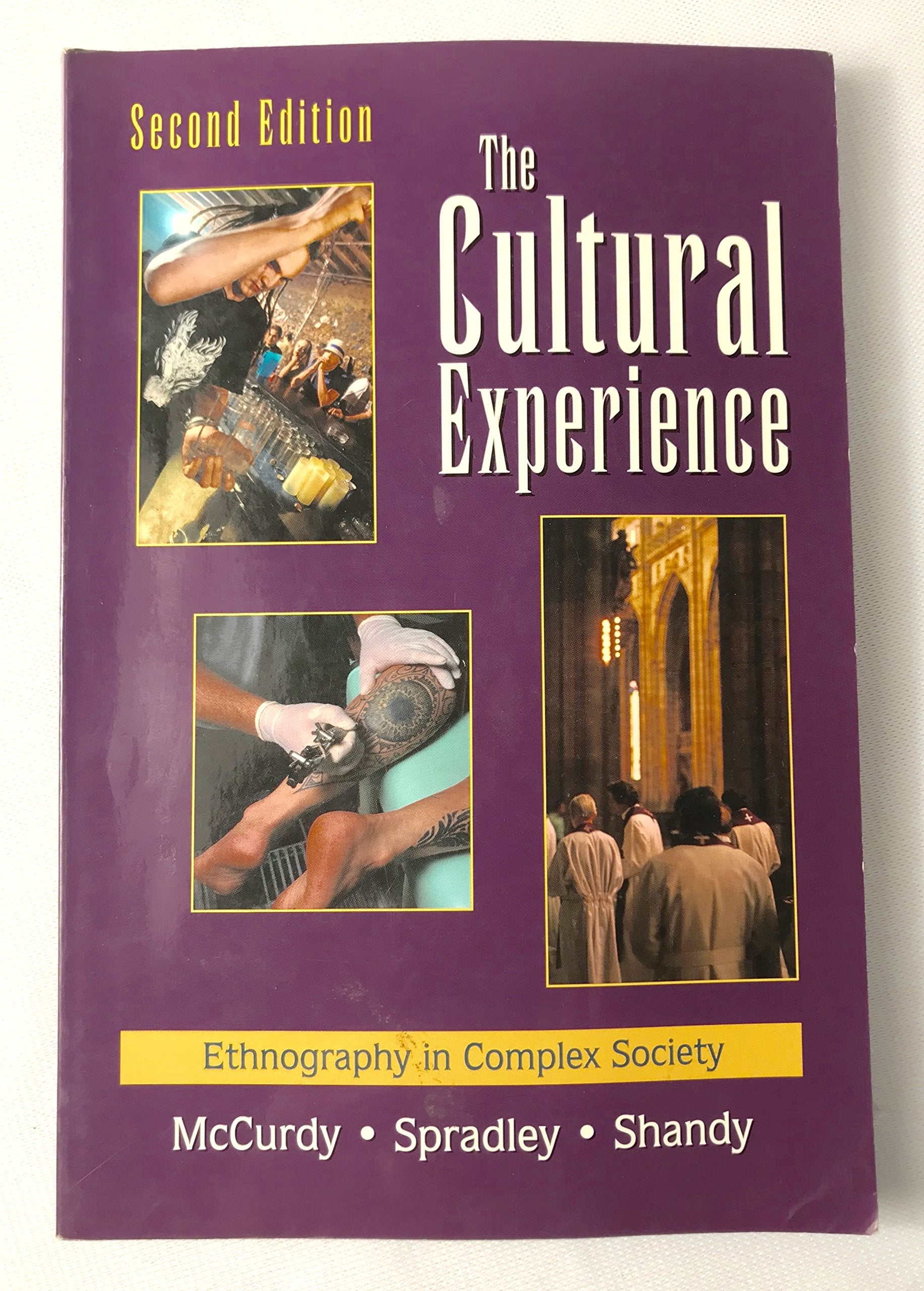
Title
The Cultural Experience: Ethnography In Complex Society
Sold by Ergodebooks, an authorized reseller.
Returns accepted within 30 days | support@ergodebooks.com
Shipping Information
- Free Standard Shipping — United States only
- Processing Time: 3–5 business days
- Estimated Delivery: 6–10 business days after dispatch
- Double-boxed, fully insured & discreetly packaged
- Tracking number sent via email once dispatched
Returns & Refund
Returns accepted within 30 days of delivery.
Damaged or Defective Item
Free return shipping + replacement or full refund
Wrong Item Received
Free return shipping + replacement or full refund
Change of Mind
Return shipping at customer's expense · 25% restocking fee applies
Payment Option

The Cultural Experience Has Helped Generations Of Undergraduates Discover The Excitement Of Ethnographic Research Through Participation In Relatively Familiar Cultures In North American Society. Grounded In The Interviewingbased Ethnographic Technique Known As Ethnosemantics, The Latest Edition Continues To Treat Ethnography As A Discovery Process. Students Are Taught How To Set Up An Ethnographic Field Study, Choose A Microculture, And Find And Approach An Informant, As Well As How To Ask Ethnographic Questions, Record Data, And Organize And Analyze What They Have Learned. Detailed Instruction On How To Write An Ethnography Is Also Provided. The Guidelines Are Followed By Ten Short But Substantive, Wellwritten Student Ethnographies On Such Microcultures As Exotic Dancing, Firefighting, Pest Extermination, And The Work Of Midwives And Police Detectives. The Second Edition Of This Popular Classroom Volume Has Been Expanded To Include Boxed Inserts That Offer Suggestions To Aid In The Research Process, New Material On How To Use Observation And Narratives With The Ethnosemantic Approach, Greater Emphasis On How To Find Cultural Themes And Adaptive Challenges By Analyzing Ethnographic Field Data, And More Extensive Strategies For Writing The Final Ethnographic Paper. The Latest Edition Also Presents An Expanded Treatment Of Ethical Responsibilities As Well As A Discussion Of The Significance Of Ethnographic Research And Its Applications In The Workplace.Titles Of Related Interest Also Available From Waveland Press: Angrosino, Doing Cultural Anthropology: Projects For Ethnographic Data Collection, Second Edition (Isbn 9781577664642); Angrosino, Exploring Oral History: A Window On The Past (Isbn 9781577665687); Angrosino, Projects In Ethnographic Research (Isbn 9781577663690); Babbie, Observing Ourselves: Essays In Social Research (Isbn 9781577660194); Craneangrosino, Field Projects In Anthropology: A Student Handbook, Third Edition (Isbn 9780881336856); Emerson, Contemporary Field Research: Perspectives And Formulations, Second Edition (Isbn 9781577661856); And Marti, Starting Fieldwork: Methods And Experiences (Isbn 9781478632955).
⚠️ WARNING (California Proposition 65):
This product may contain chemicals known to the State of California to cause cancer, birth defects, or other reproductive harm.
For more information, please visit www.P65Warnings.ca.gov.
- Q: How many pages does this book have? A: The book has two hundred pages. This length provides ample content for a thorough understanding of ethnographic research.
- Q: What binding type is used for this book? A: This book is available in paperback binding. This makes it lightweight and easy to handle for students.
- Q: Who is the author of this book? A: The author is David W. McCurdy. He is known for his expertise in anthropology and ethnography.
- Q: What is the subject matter of this book? A: The book covers ethnography in complex societies. It focuses on interviewing-based ethnographic techniques and cultural themes.
- Q: What dimensions does this book have? A: The book measures five and three-quarters inches in length by eight and one-half inches in height. Its slim profile makes it portable for students.
- Q: How do I conduct an ethnographic field study? A: To conduct an ethnographic field study, you should choose a microculture and find an informant. The book provides detailed guidelines on setting up and conducting the study.
- Q: Is this book suitable for beginners in ethnography? A: Yes, this book is suitable for beginners. It offers step-by-step instructions and practical examples of ethnographic research.
- Q: Can I use this book for college-level courses? A: Yes, this book is designed for college-level courses in anthropology. It has been used successfully by generations of undergraduates.
- Q: What types of microcultures are discussed in this book? A: The book discusses various microcultures, including exotic dancing and firefighting. These diverse examples illustrate the application of ethnographic techniques.
- Q: What ethical responsibilities are covered in this book? A: Yes, the book discusses ethical responsibilities in ethnographic research. It emphasizes the importance of ethical considerations in field studies.
- Q: How should I store this book? A: Store this book in a cool, dry place away from direct sunlight. This helps preserve the binding and pages in good condition.
- Q: Can this book be returned if I don't like it? A: Yes, this book can typically be returned if it is in new condition. Check the retailer's return policy for specific details.
- Q: What if the book arrives damaged? A: If the book arrives damaged, contact the retailer immediately for a replacement or refund. Most retailers have customer service for such issues.
- Q: How do I write an ethnography using this book? A: The book provides detailed instruction on writing an ethnography. It includes guidelines to help organize and analyze your findings.
- Q: What additional resources are mentioned in this book? A: The book mentions several related titles from Waveland Press for further study in anthropology. These resources complement the ethnographic approach.