If you have any questions, you are always welcome to contact us. We'll get back to you as soon as possible, withing 24 hours on weekdays.
Customer service
All questions about your order, return and delivery must be sent to our customer service team by e-mail at yourstore@yourdomain.com
Sale & Press
If you are interested in selling our products, need more information about our brand or wish to make a collaboration, please contact us at press@yourdomain.com
Help
If you have any questions, you are always welcome to contact us. We'll get back to you as soon as possible, withing 24 hours on weekdays.
Customer service
All questions about your order, return and delivery must be sent to our customer service team by e-mail at yourstore@yourdomain.com
Sale & Press
If you are interested in selling our products, need more information about our brand or wish to make a collaboration, please contact us at press@yourdomain.com
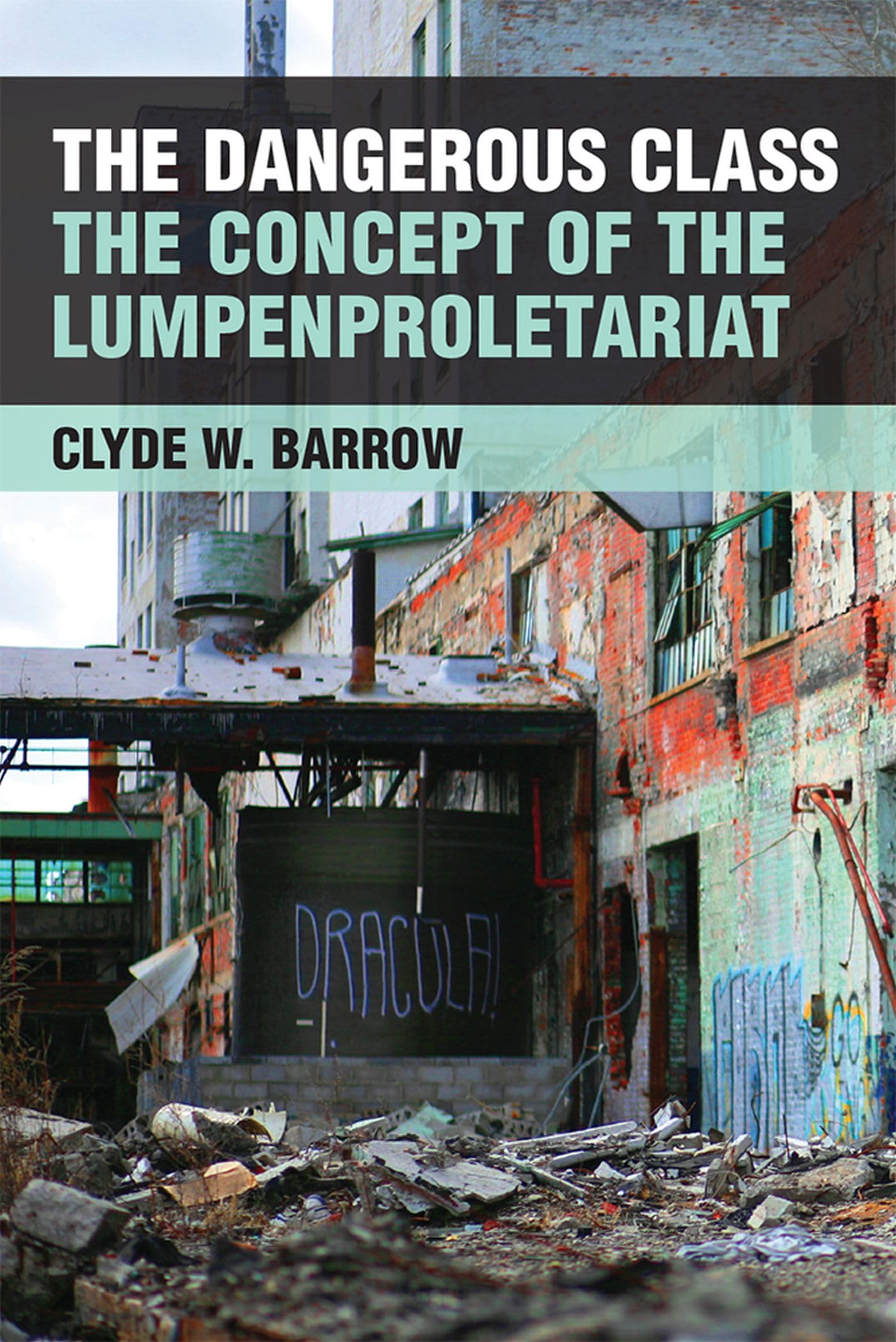
Marx and Engels concept of the lumpenproletariat, or underclass (an anglicized, politically neutral term), appears in The Communist Manifesto and other writings. It refers to the dangerous class, the social scum, that passively rotting mass thrown off by the lowest layers of old society, whose lowly status made its residents potential tools of the capitalists against the working class. Surprisingly, no one has made a substantial study of the lumpenproletariat in Marxist thought until now. Clyde Barrow argues that recent discussions about the downward spiral of the American white working class (its main problem is that it is not working) have reactivated the concept of the lumpenproletariat, despite long held belief that it is a term so illdefined as not to be theoretical. Using techniques from etymology, lexicology, and translation, Barrow brings analytical coherence to the concept of the lumpenproletariat, revealing it to be an inherent component of Marx and Engels analysis of the historical origins of capitalism. However, a proletariat that is destined to decay into an underclass may pose insurmountable obstacles to a theory of revolutionary agency in postindustrial capitalism. Barrow thus updates historical discussions of the lumpenproletariat in the context of contemporary American politics and suggests that all postindustrial capitalist societies now confront the choice between communism and dystopia.
⚠️ WARNING (California Proposition 65):
This product may contain chemicals known to the State of California to cause cancer,
birth defects, or other reproductive harm.
For MAP (Minimum Advertised Price) violations and Intellectual Property (IP) or Trademark concerns, please contact:
support@ergodebooks.com
⚠️ California Proposition 65 Warning: Some products sold on this website may expose you to chemicals known to the State of California to cause cancer, birth defects, or other reproductive harm. For more information, visit www.P65Warnings.ca.gov.