If you have any questions, you are always welcome to contact us. We'll get back to you as soon as possible, withing 24 hours on weekdays.
Customer service
All questions about your order, return and delivery must be sent to our customer service team by e-mail at yourstore@yourdomain.com
Sale & Press
If you are interested in selling our products, need more information about our brand or wish to make a collaboration, please contact us at press@yourdomain.com
Help
If you have any questions, you are always welcome to contact us. We'll get back to you as soon as possible, withing 24 hours on weekdays.
Customer service
All questions about your order, return and delivery must be sent to our customer service team by e-mail at yourstore@yourdomain.com
Sale & Press
If you are interested in selling our products, need more information about our brand or wish to make a collaboration, please contact us at press@yourdomain.com
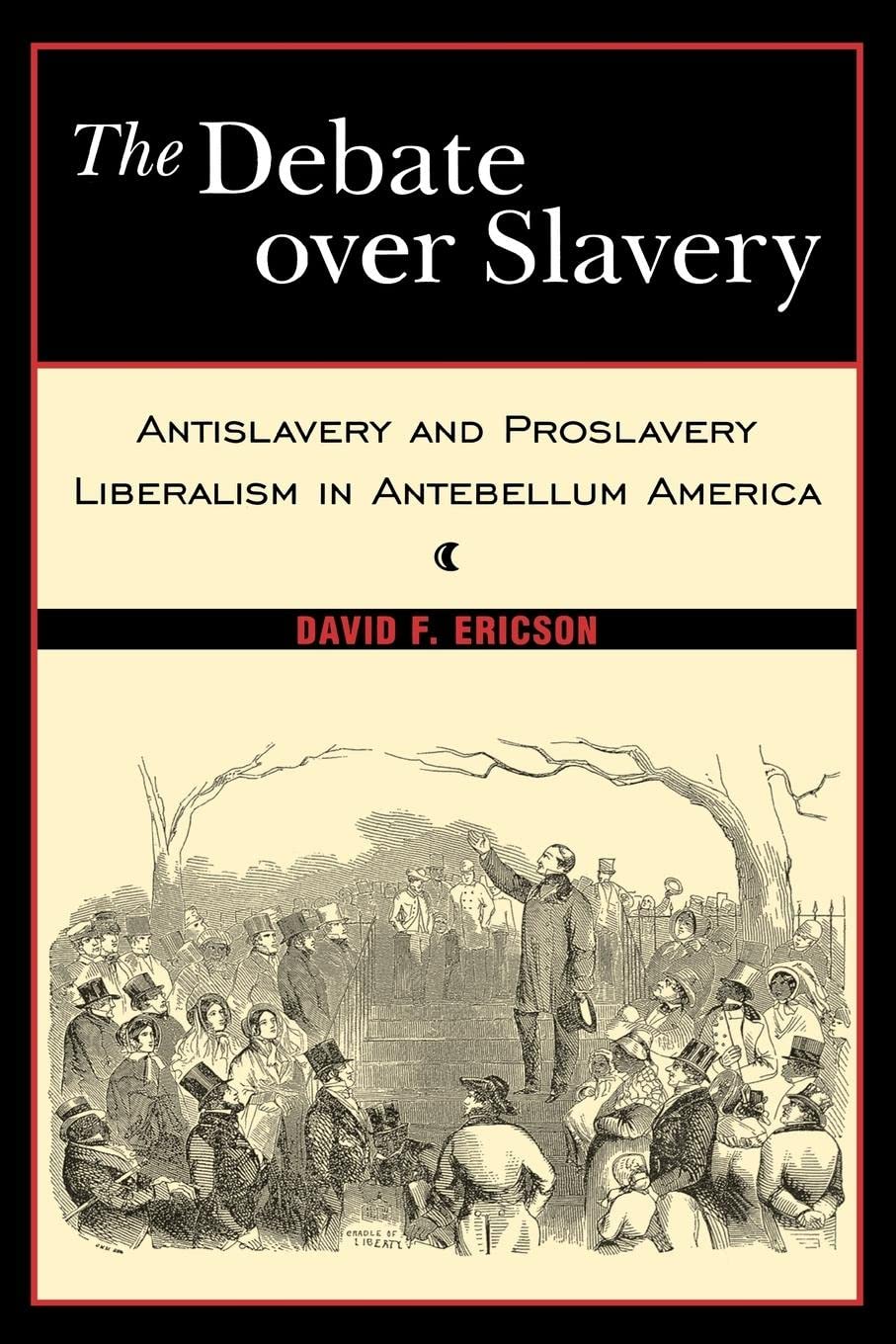
Frederick Douglass and George Fitzhugh disagreed on virtually every major issue of the day. On slavery, women's rights, and the preservation of the Union their opinions were diametrically opposed. Where Douglass thundered against the evils of slavery, Fitzhugh counted its many alleged blessings in ways that would make modern readers cringe. What then could the leading abolitionist of the day and the most prominent southern proslavery intellectual possibly have in common? According to David F. Ericson, the answer is as surprising as it is simple; liberalism.In The Debate Over Slavery David F. Ericson makes the controversial argument that despite their many ostensible differences, most Northern abolitionists and Southern defenders of slavery shared many common commitments: to liberal principles; to the nation; to the nation's special mission in history; and to secular progress. He analyzes, sidebyside, pro and antislavery thinkers such as Lydia Marie Child, Frederick Douglass, Wendell Phillips, Thomas R. Dew, and James Fitzhugh to demonstrate the links between their very different ideas and to show how, operating from liberal principles, they came to such radically different conclusions. His raises disturbing questions about liberalism that historians, philosophers, and political scientists cannot afford to ignore.
⚠️ WARNING (California Proposition 65):
This product may contain chemicals known to the State of California to cause cancer,
birth defects, or other reproductive harm.
For MAP (Minimum Advertised Price) violations and Intellectual Property (IP) or Trademark concerns, please contact:
support@ergodebooks.com
⚠️ California Proposition 65 Warning: Some products sold on this website may expose you to chemicals known to the State of California to cause cancer, birth defects, or other reproductive harm. For more information, visit www.P65Warnings.ca.gov.