
Title
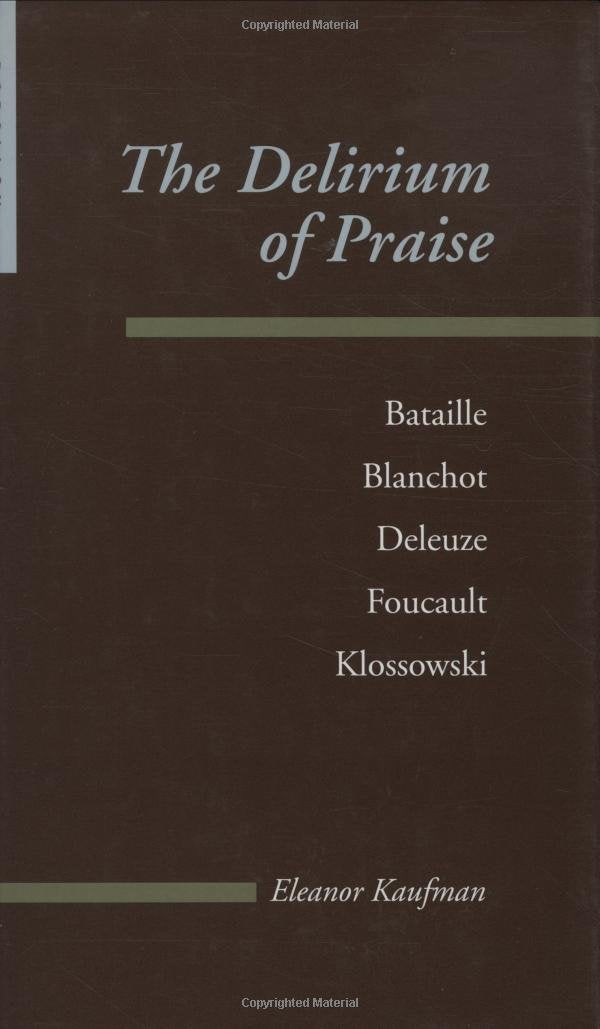
The Delirium Of Praise: Bataille, Blanchot, Deleuze, Foucault, Klossowski (Parallax: Revisions Of Culture And Society)
Sold by Ergodebooks, an authorized reseller.
Returns accepted within 30 days | support@ergodebooks.com
Shipping Information
- Free Standard Shipping — United States only
- Processing Time: 3–5 business days
- Estimated Delivery: 6–10 business days after dispatch
- Double-boxed, fully insured & discreetly packaged
- Tracking number sent via email once dispatched
Returns & Refund
Returns accepted within 30 days of delivery.
Damaged or Defective Item
Free return shipping + replacement or full refund
Wrong Item Received
Free return shipping + replacement or full refund
Change of Mind
Return shipping at customer's expense · 25% restocking fee applies
Payment Option

The Laudatory Essay, In Which One Author Praises The Work Of Another, Is Frequently Characterized As An Unimportant, Even Uncritical Mode Of Writing. But As Eleanor Kaufman Argues In The Delirium Of Praise, This Mode Of Exchange Is Serious And Substantial Enough To Merit Scholarly Attention. By Not Conforming To Standard Practices Of Critical Discourse, Laudatory Essays Give New Status To Supposedly Inferior Forms Of Communication And States Of Beingincluding Chatter, Silence, Sickness, Imbalance, And Absence Of Workand Emphasize Affective States Or Emotions Such As Joy, Friendship, And Longing.The Delirium Of Praise Examines A Group Of Five Twentiethcentury French Intellectualsgeorges Bataille, Maurice Blanchot, Michel Foucault, Gilles Deleuze, And Pierre Klossowskiand Their Laudatory Essays About Each Other. Structured As A Circular Series Of Exchanges, The Book Examines Pairings Of Two Thinkers With Respect To A Given Theme. The Exchange Between Bataille And Blanchot Takes Up The Themes Of Chatter And Silence With Regard To The Novelist Louisren Des Forts; The Blanchotfoucault Exchange Explores Friendship And Impersonality Through The Lens Of Jacques Derrida; The Foucaultdeleuze Exchange Considers Absence Of Work (Dsoeuvrement) And The Obscure French Philosopher Jacques Martin; The Deleuzeklossowski Exchange Revolves Around The Question Of The Sick Body And The Person Of Nietzsche; And The Final Exchange Between Klossowski And Bataille Focuses On Imbalanced Economies And The Writings Of The Marquis De Sade. Where The Praise Is Most Excessive, Approaching Delirium, Kaufman Locates A Powerful Thoughtenergy That Pushes The Laudatory Essay To Its Limits. In Her Conclusion, She Presents This Unique Mode Of Thought Exchange As A Form Of Intellectual Hospitality.Kaufman Uncovers A Suspension Of Subjectivity, Of Personality, Even Of Place And Time, That Is Both Articulated In The Laudatory Essays And Enacted By Them. Her Examination Of This Neglected Mode As Practiced By Five Important French Thinkers Offers A Unique Perspective On Twentiethcentury Intellectual History.
⚠️ WARNING (California Proposition 65):
This product may contain chemicals known to the State of California to cause cancer, birth defects, or other reproductive harm.
For more information, please visit www.P65Warnings.ca.gov.
- Q: What is the page count of 'The Delirium of Praise'? A: This book has two hundred forty pages. It provides a thorough examination of laudatory essays among five French intellectuals.
- Q: What are the dimensions of this book? A: The dimensions are five point five one inches in length, zero point eight three inches in width, and eight point five inches in height. This size makes it easy to handle.
- Q: What type of binding does this book have? A: The book is bound in hardcover. This ensures durability and a premium feel.
- Q: Who is the author of 'The Delirium of Praise'? A: The author is Eleanor Kaufman. She explores the significance of laudatory essays in this work.
- Q: What is the main theme of 'The Delirium of Praise'? A: The main theme revolves around the importance of laudatory essays among notable French thinkers. Kaufman argues for their scholarly significance.
- Q: Is 'The Delirium of Praise' suitable for academic use? A: Yes, it is suitable for academic use. The book provides insights into intellectual exchanges and critiques of notable figures.
- Q: How can I apply the concepts from 'The Delirium of Praise' in my studies? A: You can apply the concepts by analyzing the structure and themes of laudatory essays in your coursework. This can enhance your understanding of critical discourse.
- Q: Is this book appropriate for beginners in literary studies? A: Yes, it is appropriate for beginners. Kaufman's accessible writing style makes complex ideas understandable.
- Q: Are there any specific themes discussed in this book? A: Yes, several themes are discussed including silence, friendship, and absence of work. These themes are explored through exchanges between thinkers.
- Q: What should I consider for the care of my hardcover book? A: To care for your hardcover book, keep it in a dry place and avoid exposure to direct sunlight. This will help maintain its condition.
- Q: How do I clean my hardcover book if it gets dirty? A: To clean your hardcover book, gently wipe the exterior with a dry cloth. Avoid using water or cleaners to prevent damage.
- Q: What is the recommended storage for this book? A: It is recommended to store the book upright on a shelf. This prevents warping and keeps it in good condition.
- Q: Is there a warranty or return policy for this book? A: Yes, there is typically a return policy if the book is damaged or not as described. Check the seller's return policy for specifics.
- Q: What if my book arrives damaged? A: If your book arrives damaged, you should contact the seller immediately. Most sellers will offer a replacement or refund.
- Q: How can I contact support if I have issues with my order? A: You can contact support through the customer service link provided by the seller. They will assist you with any order-related issues.