
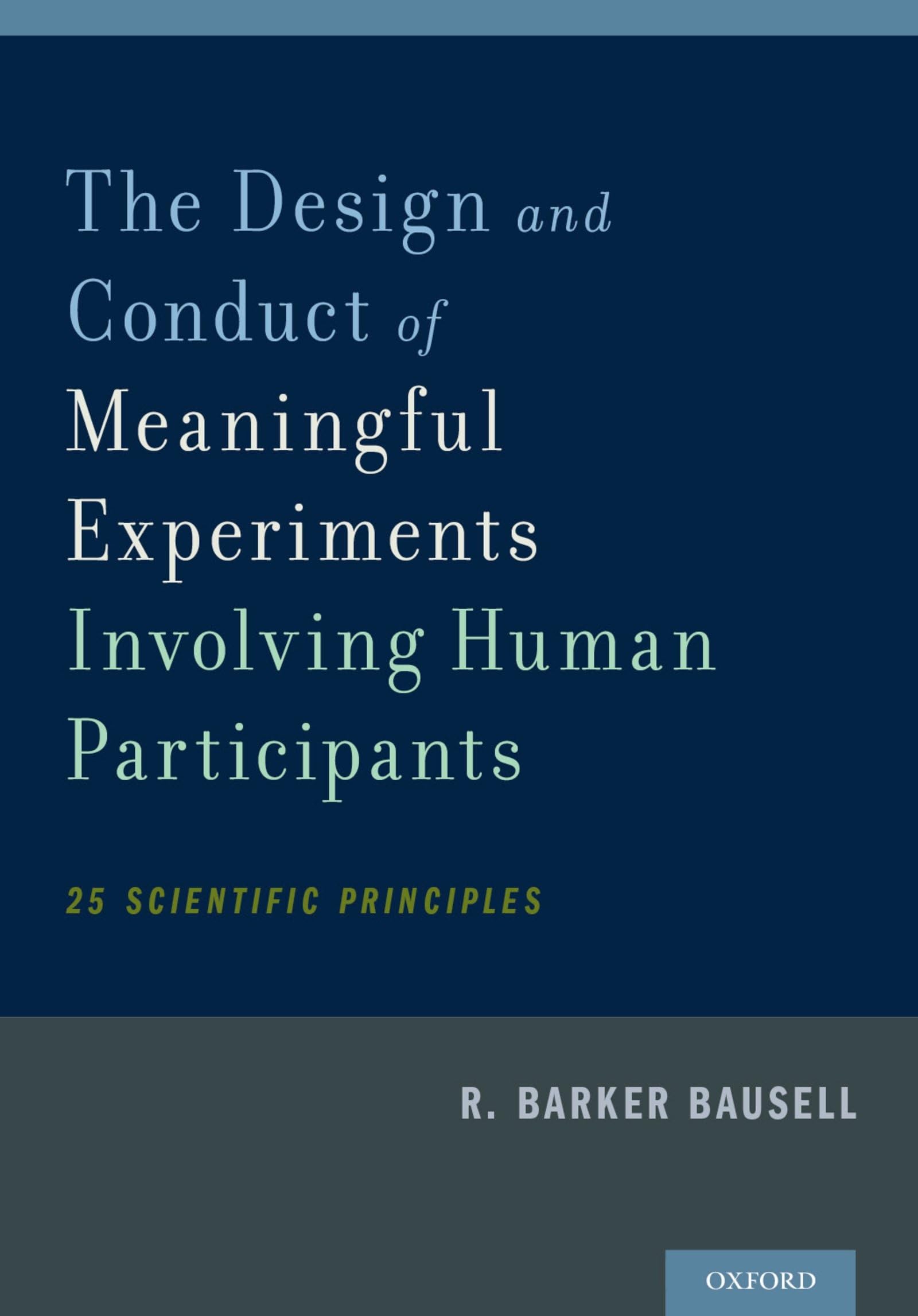
Title
The Design and Conduct of Meaningful Experiments Involving Human Participants: 25 Scientific Principles,Used
Sold by Ergodebooks, an authorized reseller.
Returns accepted within 30 days | support@ergodebooks.com
Shipping Information
- Free Standard Shipping — United States only
- Processing Time: 3–5 business days
- Estimated Delivery: 6–10 business days after dispatch
- Double-boxed, fully insured & discreetly packaged
- Tracking number sent via email once dispatched
Returns & Refund
Returns accepted within 30 days of delivery.
Damaged or Defective Item
Free return shipping + replacement or full refund
Wrong Item Received
Free return shipping + replacement or full refund
Change of Mind
Return shipping at customer's expense · 25% restocking fee applies
Payment Option

Designing and conducting experiments involving human participants requires a skillset different from that needed for statistically analyzing the resulting data. The Design and Conduct of Meaningful Experiments Involving Human Participants combines an introduction to scientific culture and ethical mores with specific experimental design and procedural content. Author R. Barker Bausell assumes no statistical background on the part of the reader, resulting in a highly accessible text. Clear instructions are provided on topics ranging from the selection of a societally important outcome variable to potentially efficacious interventions to the conduct of the experiment itself.Early chapters introduce the concept of experimental design in an intuitive manner involving both hypothetical and reallife examples of how people make causal inferences. The fundamentals of formal experimentation, randomization, and the use of control groups are introduced in the same manner, followed by the presentation and explanation of common (and later, more advanced) designs. Replete with synopses of examples from the journal literature and supplemented by 25 experimental principles, this book is designed to serve as an interdisciplinary supplementary text for researchmethods courses in the educational, psychological, behavioral, social, and health sciences. It also serves as an excellent primary text for methods seminar courses.
⚠️ WARNING (California Proposition 65):
This product may contain chemicals known to the State of California to cause cancer, birth defects, or other reproductive harm.
For more information, please visit www.P65Warnings.ca.gov.
- Q: What is the main focus of 'The Design and Conduct of Meaningful Experiments Involving Human Participants'? A: The book focuses on the design and execution of experiments involving human participants, emphasizing the unique skillset required for effective experimental design as opposed to just data analysis.
- Q: Who is the author of this book? A: The author of the book is R. Barker Bausell.
- Q: What is the publication date of this book? A: The book was published on February 26, 2015.
- Q: Is a statistical background necessary to understand this book? A: No, the book assumes no statistical background on the part of the reader, making it accessible for those new to the subject.
- Q: What topics are covered in the early chapters of the book? A: Early chapters introduce experimental design concepts, causal inference, randomization, and the use of control groups through intuitive examples.
- Q: How many pages does the book have? A: The book has a total of 352 pages.
- Q: What type of binding does the book have? A: The book is available in paperback binding.
- Q: Can this book be used as a primary text for seminar courses? A: Yes, it serves as an excellent primary text for methods seminar courses across various disciplines.
- Q: What category does this book fall under? A: The book falls under the category of Experimental Psychology.
- Q: Does the book include examples from journal literature? A: Yes, the book is replete with synopses of examples from journal literature to illustrate its concepts.