
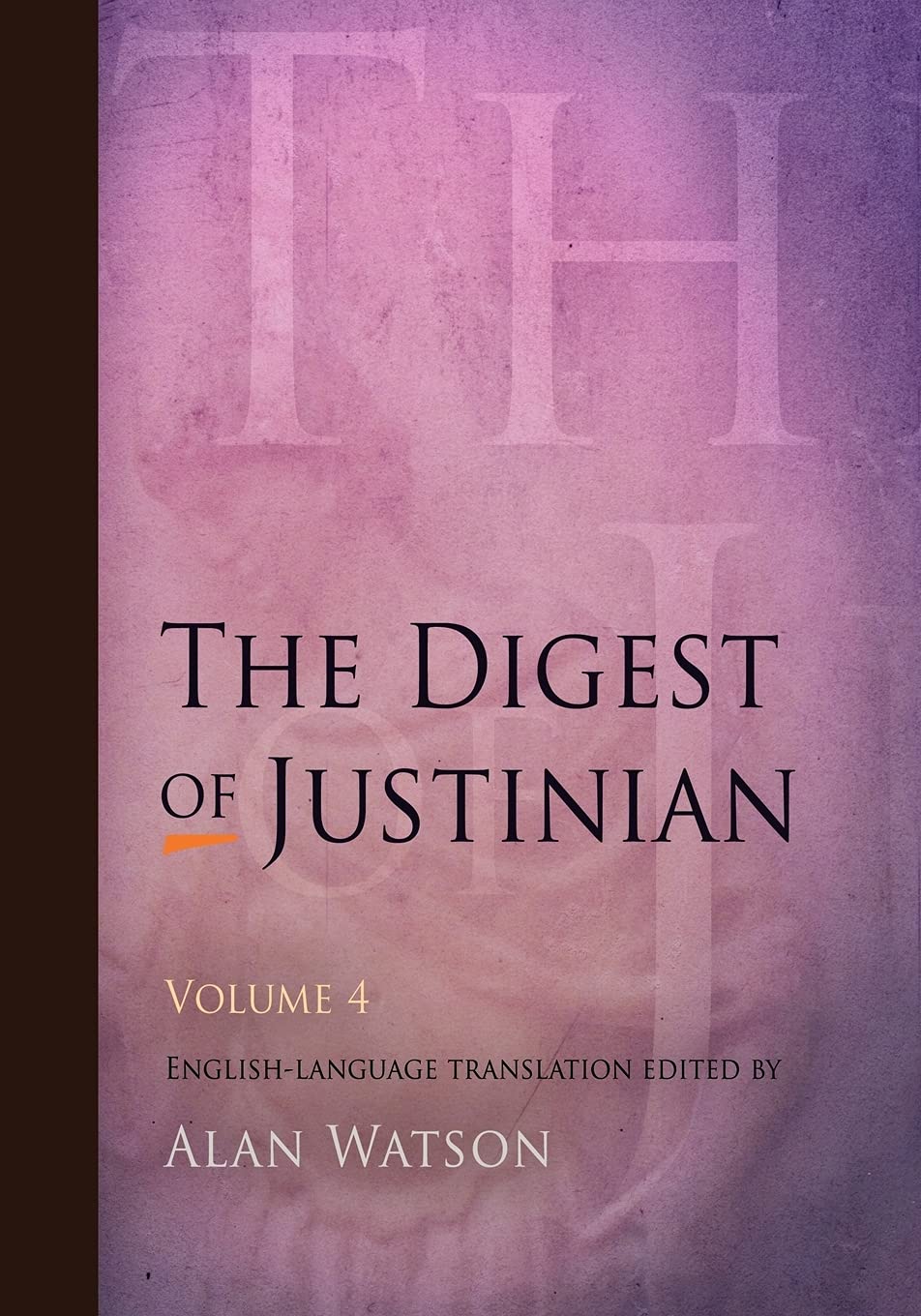
Title
The Digest of Justinian, Volume 4,Used
Sold by Ergodebooks, an authorized reseller.
Returns accepted within 30 days | support@ergodebooks.com
Shipping Information
- Free Standard Shipping — United States only
- Processing Time: 3–5 business days
- Estimated Delivery: 6–10 business days after dispatch
- Double-boxed, fully insured & discreetly packaged
- Tracking number sent via email once dispatched
Returns & Refund
Returns accepted within 30 days of delivery.
Damaged or Defective Item
Free return shipping + replacement or full refund
Wrong Item Received
Free return shipping + replacement or full refund
Change of Mind
Return shipping at customer's expense · 25% restocking fee applies
Payment Option

When Justinian became sole ruler of the Byzantine Empire in A.D. 527, he ordered the preparation of three compilations of Roman law that together formed the Corpus Juris Civilis. These works have become known individually as the Code, which collected the legal pronouncements of the Roman emperors, the Institutes, an elementary student's textbook, and the Digest, by far the largest and most highly prized of the three compilations. The Digest was assembled by a team of sixteen academic lawyers commissioned by Justinian in 533 to cull everything of value from earlier Roman law. It was for centuries the focal point of legal education in the West and remains today an unprecedented collection of the commentaries of Roman jurists on the civil law.Commissioned by the Commonwealth Fund in 1978, Alan Watson assembled a team of thirty specialists to produce this magisterial translation, which was first completed and published in 1985 with Theodor Mommsen's Latin text of 1878 on facing pages. This paperback edition presents a corrected Englishlanguage text alone, with an introduction by Alan Watson.Links to the three other volumes in the set: Volume 1 [Books 115]Volume 2 [Books 1629]Volume 3 [Books 3040]
⚠️ WARNING (California Proposition 65):
This product may contain chemicals known to the State of California to cause cancer, birth defects, or other reproductive harm.
For more information, please visit www.P65Warnings.ca.gov.
- Q: What is 'The Digest of Justinian, Volume 4' about? A: This volume is part of the Corpus Juris Civilis, a compilation of Roman law commissioned by Justinian in A.D. 527. It includes legal commentaries by Roman jurists and serves as a significant educational resource in the field of law.
- Q: Who is the author of this edition? A: The author of this edition is Alan Watson, who assembled a team of specialists to produce the translation, which was first published in 1985.
- Q: What is the binding type of this book? A: This book is available in a paperback binding, making it lightweight and portable.
- Q: How many pages does this volume contain? A: The Digest of Justinian, Volume 4 contains a total of 768 pages.
- Q: Is this book suitable for legal studies? A: Yes, this book is an important resource for legal studies, as it provides valuable insights into Roman law and its commentaries.
- Q: When was this edition published? A: This edition of The Digest of Justinian, Volume 4 was published on April 9, 2009.
- Q: What condition is the used book in? A: The used book is described as being in good condition, indicating it has been previously owned but remains usable.
- Q: Does this volume include any additional resources? A: This edition includes an introduction by Alan Watson, but does not include the Latin text, which is found in the original published edition.
- Q: Are there other volumes in this series? A: Yes, there are three other volumes in this series, covering different books of the Digest.
- Q: What is the significance of the Digest in legal history? A: The Digest is significant as it has been a central text in legal education in the West and represents a comprehensive collection of legal thought from the Roman era.