
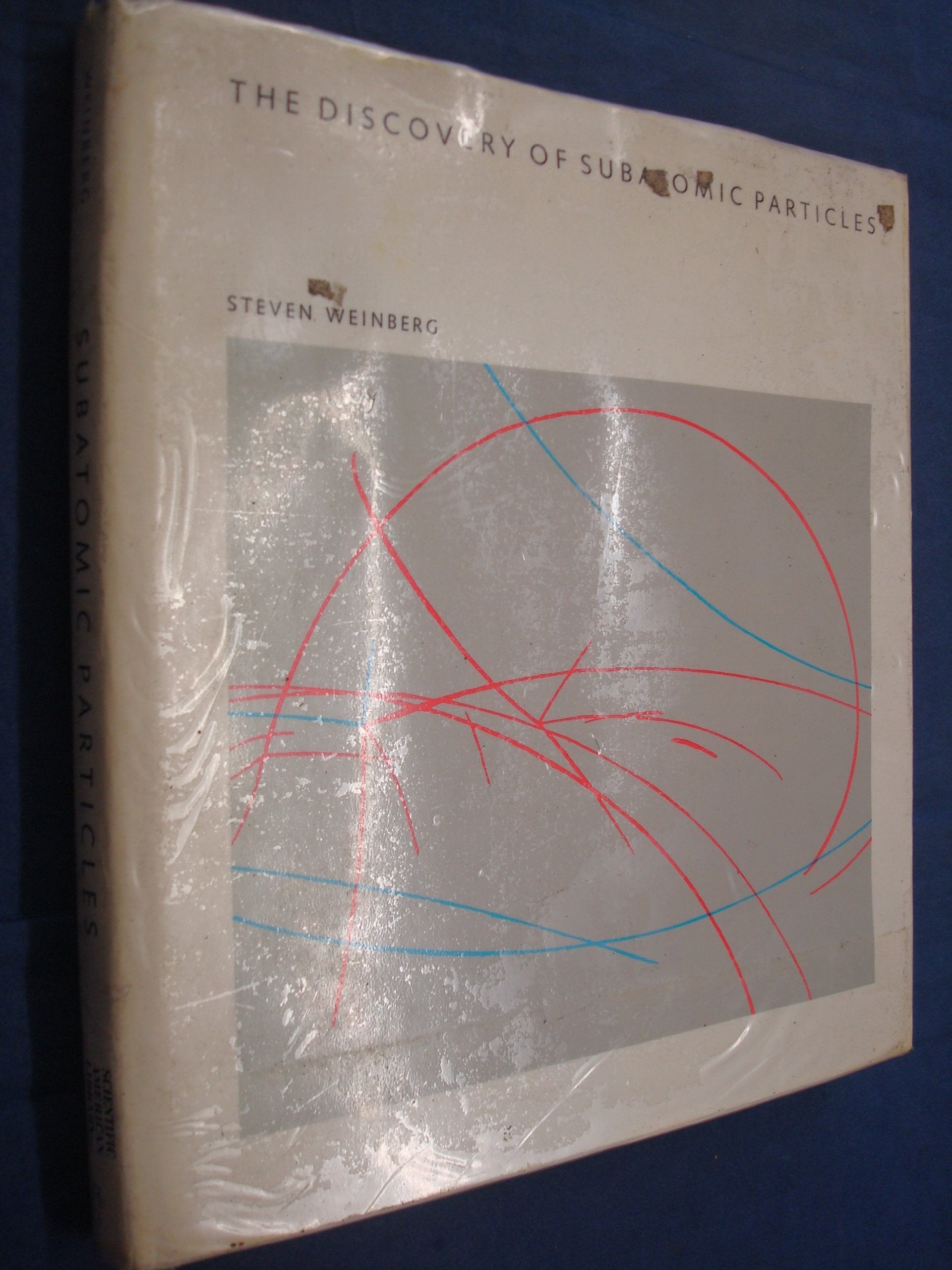
Title
The Discovery Of Subatomic Particles,Used
Sold by Ergodebooks, an authorized reseller.
Returns accepted within 30 days | support@ergodebooks.com
Shipping Information
- Free Standard Shipping — United States only
- Processing Time: 3–5 business days
- Estimated Delivery: 6–10 business days after dispatch
- Double-boxed, fully insured & discreetly packaged
- Tracking number sent via email once dispatched
Returns & Refund
Returns accepted within 30 days of delivery.
Damaged or Defective Item
Free return shipping + replacement or full refund
Wrong Item Received
Free return shipping + replacement or full refund
Change of Mind
Return shipping at customer's expense · 25% restocking fee applies
Payment Option

This Commentary On The Discovery Of The Atoms Constituents Provides An Historical Account Of Key Events In The Physics Of The Twentieth Century That Led To The Discoveries Of The Electron, Proton And Neutron. Steven Weinberg Introduces The Fundamentals Of Classical Physics That Played Crucial Roles In These Discoveries. Connections Are Shown Throughout The Book Between The Historic Discoveries Of Subatomic Particles And Contemporary Research At The Frontiers Of Physics, Including The Most Current Discoveries Of New Elementary Particles. Steven Weinberg Was Higgins Professor Of Physics At Harvard Before Moving To The University Of Texas At Austin, Where He Founded Its Theory Group. At Texas He Holds The Josey Regental Chair Of Science And Is A Member Of The Physics And Astronomy Departments. His Research Has Spanned A Broad Range Of Topics In Quantum Field Theory, Elementary Particle Physics, And Cosmology, And Has Been Honored With Numerous Awards, Including The Nobel Prize In Physics
⚠️ WARNING (California Proposition 65):
This product may contain chemicals known to the State of California to cause cancer, birth defects, or other reproductive harm.
For more information, please visit www.P65Warnings.ca.gov.
- Q: How many pages does the book have? A: The book has two hundred six pages. This length provides a thorough exploration of subatomic particles and their historical context.
- Q: What is the binding type of the book? A: The book is hardcover. This ensures durability and protection for long-term reading and storage.
- Q: What are the dimensions of the book? A: The book measures nine point zero two inches in length, one inch in width, and nine point seven six inches in height. These dimensions make it a manageable size for reading.
- Q: Who is the author of this book? A: The author is Steven Weinberg. He is a renowned physicist and Nobel Prize winner, known for his extensive research in particle physics.
- Q: What topics does the book cover? A: The book covers the discovery of subatomic particles, including electrons, protons, and neutrons. It also connects historical discoveries to contemporary research in physics.
- Q: Is this book suitable for beginners in physics? A: Yes, the book is suitable for beginners. It introduces fundamental concepts of classical physics in an accessible way.
- Q: What is the target audience for this book? A: The target audience includes students, educators, and anyone interested in the history of physics. It caters to both general readers and those with a scientific background.
- Q: Can this book be used as a textbook? A: Yes, this book can be used as a supplementary textbook in physics courses. It provides historical insights that complement standard educational materials.
- Q: Does the book include illustrations or diagrams? A: Yes, the book includes illustrations and diagrams. These visuals help clarify complex concepts related to subatomic particles.
- Q: How should I store this book? A: The book should be stored upright on a shelf or laid flat to prevent damage. Keeping it in a dry, cool place will help maintain its condition.
- Q: What is the recommended age range for readers? A: The recommended age range is high school students and older. The content is advanced but engaging for anyone interested in physics.
- Q: Is the book part of a series? A: No, this book is not part of a series. It stands alone as a comprehensive commentary on the discovery of subatomic particles.
- Q: Can I return the book if I don't like it? A: Yes, you can typically return the book if it is in original condition. Check the specific return policy of the retailer.
- Q: What if the book arrives damaged? A: If the book arrives damaged, contact customer service for a replacement or refund. Most retailers have policies for such issues.
- Q: Does the book cover modern physics topics? A: Yes, the book discusses contemporary research in physics. It connects historical findings with recent advancements in particle physics.