If you have any questions, you are always welcome to contact us. We'll get back to you as soon as possible, withing 24 hours on weekdays.
Customer service
All questions about your order, return and delivery must be sent to our customer service team by e-mail at yourstore@yourdomain.com
Sale & Press
If you are interested in selling our products, need more information about our brand or wish to make a collaboration, please contact us at press@yourdomain.com
Help
If you have any questions, you are always welcome to contact us. We'll get back to you as soon as possible, withing 24 hours on weekdays.
Customer service
All questions about your order, return and delivery must be sent to our customer service team by e-mail at yourstore@yourdomain.com
Sale & Press
If you are interested in selling our products, need more information about our brand or wish to make a collaboration, please contact us at press@yourdomain.com
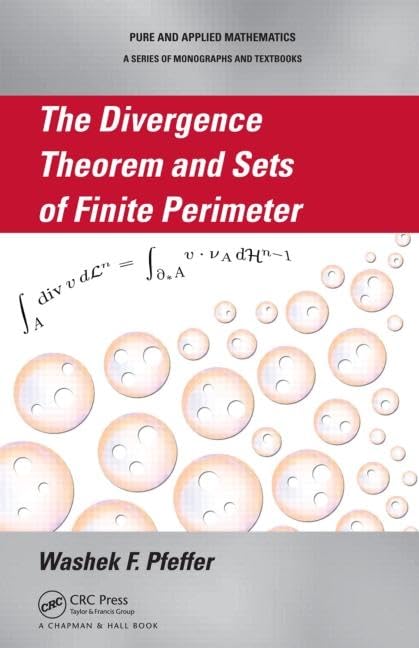
This book is devoted to a detailed development of the divergence theorem. The framework is that of Lebesgue integration no generalized Riemann integrals of HenstockKurzweil variety are involved.In Part I the divergence theorem is established by a combinatorial argument involving dyadic cubes. Only elementary properties of the Lebesgue integral and Hausdorff measures are used. The resulting integration by parts is sufficiently general for many applications. As an example, it is applied to removable singularities of CauchyRiemann, Laplace, and minimal surface equations.The sets of finite perimeter are introduced in Part II. Both the geometric and analytic points of view are presented. The equivalence of these viewpoints is obtained via the functions of bounded variation. These functions are studied in a selfcontained manner with no references to Sobolevs spaces. The coarea theorem provides a link between the sets of finite perimeter and functions of bounded variation.The general divergence theorem for bounded vector fields is proved in Part III. The proof consists of adapting the combinatorial argument of Part I to sets of finite perimeter. The unbounded vector fields and mean divergence are also discussed. The final chapter contains a characterization of the distributions that are equal to the flux of a continuous vector field.
⚠️ WARNING (California Proposition 65):
This product may contain chemicals known to the State of California to cause cancer,
birth defects, or other reproductive harm.
For MAP (Minimum Advertised Price) violations and Intellectual Property (IP) or Trademark concerns, please contact:
support@ergodebooks.com
⚠️ California Proposition 65 Warning: Some products sold on this website may expose you to chemicals known to the State of California to cause cancer, birth defects, or other reproductive harm. For more information, visit www.P65Warnings.ca.gov.