
Title
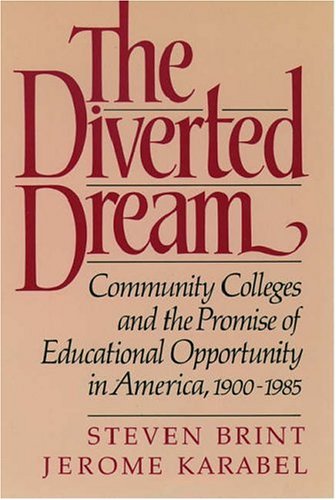
The Diverted Dream: Community Colleges and the Promise of Educational Opportunity in America, 19001985,Used
Sold by Ergodebooks, an authorized reseller.
Returns accepted within 30 days | support@ergodebooks.com
Shipping Information
- Free Standard Shipping — United States only
- Processing Time: 3–5 business days
- Estimated Delivery: 6–10 business days after dispatch
- Double-boxed, fully insured & discreetly packaged
- Tracking number sent via email once dispatched
Returns & Refund
Returns accepted within 30 days of delivery.
Damaged or Defective Item
Free return shipping + replacement or full refund
Wrong Item Received
Free return shipping + replacement or full refund
Change of Mind
Return shipping at customer's expense · 25% restocking fee applies
Payment Option

In the twentieth century, Americans have increasingly looked to the schoolsand, in particular, to the nation's colleges and universitiesas guardians of the cherished national ideal of equality of opportunity. With the best jobs increasingly monopolized by those with higher education, the opportunity to attend college has become an integral part of the American dream of upward mobility. The twoyear collegewhich now enrolls more than four million students in over 900 institutionsis a central expression of this dream, and its invention at the turn of the century constituted one of the great innovations in the history of American education. By offering students of limited means the opportunity to start higher education at home and to later transfer to a fouryear institution, the twoyear school provided a major new pathway to a college diplomaand to the nation's growing professional and managerial classes.But in the past two decades, the community college has undergone a profound change, shifting its emphasis from liberalarts transfer courses to terminal vocational programs. Drawing on developments nationwide as well as in the specific case of Massachusetts, Steven Brint and Jerome Karabel offer a history of community colleges in America, explaining why this shift has occurred after years of student resistance and examining its implications for upward mobility. As the authors argue in this exhaustively researched and pioneering study, the junior college has always faced the contradictory task of extending a college education to the hitherto excluded, while diverting the majority of them from the nation's fouryear colleges and universities. Very early on, twoyear college administrators perceived vocational training for 'semiprofessional' work as their and their students' most secure longterm niche in the educational hierarchy. With two thirds of all community college students enrolled in vocational programs, the authors contend that the dream of education as a route to upward mobility, as well as the ideal of equal educational opportunity for all, are seriously threatened.With the growing public debate about the state of American higher education and with more than half of all firsttime degreecredit students now enrolled in community colleges, a fullscale, historically grounded examination of their place in American life is long overdue. This landmark study provides such an examination, and in so doing, casts critical light on what is distinctive not only about American education, but American society itself.
⚠️ WARNING (California Proposition 65):
This product may contain chemicals known to the State of California to cause cancer, birth defects, or other reproductive harm.
For more information, please visit www.P65Warnings.ca.gov.