
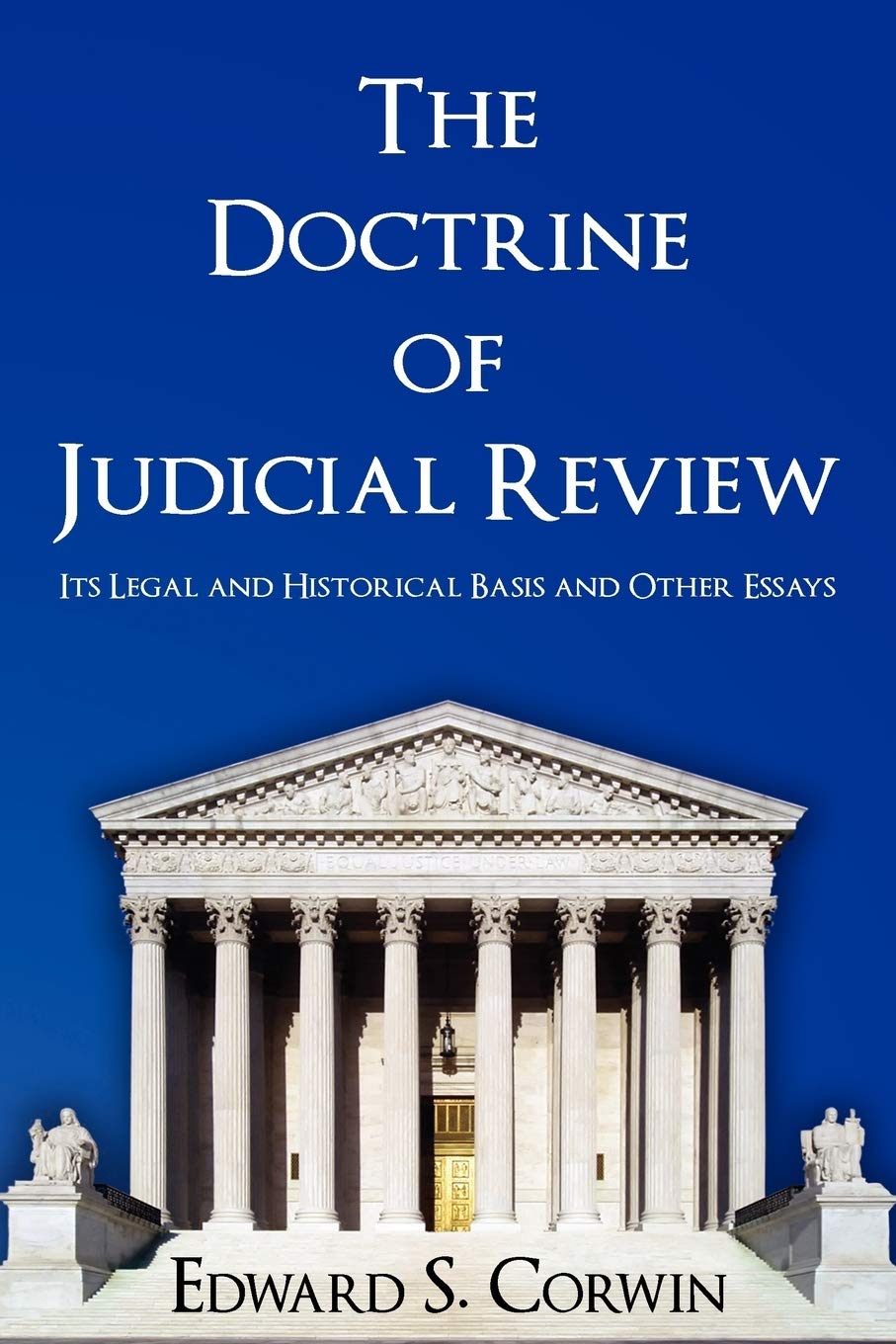
Title
The Doctrine Of Judicial Review: Its Legal And Historical Basis And Other Essays
Sold by Ergodebooks, an authorized reseller.
Returns accepted within 30 days | support@ergodebooks.com
Shipping Information
- Free Standard Shipping — United States only
- Processing Time: 3–5 business days
- Estimated Delivery: 6–10 business days after dispatch
- Double-boxed, fully insured & discreetly packaged
- Tracking number sent via email once dispatched
Returns & Refund
Returns accepted within 30 days of delivery.
Damaged or Defective Item
Free return shipping + replacement or full refund
Wrong Item Received
Free return shipping + replacement or full refund
Change of Mind
Return shipping at customer's expense · 25% restocking fee applies
Payment Option

Provocative Essays On Judicial Review. This Book Contains Five Historical Essays, Three Of Them On The Concept Of Judicial Review, Which Is Defined As The Power And Duty Of A Court To Disregard Ultra Vires Legislative Acts. In Marbury V. Madison And The Doctrine Of Judicial Review, Corwin Asks: What Is The Exact Legal Basis Of The Power Of The Supreme Court To Pass Upon The Constitutionality Of Acts Of Congress? We, The People Examines The Issues Of Secession And Nullification. The Pelatiah Webster Myth Demolishes Hannis Taylor'S Thesis That Webster Was The Secret Author Of The United States Constitution. The Dred Scott Decision Considers Chief Justice Taney'S Argument Concerning Scott'S Title To Citizenship Under The Constitution. Some Possibilities In The Way Of Treatymaking Discusses How The Us Constitution Relates To International Treaties. Edward S. Corwin [18781963] Succeeded Woodrow Wilson As The Mccormick Professor Of Jurisprudence At Princeton University, And Was The First Chairman Of The Department Of Politics. The Author Of Numerous Books On Constitutional Law, He Is Best Known For The Constitution And What It Means Today (1920). He Was The President Of The American Political Science Association, Winner Of The American Philosophical Society'S Franklin Medal And Phillips Prize And Was Among The Notable Scholars Acknowledged At The Harvard Tercentenary. In 1952, Princeton'S Woodrow Wilson Hall Was Renamed Edward S. Corwin Hall.
⚠️ WARNING (California Proposition 65):
This product may contain chemicals known to the State of California to cause cancer, birth defects, or other reproductive harm.
For more information, please visit www.P65Warnings.ca.gov.
- Q: How many pages does the book contain? A: The book contains one hundred ninety pages. This length allows for an in-depth exploration of judicial review and its historical context.
- Q: What is the binding type of the book? A: The book has a paperback binding. This makes it lightweight and easy to handle for readers.
- Q: What are the dimensions of the book? A: The book measures six inches in length, zero point four four inches in width, and nine point zero two inches in height. These dimensions make it convenient for storage and reading.
- Q: Who is the author of this book? A: The author is Edward S. Corwin, a prominent scholar in constitutional law. His expertise provides valuable insights into the concept of judicial review.
- Q: What is the main theme of the book? A: The main theme revolves around judicial review and its historical implications. The essays discuss its legal basis and significant cases.
- Q: Is this book suitable for beginners in law? A: Yes, the book is suitable for beginners. It provides foundational essays that introduce key concepts in judicial review.
- Q: Can this book be used for academic purposes? A: Yes, this book is appropriate for academic study. It includes historical essays that can support research in constitutional law.
- Q: What topics are covered in the essays? A: The essays cover various topics, including Marbury v. Madison, secession, nullification, and the Dred Scott Decision. Each topic is crucial for understanding judicial review.
- Q: Is the book appropriate for high school students? A: Yes, the book is appropriate for high school students interested in law. It offers accessible discussions on complex legal concepts.
- Q: How should I store this book to keep it in good condition? A: Store the book in a cool, dry place away from direct sunlight. Proper storage helps maintain its condition and extends its lifespan.
- Q: What if the book arrives damaged? A: If the book arrives damaged, you should contact customer support for a return or exchange. Most sellers offer a satisfaction guarantee.
- Q: Are there any special care instructions for this book? A: No special care instructions are needed. Just handle it with care and avoid exposure to moisture.
- Q: How do I clean the book if it gets dirty? A: To clean the book, gently wipe the cover with a dry cloth. Avoid using water or cleaning solutions that could damage the pages.
- Q: Does the book include a bibliography or references? A: Yes, the book includes references and a bibliography. This is helpful for further reading and academic research.
- Q: What makes this book unique compared to others on judicial review? A: This book is unique due to its combination of historical context and legal analysis. Edward S. Corwin's insights provide a comprehensive understanding of judicial review.