
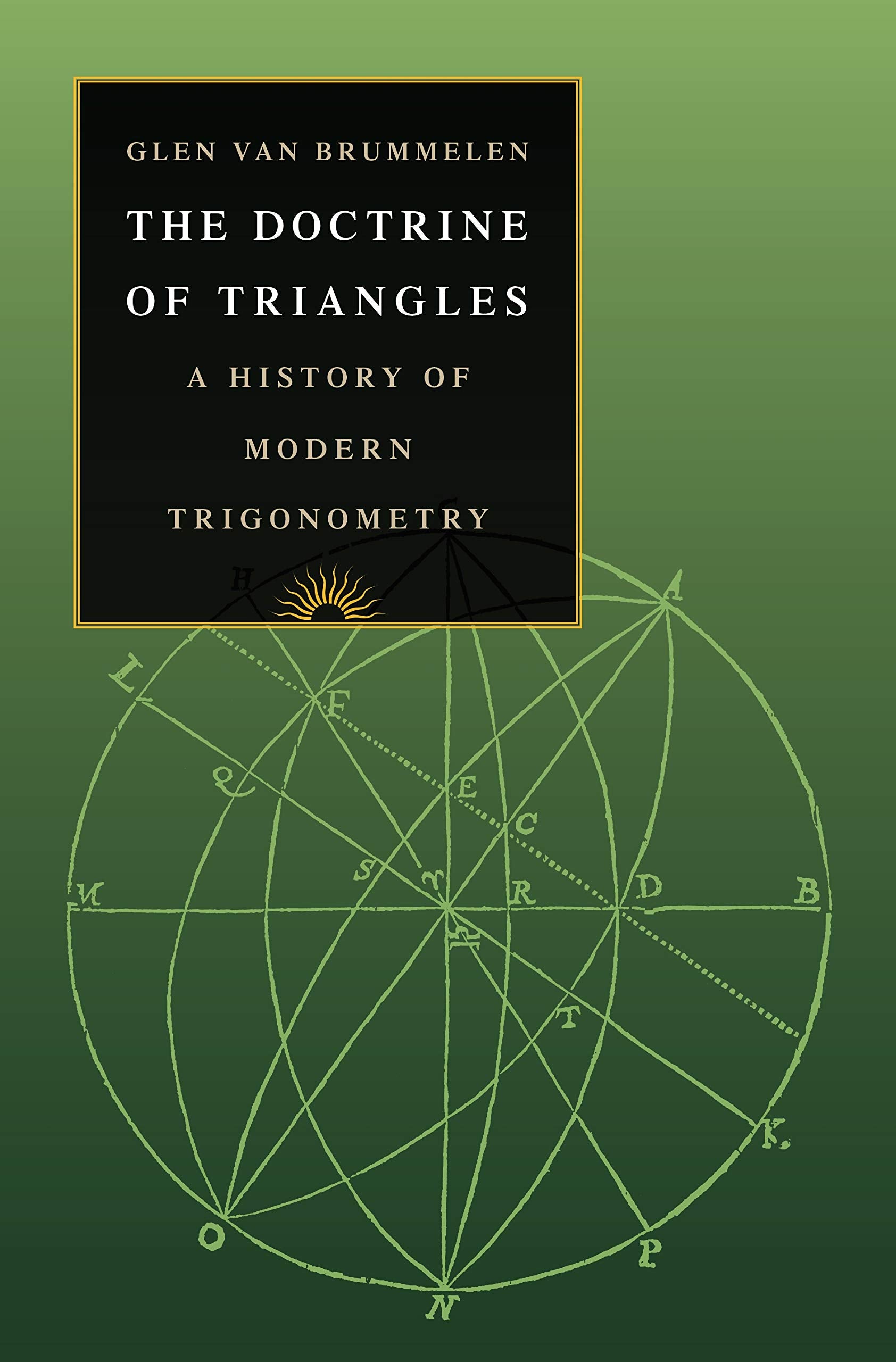
Title
The Doctrine of Triangles: A History of Modern Trigonometry,Used
Sold by Ergodebooks, an authorized reseller.
Returns accepted within 30 days | support@ergodebooks.com
Shipping Information
- Free Standard Shipping — United States only
- Processing Time: 3–5 business days
- Estimated Delivery: 6–10 business days after dispatch
- Double-boxed, fully insured & discreetly packaged
- Tracking number sent via email once dispatched
Returns & Refund
Returns accepted within 30 days of delivery.
Damaged or Defective Item
Free return shipping + replacement or full refund
Wrong Item Received
Free return shipping + replacement or full refund
Change of Mind
Return shipping at customer's expense · 25% restocking fee applies
Payment Option

An interdisciplinary history of trigonometry from the midsixteenth century to the early twentiethThe Doctrine of Triangles offers an interdisciplinary history of trigonometry that spans four centuries, starting in 1550 and concluding in the 1900s. Glen Van Brummelen tells the story of trigonometry as it evolved from an instrument for understanding the heavens to a practical tool, used in fields such as surveying and navigation. In Europe, China, and America, trigonometry aided and was itself transformed by concurrent mathematical revolutions, as well as the rise of science and technology.Following its uses in midsixteenthcentury Europe as the 'foot of the ladder to the stars' and the mathematical helpmate of astronomy, trigonometry became a ubiquitous tool for modeling various phenomena, including animal populations and sound waves. In the late sixteenth century, trigonometry increasingly entered the physical world through the practical disciplines, and its societal reach expanded with the invention of logarithms. Calculus shifted mathematical reasoning from geometric to algebraic patterns of thought, and trigonometrys participation in this new mathematical analysis grew, encouraging such innovations as complex numbers and nonEuclidean geometry. Meanwhile in China, trigonometry was evolving rapidly too, sometimes merging with indigenous forms of knowledge, and with Western discoveries. In the nineteenth century, trigonometry became even more integral to science and industry as a fundamental part of the science and engineering toolbox, and a staple subject in high school classrooms.A masterful combination of scholarly rigor and compelling narrative, The Doctrine of Triangles brings trigonometrys rich historical past full circle into the modern era.
⚠️ WARNING (California Proposition 65):
This product may contain chemicals known to the State of California to cause cancer, birth defects, or other reproductive harm.
For more information, please visit www.P65Warnings.ca.gov.
- Q: What is the primary focus of 'The Doctrine of Triangles'? A: The book offers an interdisciplinary history of trigonometry from the mid-sixteenth century to the early twentieth century, detailing its evolution and applications across various fields.
- Q: Who is the author of 'The Doctrine of Triangles'? A: The author is Glen Van Brummelen, known for his scholarly work in mathematics and its history.
- Q: What topics are covered in this book? A: The book covers the historical development of trigonometry, its role in astronomy, surveying, navigation, and its integration with other mathematical advancements.
- Q: How many pages does 'The Doctrine of Triangles' contain? A: The book contains 392 pages.
- Q: What is the publication date of this book? A: The book was published on June 8, 2021.
- Q: What type of binding does this book have? A: The book is available in hardcover binding.
- Q: Is 'The Doctrine of Triangles' suitable for beginners in mathematics? A: While the book is well-researched and informative, it may be more suited for readers with some background in mathematics or history of science due to its scholarly approach.
- Q: Does the book include illustrations or diagrams? A: The product details do not specify whether the book includes illustrations or diagrams, so it is advisable to check the book directly for visual content.
- Q: Can this book be used as a textbook for a mathematics course? A: While it provides a comprehensive history of trigonometry, its narrative style may make it more suitable as a supplementary reading rather than a primary textbook.
- Q: What makes 'The Doctrine of Triangles' different from other mathematics history books? A: The book combines scholarly rigor with a compelling narrative, focusing specifically on the evolution of trigonometry and its societal impact over four centuries.