
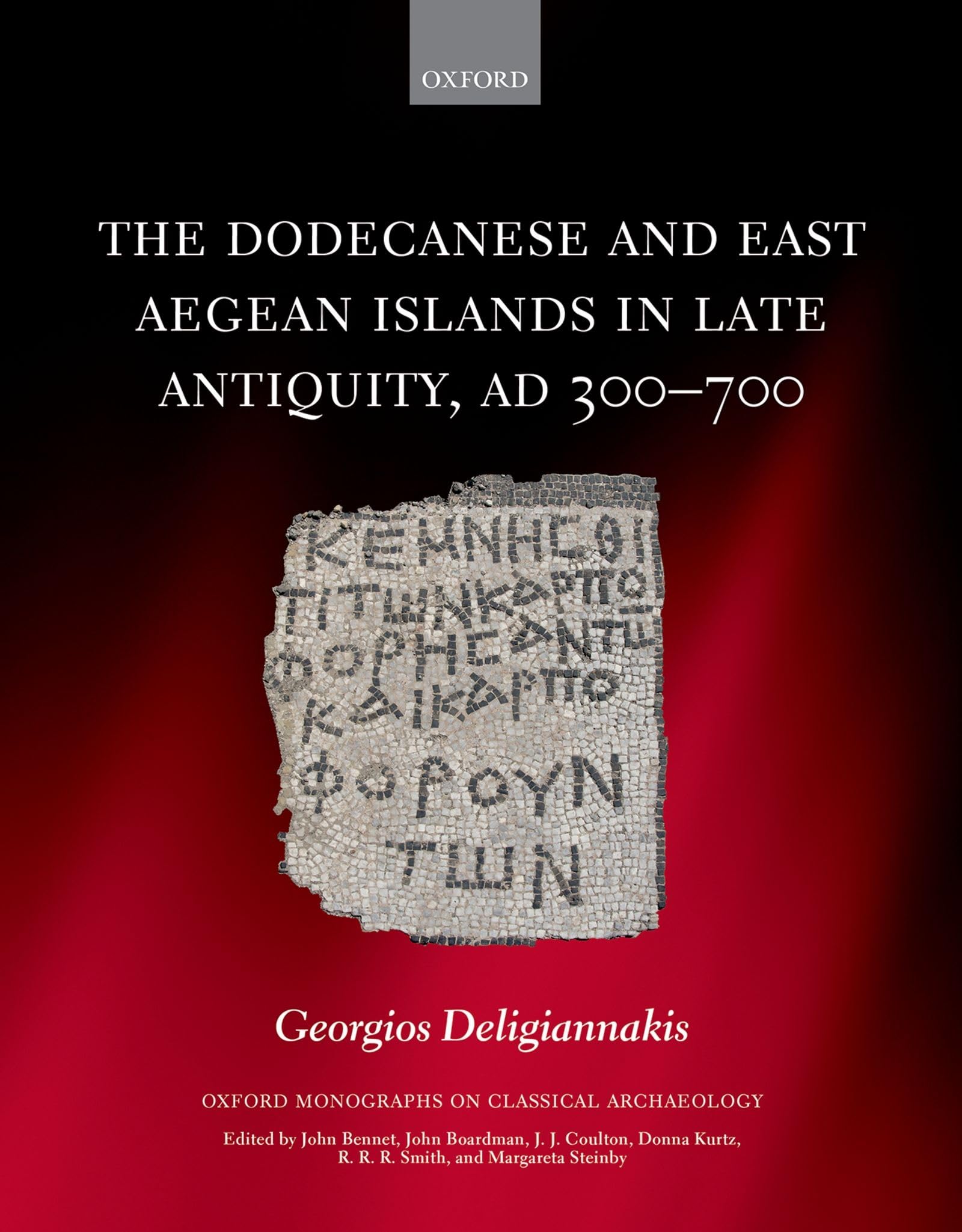
Title
The Dodecanese and East Aegean Islands in Late Antiquity, AD 300700 (Oxford Monographs on Classical Archaeology),New
Sold by Ergodebooks, an authorized reseller.
Returns accepted within 30 days | support@ergodebooks.com
Shipping Information
- Free Standard Shipping — United States only
- Processing Time: 3–5 business days
- Estimated Delivery: 6–10 business days after dispatch
- Double-boxed, fully insured & discreetly packaged
- Tracking number sent via email once dispatched
Returns & Refund
Returns accepted within 30 days of delivery.
Damaged or Defective Item
Free return shipping + replacement or full refund
Wrong Item Received
Free return shipping + replacement or full refund
Change of Mind
Return shipping at customer's expense · 25% restocking fee applies
Payment Option

The Dodecanese and the Eastern Aegean Islands in Late Antiquity, AD 300700 is a regional study of the history, archaeology, and religious profile of the Late Antique Dodecanese (the islands of the southeastern Aegean, centered on Rhodes), exploring how the spread of Christianity altered these communities and how the prosperity of the eastern Roman Empire, and the new capital in Constantinople, affected their life. Incorporating comparative evidence from the rest of the Aegean islands and both the Greek and Turkish mainlands, the volume analyzes material from the whole area as part of a wider system of social and economic relations, political history, and culture.Accompanied by an extensive archaeological gazetteer, it presents the administrative and political history of the islands and considers the written and archaeological evidence for the monotheistic communities of the eastern Aegean, offering a closer examination of the late history of pagan temples and the transition to Christianity. It discusses the settlement and economic history of the islands, focusing on the urban history of Rhodes and Kos, but also on the numerous key nonurban sites from the rest of the islands, in particular the extended ruins of a barely known site located in the small island of Saria, north of Karpathos. The final chapter addresses the seventh centurywhich saw the destruction of so much of what had been built up in the fourth to sixth centurieswhen the islands' societies acquired a new role for the State as naval outposts, functioning as a border zone in the course of the ArabByzantine wars.
⚠️ WARNING (California Proposition 65):
This product may contain chemicals known to the State of California to cause cancer, birth defects, or other reproductive harm.
For more information, please visit www.P65Warnings.ca.gov.