If you have any questions, you are always welcome to contact us. We'll get back to you as soon as possible, withing 24 hours on weekdays.
Customer service
All questions about your order, return and delivery must be sent to our customer service team by e-mail at yourstore@yourdomain.com
Sale & Press
If you are interested in selling our products, need more information about our brand or wish to make a collaboration, please contact us at press@yourdomain.com
Help
If you have any questions, you are always welcome to contact us. We'll get back to you as soon as possible, withing 24 hours on weekdays.
Customer service
All questions about your order, return and delivery must be sent to our customer service team by e-mail at yourstore@yourdomain.com
Sale & Press
If you are interested in selling our products, need more information about our brand or wish to make a collaboration, please contact us at press@yourdomain.com
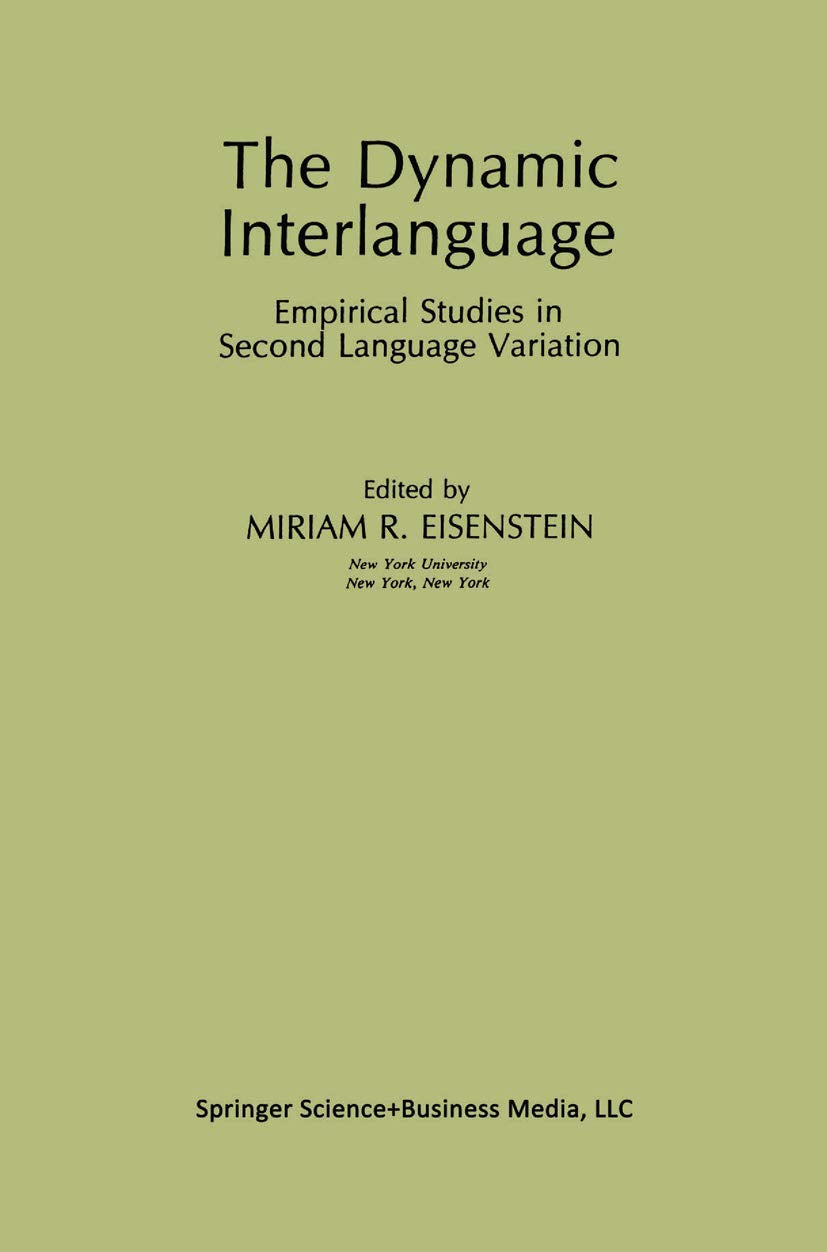
Recent work in applied linguistics has expanded our understanding of the rule governed nature of language. The concept of an idealized speaker hearer whose linguistic competence is abstract and separate from reality has been enriched by the notion of an actual interlocutor who possesses communicative compe tence, a knowledge of language which accounts for its use in realworld con texts. Areas of variation previously relegated to idiosyncratic differences in performance have been found to be dynamic yet consistent and lend themselves to study and systematic description. Because language acquisition involves the development of communicative competence, by its very nature it incorporates variation and systematicity. Sec ondlanguage acquisition is similarly variable, since interlanguage is subject to the same universal and languagespecific conventions. In addition, aspects of the second language have been found to be unevenly acquired and are differ entially reflected in particular contexts or settings. Yet, despite our expanding knowledge, this variability is only beginning to be treated in much of the sec ondlanguage acquisition literature. This volume presents the work of some researchers and methodologists who have taken on the challenge of including variation in their research designs and pedagogical recommendations. Variation is shown to be relevant to lin guistic, social, and psychological aspects of language. It is apparent in the registers and dialects of the target language and in the inter language of learners.
⚠️ WARNING (California Proposition 65):
This product may contain chemicals known to the State of California to cause cancer,
birth defects, or other reproductive harm.
For MAP (Minimum Advertised Price) violations and Intellectual Property (IP) or Trademark concerns, please contact:
support@ergodebooks.com
⚠️ California Proposition 65 Warning: Some products sold on this website may expose you to chemicals known to the State of California to cause cancer, birth defects, or other reproductive harm. For more information, visit www.P65Warnings.ca.gov.