
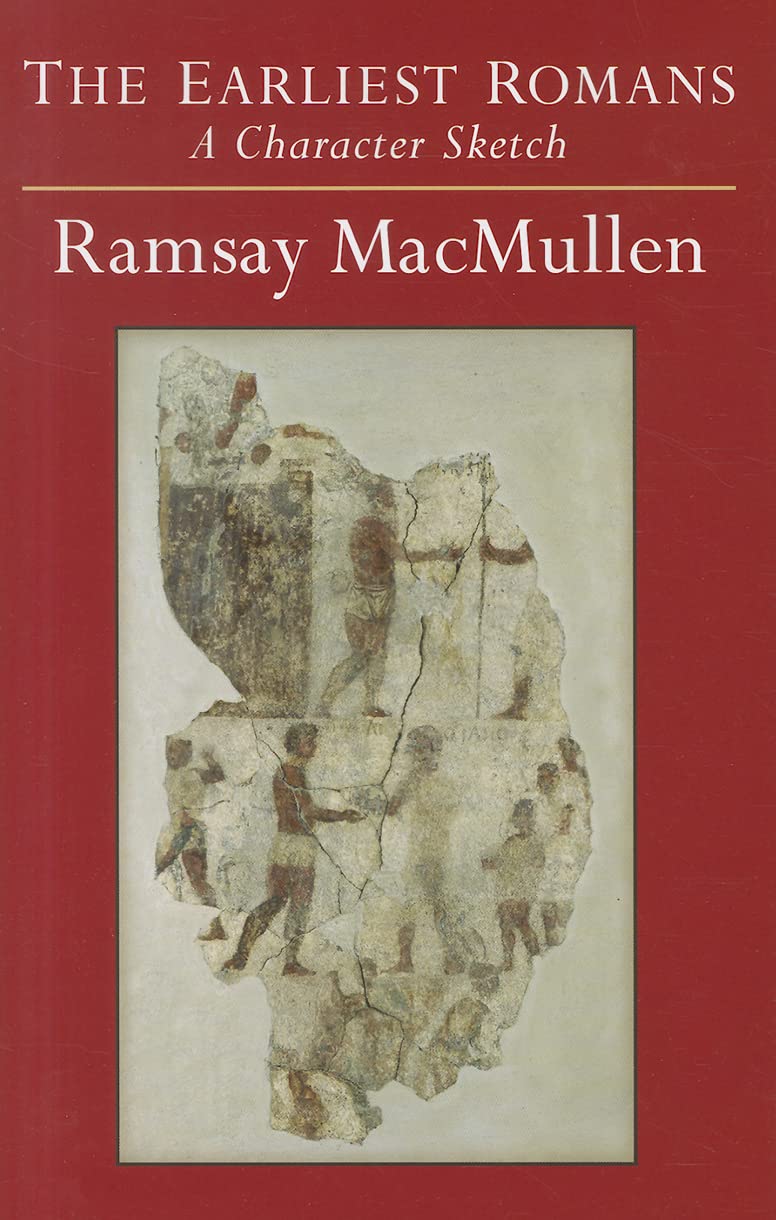
Title
The Earliest Romans: A Character Sketch,Used
Sold by Ergodebooks, an authorized reseller.
Returns accepted within 30 days | support@ergodebooks.com
Shipping Information
- Free Standard Shipping — United States only
- Processing Time: 3–5 business days
- Estimated Delivery: 6–10 business days after dispatch
- Double-boxed, fully insured & discreetly packaged
- Tracking number sent via email once dispatched
Returns & Refund
Returns accepted within 30 days of delivery.
Damaged or Defective Item
Free return shipping + replacement or full refund
Wrong Item Received
Free return shipping + replacement or full refund
Change of Mind
Return shipping at customer's expense · 25% restocking fee applies
Payment Option

Excerpt. Reprinted by permission. All rights reserved. THE EARLIEST ROMANSA Character SketchBy Ramsay MacMullenThe University of Michigan PressCopyright 2011Ramsay MacMullenAll right reserved. ISBN: 9780472117987 ContentsPreface.........................................vii1. Conservative.................................32. Tolerant.....................................173. Aggressive...................................294. Practical....................................43PART 2. FROM 509 TO.............................2645. Conservative (continued).....................576. Tolerant (continued).........................767. Aggressive (continued).......................878. Practical (continued)........................989. Wrapup......................................114Notes...........................................123Bibliography....................................165Index...........................................187Chapter One CONSERVATIVE The Romans were a people distrustful of novelties, slow to adopt a change, grudging in their surrender to it. They liked the old ways. This trait appears, for example, in the fact of their being only twenty miles from the sea and yet never for a halfmillennium bothering with it: building no fishing fleet that's ever mentioned, no port, no navy, or even a watchtower. For their own countrified purposes they had a cattle and a produce market but no interest in market tolls. Their riverine location invited them to look beyond their immediate horizons, but there is no sign of their attempting this, themselves; at most they allowed others from elsewhere to conduct business among them in an assigned, convenient spot: notably the traders in salt from the flats at the mouth of the Tiber, coming upriver on the right bank, who found at Rome the first fording place and could so continue up the socalled Salt Road on the left bank to their inland markets. They passed through leaving no trace. To judge from the problems of interest to the Romans' earliest laws, down to the midfifth century, it was lands and family property that they were concerned with, not commerce or banking. We have in view, here, not just two or three generations but several hundred years of opportunities neglected. Another people would have behaved differently, with different historical consequences. Surely there would have been some such effect as Plato imagined, had the Romans chosen to engage themselves in the scenes beyond their own home at the invitation of the nearby waterways. We would have, or it would have produced, a different people; for 'the sea', as Plato said, 'is pleasant enough as a daily companion, but has indeed also a bitter and brackish quality, filling the streets with merchants and shopkeepers, and begetting in the souls of men uncertain and unfaithful ways' (Laws 705, trans. Jowett). The philosopher had in mind and detested the very Athenians whom Pericles described in his funeral oration, loving them: always ready for something new, always the active agents of it at the cost of everything fixed and trustworthy. Indeed the early Romans would have suited Plato much better than Pericles. Something can thus be inferred about the earliest Romans from what they chose to do or not do on a grand scale. Nature unfolds in behavior; 'actions are proof of character' (Aristotle, Rhet. 1367b). If inferences are indeed fair, then we should be able to identify and similarly learn from further illustrations drawing on our familiar sources. We don't lack for a good base of information. On the shelf, inviting our inquiry, the ancient writers seem ample enough. Their appearance, however, is itself a problem that I need to explain before I go any further. Among those that tell us about early Rome, one of the best known was Marcus Terentius Varro (born in 116). Though his work survives only in bits and pieces, he counts as first in a long line of scholars called antiquarians. He served as a prime source for most his
⚠️ WARNING (California Proposition 65):
This product may contain chemicals known to the State of California to cause cancer, birth defects, or other reproductive harm.
For more information, please visit www.P65Warnings.ca.gov.