
Title
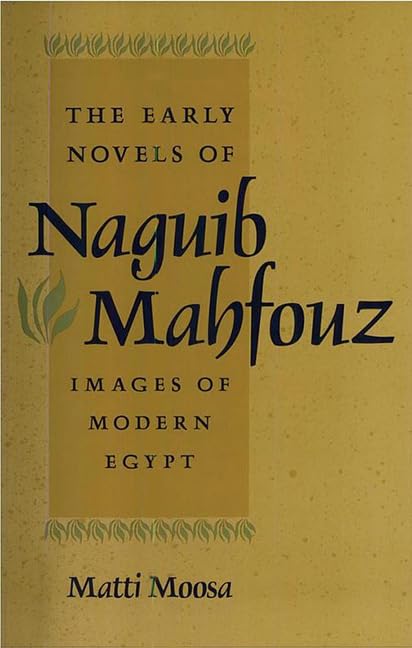
The Early Novels Of Naguib Mahfouz: Images Of Modern Egypt,Used
Sold by Ergodebooks, an authorized reseller.
Returns accepted within 30 days | support@ergodebooks.com
Shipping Information
- Free Standard Shipping — United States only
- Processing Time: 3–5 business days
- Estimated Delivery: 6–10 business days after dispatch
- Double-boxed, fully insured & discreetly packaged
- Tracking number sent via email once dispatched
Returns & Refund
Returns accepted within 30 days of delivery.
Damaged or Defective Item
Free return shipping + replacement or full refund
Wrong Item Received
Free return shipping + replacement or full refund
Change of Mind
Return shipping at customer's expense · 25% restocking fee applies
Payment Option

An invaluable contribution to our understanding of Mahfouz and a full, descriptive survey of novels by the Egyptian Nobel Prizewinning writer. It bridges the gap for nonArabists, and in detail gives a vivid portrait of each novel, its subject matter, and the historical period in which it was written.'Omar Pound, Princeton UniversityUntil he won the Nobel Prize for literature in 1988, little was known in the West about the life and literary accomplishments of Naguib Mahfouz, an Egyptian and the first Arab to receive the award. His writing, examined by Matti Moosa in its original Arabic, thereafter became widely available and widely scrutinized.Moosa introduces Mahfouz and his principal works to a Western audience by examining his treatment of social, political, and religious themes against the background of twentiethcentury Egypt. Often compared to Dickens and Balzac, Mahfouz portrays the condition of the poor and oppressed in a realistic and classically Arabic style.Concentrating on the early novels, Moosa discusses such themes as conflict between generations, the changing role of women, and the humiliating inefficiency of bureaucracy. He describes how Mahfouz, a moderate Muslim, explains Islamic tradition and its place in a modern technological world.Moosa begins with Mahfouz's formative years as an essayist and ends with his Awlad Haratina (translated as Children of Gebelawi ), which was considered blasphemous by Islamic fundamentalists when it was serialized in Cairo's daily newspaper in 1959. (It has never been published in book form in Egypt.) He devotes nearly half of the book to Mahfouz's Thulathiyya (Trilogy, completed in 1952), which Mahfouz considers his best work. These novels in particular, Moosa says, accurately convey Mahfouz's representation of both the religious ideas of the zealous Muslim Brotherhood and the tolerant ideas of many modern Muslims. At the same time they offer abundant insight into the social and religious attitudes of Egyptians from all walks of life and of Arab and Islamic culture and institutions.Matti Moosa is professor of history at Gannon University inErie, Pennsylvania. He is the author of Extremist Shiites: The Ghulat Sects, The Maronites in History, The Origin of Modern Arabic Fiction, and other books and numerous articles.
⚠️ WARNING (California Proposition 65):
This product may contain chemicals known to the State of California to cause cancer, birth defects, or other reproductive harm.
For more information, please visit www.P65Warnings.ca.gov.