
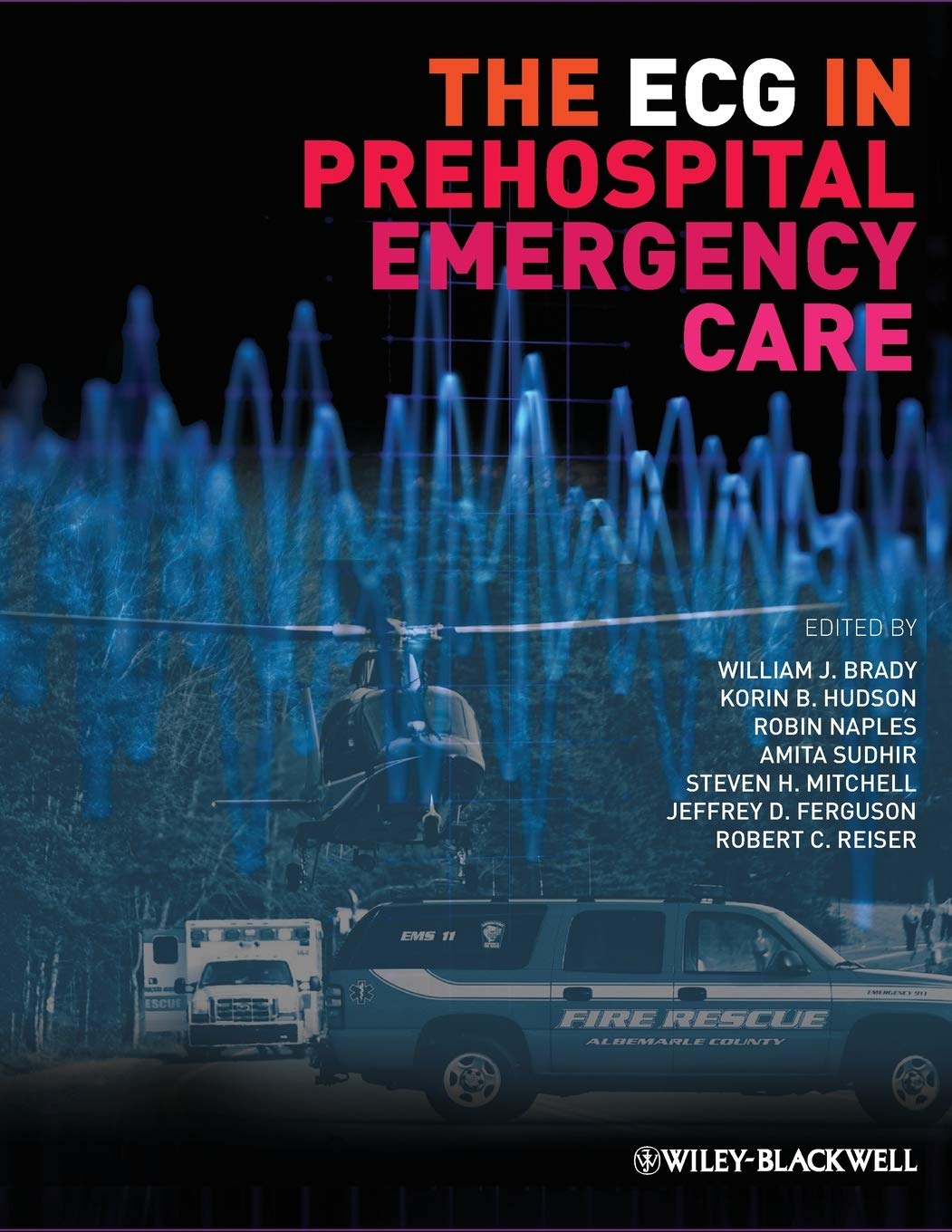
Title
The ECG in Prehospital Emergency Care,New
Sold by Ergodebooks, an authorized reseller.
Returns accepted within 30 days | support@ergodebooks.com
Shipping Information
- Free Standard Shipping — United States only
- Processing Time: 3–5 business days
- Estimated Delivery: 6–10 business days after dispatch
- Double-boxed, fully insured & discreetly packaged
- Tracking number sent via email once dispatched
Returns & Refund
Returns accepted within 30 days of delivery.
Damaged or Defective Item
Free return shipping + replacement or full refund
Wrong Item Received
Free return shipping + replacement or full refund
Change of Mind
Return shipping at customer's expense · 25% restocking fee applies
Payment Option

Now that state of the art equipment can be carried in ambulances, prehospital emergency staff are able to perform an ECG soon after arrival on scene, enabling the EMS provider to gather important diagnostic information that can not only guide prehospital therapy but also direct hospitalbased treatment.This book exclusively addresses ECGs for prehospital emergencies, ranging from basic rhythm diagnosis to critical care applications of the electrocardiogram and advanced 12lead ECG interpretation in the ACS patient. It provides self testing traces covering all these conditions seen in prehospital and hospital based environments. It includes 200 randomly presented cases mirroring real life situations, with the answers set out separately together with additional invaluable information.Written by highly experienced emergency physicians with EMS qualifications and experience, this text is an ideal learning tool for trainees and fully qualified staff alike, including ground EMS advanced life support providers, aeromedical staff, and interfacility critical care transport personnel.
⚠️ WARNING (California Proposition 65):
This product may contain chemicals known to the State of California to cause cancer, birth defects, or other reproductive harm.
For more information, please visit www.P65Warnings.ca.gov.
- Q: How many pages does the book contain? A: The book contains two hundred twenty-four pages. It provides comprehensive coverage of ECGs in prehospital emergency care.
- Q: What are the dimensions of the book? A: The book measures eight point seven inches in length, zero point five one inches in width, and ten point nine one inches in height. These dimensions make it portable for on-the-go learning.
- Q: What type of binding does the book have? A: The book has a paperback binding. This makes it lightweight and easy to handle during training sessions.
- Q: Who is the author of this book? A: The author of the book is William J. Brady. He is a highly experienced emergency physician with EMS qualifications.
- Q: What topics does the book cover? A: The book covers topics from basic rhythm diagnosis to advanced twelve-lead ECG interpretation. It addresses both prehospital and hospital-based emergency scenarios.
- Q: Is this book suitable for beginners? A: Yes, the book is suitable for both trainees and fully qualified staff. It serves as an ideal learning tool for various emergency medical personnel.
- Q: Can I use this book for self-testing? A: Yes, the book includes self-testing traces covering various conditions. This feature enhances the learning experience by providing practical application.
- Q: Is this book appropriate for advanced life support training? A: Yes, it is appropriate for advanced life support training. The content is designed for ground EMS providers, aeromedical staff, and critical care transport personnel.
- Q: What should I do if I have questions while using the book? A: If you have questions, refer to the separate answer section provided in the book. This section includes invaluable information to assist your learning.
- Q: How should I store the book to keep it in good condition? A: Store the book in a cool, dry place away from direct sunlight. This will help maintain its quality and longevity.
- Q: Is there a warranty on this book? A: No, there is typically no warranty on books. However, you can check with the retailer for their return policy.
- Q: What if the book arrives damaged? A: If the book arrives damaged, contact the retailer for return instructions. Most retailers have policies to address such issues.
- Q: Is the book suitable for emergency medical services personnel? A: Yes, the book is specifically designed for emergency medical services personnel. It addresses practical applications relevant to their work.
- Q: Does the book cover ECGs for critical care situations? A: Yes, it covers ECGs for critical care applications. This includes advanced interpretations necessary for treating acute coronary syndrome patients.
- Q: Are there illustrations in the book? A: Yes, the book includes illustrations to support the learning process. These visuals enhance understanding of complex concepts.