
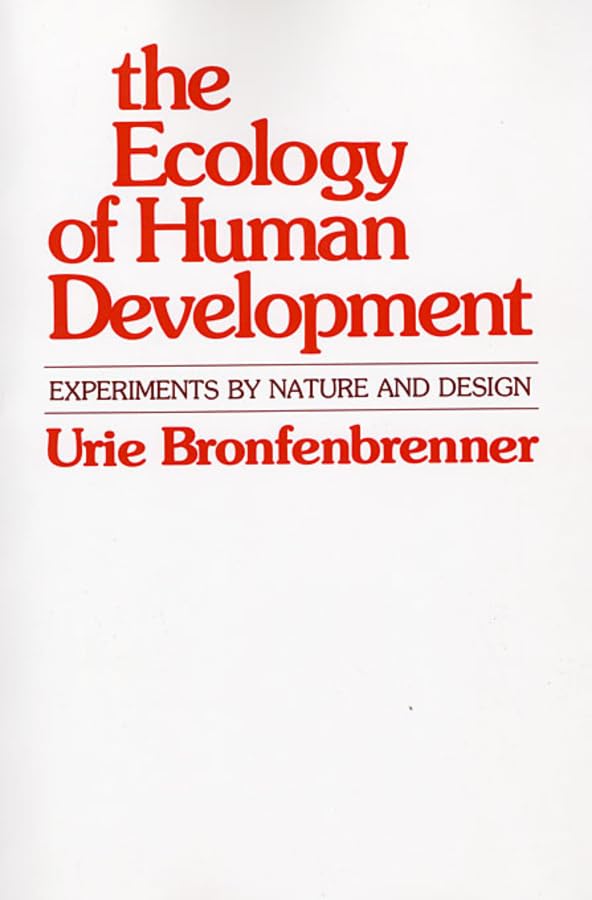
Title
The Ecology Of Human Development: Experiments By Nature And Design
Sold by Ergodebooks, an authorized reseller.
Returns accepted within 30 days | support@ergodebooks.com
Shipping Information
- Free Standard Shipping — United States only
- Processing Time: 3–5 business days
- Estimated Delivery: 6–10 business days after dispatch
- Double-boxed, fully insured & discreetly packaged
- Tracking number sent via email once dispatched
Returns & Refund
Returns accepted within 30 days of delivery.
Damaged or Defective Item
Free return shipping + replacement or full refund
Wrong Item Received
Free return shipping + replacement or full refund
Change of Mind
Return shipping at customer's expense · 25% restocking fee applies
Payment Option

Here Is A Book That Challenges The Very Basis Of The Way Psychologists Have Studied Child Development. According To Urie Bronfenbrenner, One Of The World?S Foremost Developmental Psychologists, Laboratory Studies Of The Child?S Behavior Sacrifice Too Much In Order To Gain Experimental Control And Analytic Rigor. Laboratory Observations, He Argues, Too Often Lead To ?The Science Of The Strange Behavior Of Children In Strange Situations With Strange Adults For The Briefest Possible Periods Of Time.? To Understand The Way Children Actually Develop, Bronfenbrenner Believes That It Will Be Necessary To Observe Their Behavior In Natural Settings, While They Are Interacting With Familiar Adults Over Prolonged Periods Of Time.This Book Offers An Important Blueprint For Constructing Such A New And Ecologically Valid Psychology Of Development. The Blueprint Includes A Complete Conceptual Framework For Analysing The Layers Of The Environment That Have A Formative Influence On The Child. This Framework Is Applied To A Variety Of Settings In Which Children Commonly Develop, Ranging From The Pediatric Ward To Daycare, School, And Various Family Configurations. The Result Is A Rich Set Of Hypotheses About The Developmental Consequences Of Various Types Of Environments. Where Current Research Bears On These Hypotheses, Bronfenbrenner Marshals The Data To Show How An Ecological Theory Can Be Tested. Where No Relevant Data Exist, He Suggests New And Interesting Ecological Experiments That Might Be Undertaken To Resolve Current Unknowns.Bronfenbrenner?S Groundbreaking Program For Reform In Developmental Psychology Is Certain To Be Controversial. His Argument Flies In The Face Of Standard Psychological Procedures And Challenges Psychology To Become More Relevant To The Ways In Which Children Actually Develop. It Is A Challenge Psychology Can Illafford To Ignore.
⚠️ WARNING (California Proposition 65):
This product may contain chemicals known to the State of California to cause cancer, birth defects, or other reproductive harm.
For more information, please visit www.P65Warnings.ca.gov.
- Q: What is the page count of the book? A: The book contains three hundred fifty-two pages. This provides ample content for readers interested in child development.
- Q: What are the dimensions of this book? A: The book measures six point fourteen inches in length, zero point ninety-one inches in width, and nine point twenty-five inches in height. These dimensions make it a portable read.
- Q: What type of binding does the book have? A: This book is available in paperback binding. This format is lightweight and flexible, suitable for easy handling.
- Q: Who is the author of 'The Ecology of Human Development'? A: The author is Urie Bronfenbrenner, a prominent developmental psychologist known for his work on child development theories.
- Q: What category does this book fall under? A: The book is categorized under Mental Health. It explores significant themes related to child development and psychology.
- Q: What are the main themes of the book? A: The main themes include ecological valid psychology, child development in natural settings, and the influence of environments on children. These insights are pivotal for understanding child development.
- Q: How can I apply the insights from this book? A: You can apply the insights by observing children's behavior in natural settings and considering the various environments they interact with. This approach enhances understanding of their development.
- Q: Is this book suitable for educators? A: Yes, this book is suitable for educators. It provides valuable insights into child development that can enhance teaching strategies.
- Q: Can parents benefit from reading this book? A: Yes, parents can benefit from this book. It offers a deeper understanding of how children's environments affect their development.
- Q: What kind of research does Bronfenbrenner advocate for? A: Bronfenbrenner advocates for ecological research that observes children's behavior in natural environments. This contrasts with traditional laboratory studies.
- Q: How should I store this book? A: Store the book in a cool, dry place, away from direct sunlight. This will help preserve its condition over time.
- Q: Is there a return policy for this book? A: Yes, there is a no-quibbles return policy. If you're not satisfied, you can return the book easily.
- Q: What should I do if the book arrives damaged? A: If the book arrives damaged, contact customer service immediately for assistance with a return or exchange.
- Q: Is this book appropriate for young adults? A: Yes, this book is appropriate for young adults. It offers insights that are relevant for those studying psychology or education.
- Q: What types of environments does Bronfenbrenner discuss? A: Bronfenbrenner discusses various environments, including pediatric wards, daycare, schools, and family configurations. Each setting provides unique insights into child development.
- Q: Are there any unique experiments suggested in the book? A: Yes, Bronfenbrenner suggests new ecological experiments to explore unanswered questions in child development. These experiments are aimed at enhancing understanding of environmental impacts.