
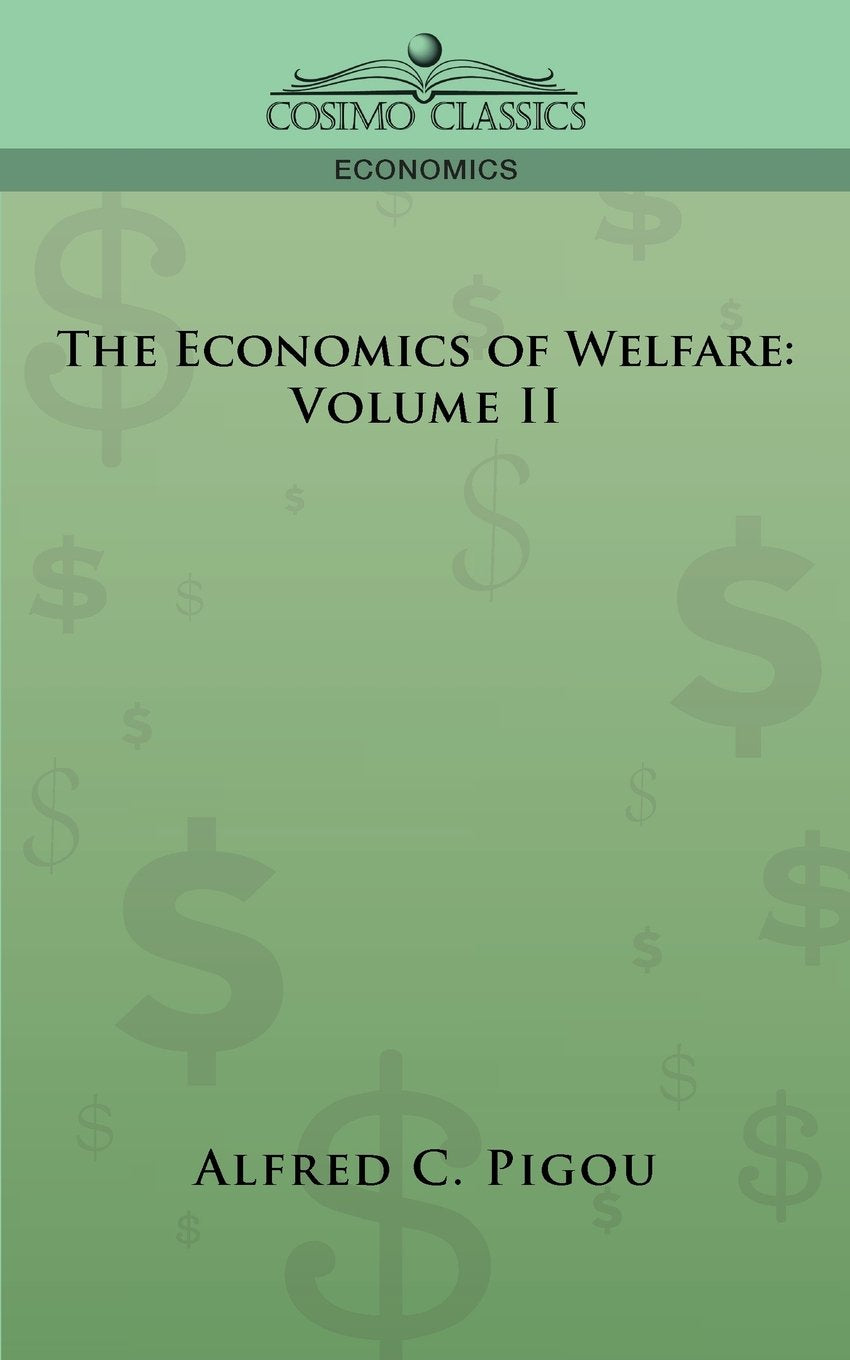
Title
The Economics of Welfare: Volume II,New
Sold by Ergodebooks, an authorized reseller.
Returns accepted within 30 days | support@ergodebooks.com
Shipping Information
- Free Standard Shipping — United States only
- Processing Time: 3–5 business days
- Estimated Delivery: 6–10 business days after dispatch
- Double-boxed, fully insured & discreetly packaged
- Tracking number sent via email once dispatched
Returns & Refund
Returns accepted within 30 days of delivery.
Damaged or Defective Item
Free return shipping + replacement or full refund
Wrong Item Received
Free return shipping + replacement or full refund
Change of Mind
Return shipping at customer's expense · 25% restocking fee applies
Payment Option

Product DescriptionWelfare economics is a branch of economics using microeconomic techniques to simultaneously determine the efficiency of the overall economy and the income distribution consequences associated with it. As a British economist best known for his work in many fields and particularly in welfare economics, Pigou attended the prestigious Harrow School and was a graduate of King's College, Cambridge, where he studied under Alfred Marshall, famously known as the creator of 'The Marshall Plan'. Here in The Economics of Welfare, Pigou asserts that individuals are the best judges of their own welfare, that people will prefer greater welfare to less welfare, and that welfare can be adequately measured either in monetary terms or as a relative preference. Scholars and students of both economics and welfare policy will find Pigou's work a significant contribution to current debates on welfare policy directions. Included in Volume II: 'The National Dividend and Labour' and 'The Distribution of the National Dividend.' Detailed Appendices include, 'UncertaintyBearing as a Factor of Production' (Appendix I), 'The Measurement of Elasticities of Demand' (Appendix II), a 'A Diagrammatic and Mathematical Treatment of Certain Problems of Competition and Monopoly' (Appendix III). ALSO AVAILABLE AT COSIMO CLASSICS: The Economics of Welfare: Volume I ARTHUR CECIL PIGOU (18771959) was a Professor of Political Economy at Cambridge University from 1908 to 1943. He is best known for the development of 'The Pigou Effect,' an economics term, which refers to the stimulation of output & employment caused by increasing consumption. Pigou served on a number of royal commissions, including the 1919 committee on income tax.About the AuthorARTHUR CECIL PIGOU (18771959) was a Professor of Political Economy at Cambridge University from 1908 to 1943. He is best known for the development of 'The Pigou Effect,' an economics term, which refers to the stimulation of output & employment caused by increasing consumption. Pigou served on a number of royal commissions, including the 1919 committee on income tax.
⚠️ WARNING (California Proposition 65):
This product may contain chemicals known to the State of California to cause cancer, birth defects, or other reproductive harm.
For more information, please visit www.P65Warnings.ca.gov.
- Q: What is the main focus of 'The Economics of Welfare: Volume II'? A: 'The Economics of Welfare: Volume II' primarily focuses on welfare economics, exploring efficiency in the overall economy and the implications of income distribution. It emphasizes that individuals are the best judges of their welfare and discusses how welfare can be measured.
- Q: Who is the author of this book and what is his significance? A: The author is Alfred C. Pigou, a prominent British economist known for his contributions to welfare economics and the development of the 'Pigou Effect,' which describes the relationship between consumption and economic output.
- Q: What topics are covered in Volume II of 'The Economics of Welfare'? A: Volume II includes discussions on 'The National Dividend and Labour' and 'The Distribution of the National Dividend,' along with detailed appendices on production factors, demand elasticity, and competition problems.
- Q: What is the condition of the book being sold? A: The book is in new condition, ensuring that it is free from wear and tear, and is suitable for readers seeking a fresh copy.
- Q: How many pages does 'The Economics of Welfare: Volume II' have? A: 'The Economics of Welfare: Volume II' contains 448 pages, providing an extensive exploration of its subject matter.
- Q: What is the binding type of this book? A: The book is available in paperback binding, making it lightweight and easy to handle.
- Q: When was 'The Economics of Welfare: Volume II' published? A: The book was published on January 1, 2013, and is available for readers interested in historical and contemporary welfare economics.
- Q: Is there an earlier volume of 'The Economics of Welfare'? A: Yes, there is a Volume I of 'The Economics of Welfare' which is also available at Cosimo Classics, providing foundational insights into welfare economics.
- Q: What kind of readers would benefit from this book? A: Scholars, students, and policymakers interested in economics and welfare policy would find valuable insights in this book, as it contributes to ongoing debates in these fields.
- Q: What are the appendices about in this volume? A: The appendices cover topics such as uncertainty-bearing as a factor of production, measurement of demand elasticities, and a mathematical treatment of competition and monopoly issues, adding depth to the main text.