
Title
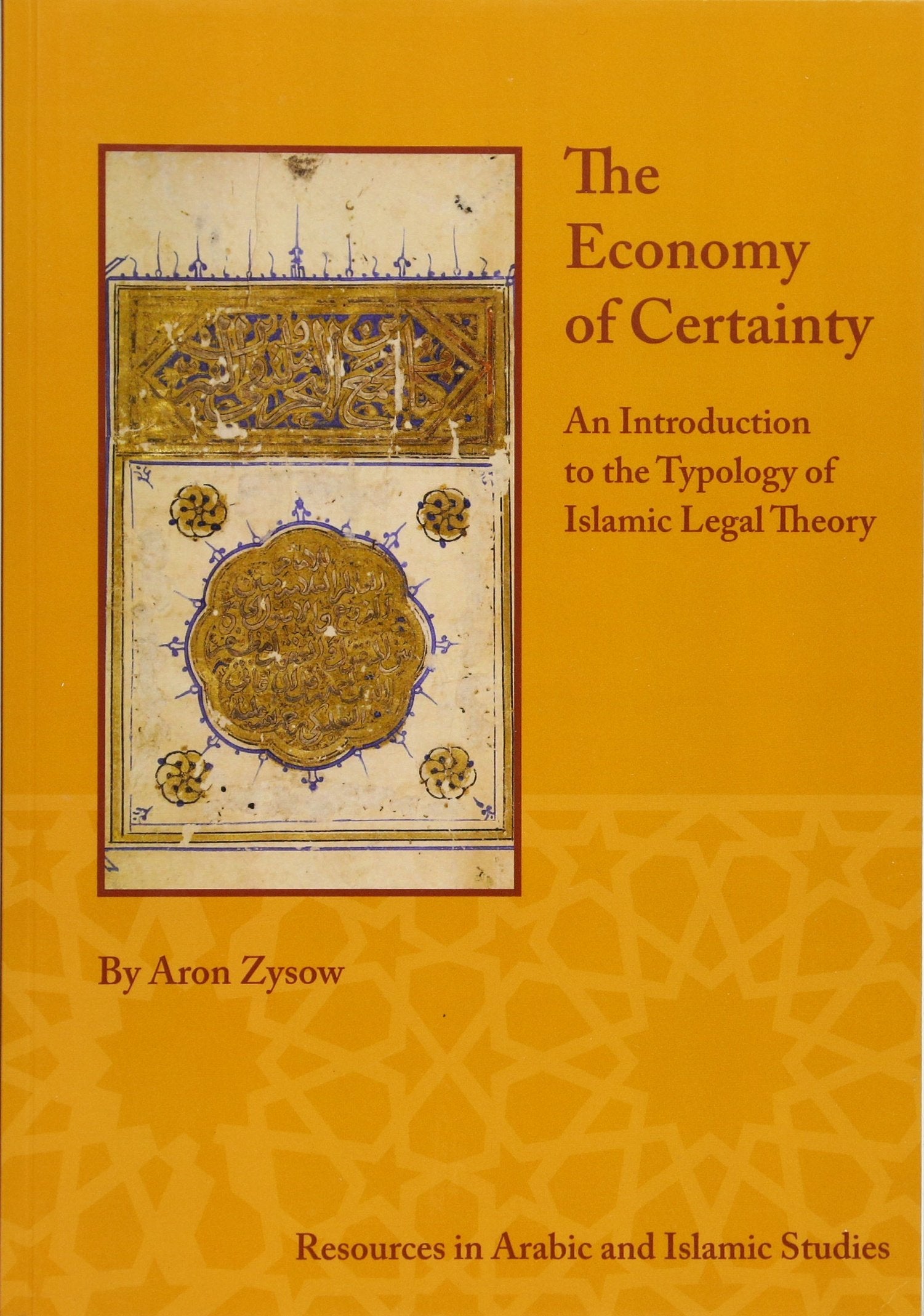
The Economy of Certainty: An Introduction to the Typology of Islamic Legal Theory (Resources in Arabic and Islamic Studies) (Res,Used
Sold by Ergodebooks, an authorized reseller.
Returns accepted within 30 days | support@ergodebooks.com
Shipping Information
- Free Standard Shipping — United States only
- Processing Time: 3–5 business days
- Estimated Delivery: 6–10 business days after dispatch
- Double-boxed, fully insured & discreetly packaged
- Tracking number sent via email once dispatched
Returns & Refund
Returns accepted within 30 days of delivery.
Damaged or Defective Item
Free return shipping + replacement or full refund
Wrong Item Received
Free return shipping + replacement or full refund
Change of Mind
Return shipping at customer's expense · 25% restocking fee applies
Payment Option

Aron Zysow's 1984 PhD dissertation, "The Economy of Certainty," remains the most important, compelling, and intellectually ambitious treatment of Islamic legal theory (usul alfiqh) in Western scholarship to date. It continues to be widely read and cited, and remains unsurpassed in its incisive analysis of the fundamental assumptions of Islamic legal thought. Zysow's important work is published here in full, for the first time, with updated references and some further reflections by the author. Zysow argues that the great dividing line in Islamic legal thought is between those legal theories that require certainty in every detail of the law and those that will admit probability. The latter were historically dominant and include the leading legal schools that have survived to our own day. Zahirism and, for much of its history, Twelver Shi'ism, are examples of the former. The wellknown dispute regarding the legitimacy of juridical analogy is only one feature of this fundamental epistemological division, since probability can enter the law in the process of authenticating prophetic traditions and in the interpretation of the revealed texts, as well as through analogy. The notion of consensus in Islamic legal theory functioned to reintroduce some measure of certainty into the law by identifying one of the competing probable solutions as correct. Consequently, consensus has only a reduced role in those systems that reject probability. Another, more radical, means of regaining certainty was the doctrine that regarded the legal reasoning of all qualified jurists on matters of probability as infallible. The development of legal theories of both types was to a large extent shaped by theology and, most significantly, by Mu'tazilism, and subsequently by Ash'arism and Maturidism.
⚠️ WARNING (California Proposition 65):
This product may contain chemicals known to the State of California to cause cancer, birth defects, or other reproductive harm.
For more information, please visit www.P65Warnings.ca.gov.