If you have any questions, you are always welcome to contact us. We'll get back to you as soon as possible, withing 24 hours on weekdays.
Customer service
All questions about your order, return and delivery must be sent to our customer service team by e-mail at yourstore@yourdomain.com
Sale & Press
If you are interested in selling our products, need more information about our brand or wish to make a collaboration, please contact us at press@yourdomain.com
Help
If you have any questions, you are always welcome to contact us. We'll get back to you as soon as possible, withing 24 hours on weekdays.
Customer service
All questions about your order, return and delivery must be sent to our customer service team by e-mail at yourstore@yourdomain.com
Sale & Press
If you are interested in selling our products, need more information about our brand or wish to make a collaboration, please contact us at press@yourdomain.com
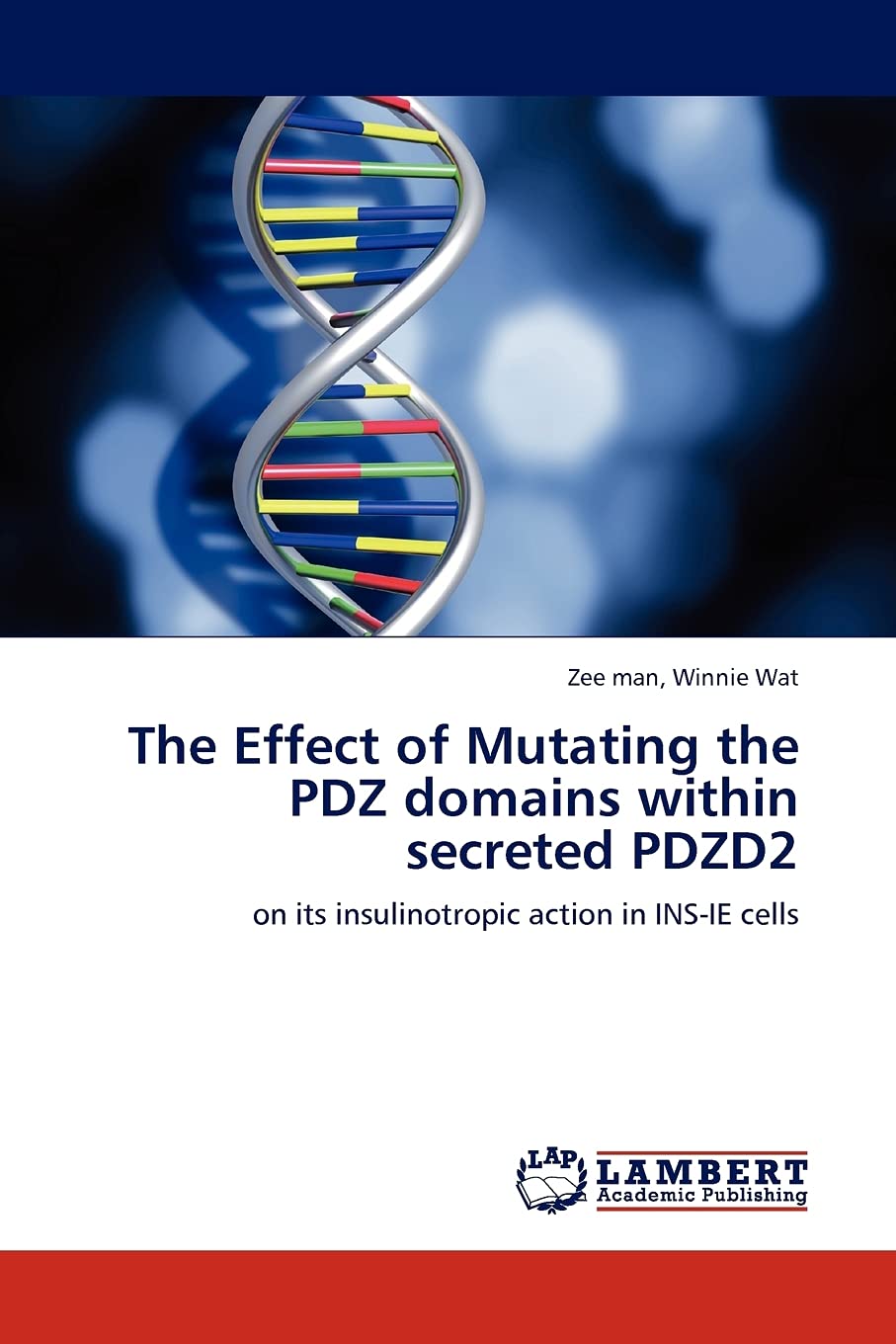
PDZ domains are one of the most common proteinprotein interaction domains in human. PDZ domain containing 2 protein (PDZD2) contains 6 PDZ domains and is highly expressed in pancreatic beta cells. It undergoes cleavage in the endoplasmic reticulum to produce a secreted form PDZD2 (sPDZD2) which retains the last two PDZ domains of PDZD2. sPDZD2 is a candidate beta cell regulatory factor. In current study, two mutated forms of sPDZD2 were generated with alterations in the amino acid sequence within the carboxylatebinding loop of one of the two PDZ domains, either at the PDZ5 or at the PDZ6 domain. Current study revealed that both the PDZ5mutated and PDZ6mutated sPDZD2 proteins failed to exert the insulinotropic effect that the wildtype sPDZD2 had on INS1E cells when added exogenously in the culture medium. Both mutant proteins also failed to rescue the silencing action of siRNA on the insulinotropic effect of endogenous PDZD2 in INS1E cells. These results suggest that intact carboxylatebinding loops of both PDZ5 and PDZ6 domain are crucial for the insulinotropic effect of sPDZD2 exerting on INS1E cells.
⚠️ WARNING (California Proposition 65):
This product may contain chemicals known to the State of California to cause cancer,
birth defects, or other reproductive harm.
For MAP (Minimum Advertised Price) violations and Intellectual Property (IP) or Trademark concerns, please contact:
support@ergodebooks.com
⚠️ California Proposition 65 Warning: Some products sold on this website may expose you to chemicals known to the State of California to cause cancer, birth defects, or other reproductive harm. For more information, visit www.P65Warnings.ca.gov.