If you have any questions, you are always welcome to contact us. We'll get back to you as soon as possible, withing 24 hours on weekdays.
Customer service
All questions about your order, return and delivery must be sent to our customer service team by e-mail at yourstore@yourdomain.com
Sale & Press
If you are interested in selling our products, need more information about our brand or wish to make a collaboration, please contact us at press@yourdomain.com
Help
If you have any questions, you are always welcome to contact us. We'll get back to you as soon as possible, withing 24 hours on weekdays.
Customer service
All questions about your order, return and delivery must be sent to our customer service team by e-mail at yourstore@yourdomain.com
Sale & Press
If you are interested in selling our products, need more information about our brand or wish to make a collaboration, please contact us at press@yourdomain.com
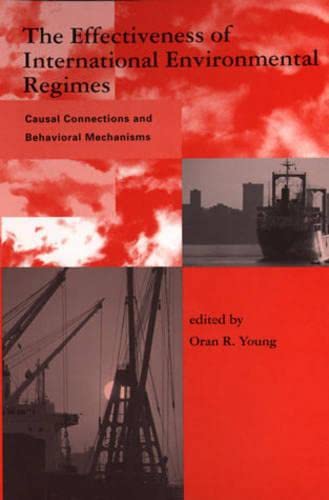
To be effective, an international regime must play a significant role in solving or at least managing the problem that led to its creation. But because regimessocial institutions composed of roles, rules, and relationshipsare not actors in their own right, they can succeed only by influencing the behavior of their members or actors operating under their members' jurisdiction.This book examines how regimes influence the behavior of their members and those associated with them. It identifies six mechanisms through which regimes affect behavior and discusses the role of each through indepth case studies of three major environmental concerns: intentional vesselsource oil pollution, shared fisheries, and transboundary acid rain. The behavioral mechanisms feature regimes as utility modifiers, as enhancers of cooperation, as bestowers of authority, as learning facilitators, as role definers, and as agents of internal realignments. The case studies show how these mechanisms can cause variations in effectiveness both across regimes and within individual regimes over time. One of the book's primary contributions is to develop methods to demonstrate which causal mechanisms come into play with specific regimes. It emphasizes the need to supplement conventional models assuming unitary and utilitymaximizing actors to explain variations in regime effectiveness.ContributorsLee G. Anderson, Ann Barrett, Marc A. Levy, Moira L. McConnell, Natalia Mirovitskaya, Ronald Mitchell, Don Munton, Elena Nikitina, Gail Osherenko, Alexei Roginko, Marvin Soroos, Olav Schram Stokke, Oran R. Young
⚠️ WARNING (California Proposition 65):
This product may contain chemicals known to the State of California to cause cancer,
birth defects, or other reproductive harm.
For MAP (Minimum Advertised Price) violations and Intellectual Property (IP) or Trademark concerns, please contact:
support@ergodebooks.com
⚠️ California Proposition 65 Warning: Some products sold on this website may expose you to chemicals known to the State of California to cause cancer, birth defects, or other reproductive harm. For more information, visit www.P65Warnings.ca.gov.