
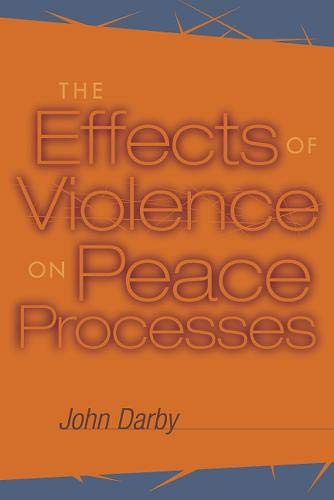
Title
The Effects of Violence on Peace Processes,Used
Sold by Ergodebooks, an authorized reseller.
Returns accepted within 30 days | support@ergodebooks.com
Shipping Information
- Free Standard Shipping — United States only
- Processing Time: 3–5 business days
- Estimated Delivery: 6–10 business days after dispatch
- Double-boxed, fully insured & discreetly packaged
- Tracking number sent via email once dispatched
Returns & Refund
Returns accepted within 30 days of delivery.
Damaged or Defective Item
Free return shipping + replacement or full refund
Wrong Item Received
Free return shipping + replacement or full refund
Change of Mind
Return shipping at customer's expense · 25% restocking fee applies
Payment Option

As recent events demonstrate, violence, especially ethnic violence, is exceptionally hard to extinguish. Ceasefires almost never bring a complete end to the killing, and formal peace agreements are more often than not undone by men unwilling to forsake the gun. As John Darby argues in this original, holistic, and comparative treatment of the subject, 'even when political violence is ended by a ceasefire, it reappears in other forms to threaten the evolving peace process.'Unlike most scholars, Darby focuses on peace processes that have involved actors other than the United Nations. He analyzes the nature and impact of four interrelated kinds of violence: violence by the state, violence by militants, violence in the community, and the emergence of new violencerelated issues during negotiations. For each kind of violence, the author draws out the policy implications, suggesting how the 'guardians' of the peace process can defeat wouldbe spoilers and change a culture of violence. The volume concludes by distilling five propositions on the relationship between violence and peace processes.Insightful, concise, and highly readable, the book will engage the scholar, inspire the policymaker, and inform the student. Indepth profiles of the five featured cases (Northern Ireland, South Africa, Sri Lanka, IsraelPalestine, and the Basque country) provide ample background and enrich understanding.
⚠️ WARNING (California Proposition 65):
This product may contain chemicals known to the State of California to cause cancer, birth defects, or other reproductive harm.
For more information, please visit www.P65Warnings.ca.gov.
- Q: What is the main focus of 'The Effects of Violence on Peace Processes'? A: The book focuses on the impact of various forms of violence on peace processes, particularly emphasizing cases where actors other than the United Nations are involved.
- Q: Who is the author of this book? A: The author of 'The Effects of Violence on Peace Processes' is John Darby.
- Q: How many pages does the book have? A: The book contains 144 pages.
- Q: What type of binding does this book have? A: This book is available in paperback binding.
- Q: When was 'The Effects of Violence on Peace Processes' published? A: The book was published on November 1, 2001.
- Q: What condition is the book in? A: The book is categorized as a used book in good condition.
- Q: What are some of the featured case studies in the book? A: The book includes in-depth profiles of case studies from Northern Ireland, South Africa, Sri Lanka, Israel-Palestine, and the Basque country.
- Q: What unique perspective does John Darby offer in this book? A: John Darby provides a holistic and comparative treatment of violence in peace processes, analyzing the roles of state and militant violence, community violence, and the emergence of new violence-related issues.
- Q: Who would benefit from reading this book? A: The book is designed for scholars, policymakers, and students interested in understanding the dynamics between violence and peace processes.
- Q: What insights does the book provide regarding policy implications? A: The book suggests ways in which the 'guardians' of peace processes can counteract potential spoilers and foster a culture of peace.