If you have any questions, you are always welcome to contact us. We'll get back to you as soon as possible, withing 24 hours on weekdays.
Customer service
All questions about your order, return and delivery must be sent to our customer service team by e-mail at yourstore@yourdomain.com
Sale & Press
If you are interested in selling our products, need more information about our brand or wish to make a collaboration, please contact us at press@yourdomain.com
Help
If you have any questions, you are always welcome to contact us. We'll get back to you as soon as possible, withing 24 hours on weekdays.
Customer service
All questions about your order, return and delivery must be sent to our customer service team by e-mail at yourstore@yourdomain.com
Sale & Press
If you are interested in selling our products, need more information about our brand or wish to make a collaboration, please contact us at press@yourdomain.com
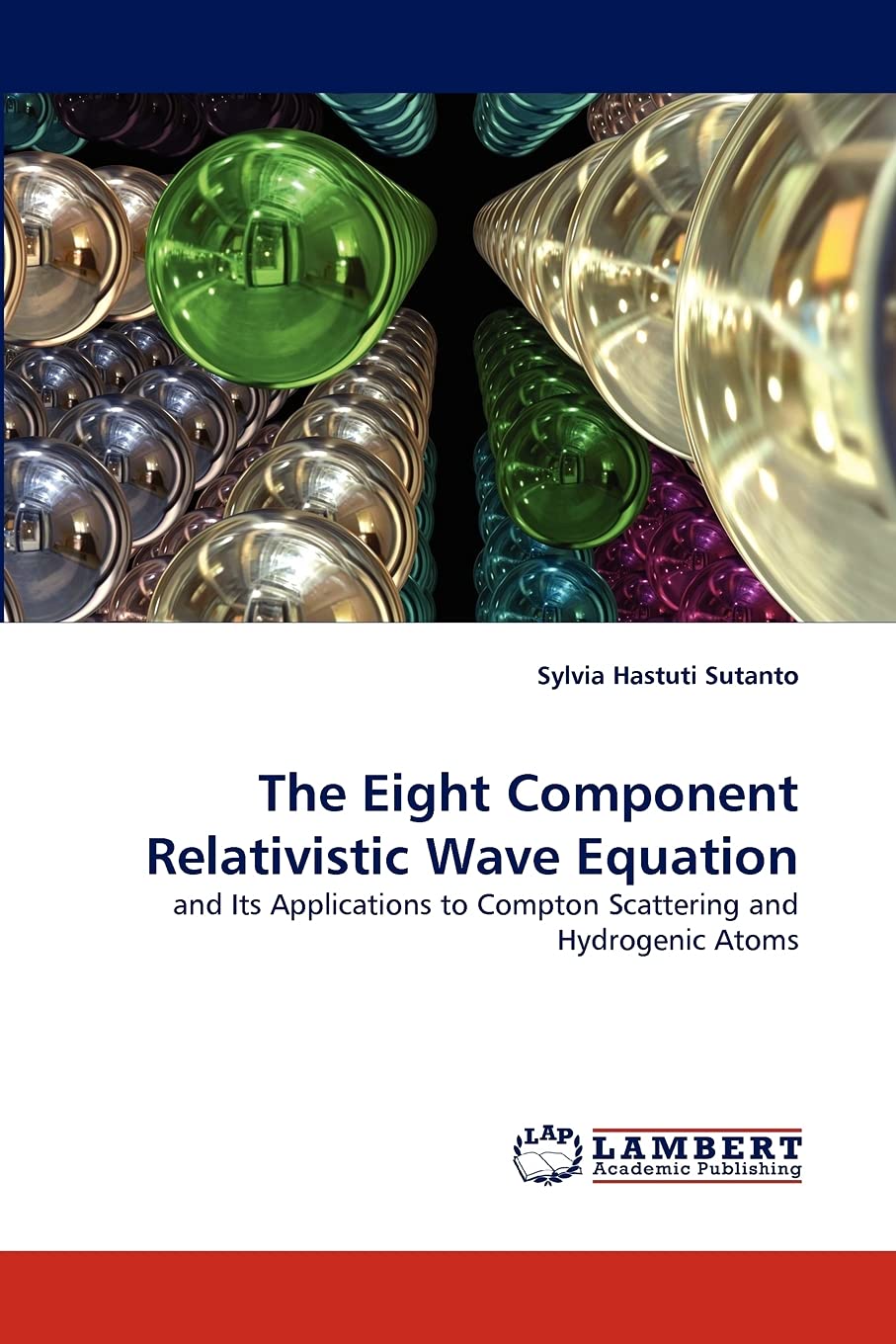
The eightcomponent (8C) relativistic wave equation for spin1/2 particles was developed by B. A. Robson and D. S. Staudte in 1993 using the procedure analogous to the one used earlier on the KleinGordon equation. The relativistic covariance and the solution behaviour of the 8C equation have been studied extensively by D. S. Staudte in 1993. The book provides the study of the 8C equation, particularly its application to physical problems such as Compton scattering and transition probabilities in hydrogenic atoms. The application of the 8C equation to the Compton scattering problem shows that it gives the same wellknown KleinNishina cross section formula as that initially obtained using the Dirac equation. The 8C equation has also been applied to the calculation of the transition probabilities for the components of both the Balmer and Lyman alphalines of hydrogenic atoms, and the results show the first indication that the 8C equation and the Dirac equation are actually not equivalent. This book is intended for those who are interested in the comparative study between the 8C equation and the wellknown Dirac equation, as well as their theoretical consequences.
⚠️ WARNING (California Proposition 65):
This product may contain chemicals known to the State of California to cause cancer,
birth defects, or other reproductive harm.
For MAP (Minimum Advertised Price) violations and Intellectual Property (IP) or Trademark concerns, please contact:
support@ergodebooks.com
⚠️ California Proposition 65 Warning: Some products sold on this website may expose you to chemicals known to the State of California to cause cancer, birth defects, or other reproductive harm. For more information, visit www.P65Warnings.ca.gov.