If you have any questions, you are always welcome to contact us. We'll get back to you as soon as possible, withing 24 hours on weekdays.
Customer service
All questions about your order, return and delivery must be sent to our customer service team by e-mail at yourstore@yourdomain.com
Sale & Press
If you are interested in selling our products, need more information about our brand or wish to make a collaboration, please contact us at press@yourdomain.com
Help
If you have any questions, you are always welcome to contact us. We'll get back to you as soon as possible, withing 24 hours on weekdays.
Customer service
All questions about your order, return and delivery must be sent to our customer service team by e-mail at yourstore@yourdomain.com
Sale & Press
If you are interested in selling our products, need more information about our brand or wish to make a collaboration, please contact us at press@yourdomain.com
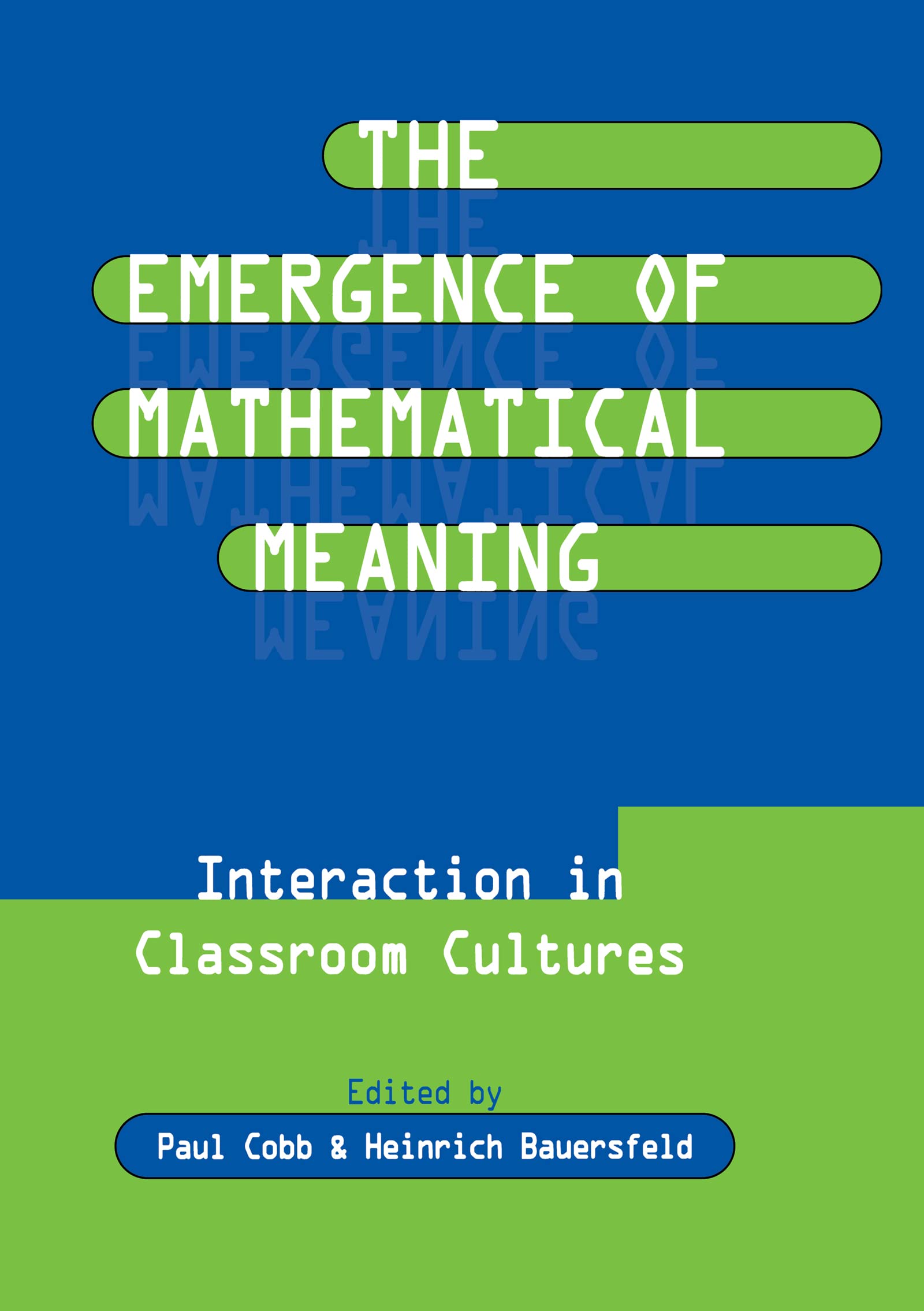
This book grew out of a fiveyear collaboration between groups of American and German mathematics educators. The central issue addressed accounting for the messiness and complexity of mathematics learning and teaching as it occurs in classroom situations. The individual chapters are based on the view that psychological and sociological perspectives each tell half of a good story. To unify these concepts requires a combined approach that takes individual students' mathematical activity seriously while simultaneously seeing their activity as necessarily socially situated. Throughout their collaboration, the chapter authors shared a single set of video recordings and transcripts made in an American elementary classroom where instruction was generally compatible with recent reform recommendations. As a consequence, the book is much more than a compendium of loosely related papers.The combined approach taken by the authors draws on interactionism and ethnomethodology. Thus, it constitutes an alternative to Vygotskian and Soviet activity theory approaches. The specific topics discussed in individual chapters include small group collaboration and learning, the teacher's practice and growth, and language, discourse, and argumentation in the mathematics classroom. This collaborative effort is valuable to educators and psychologists interested in situated cognition and the relation between sociocultural processes and individual psychological processes.
⚠️ WARNING (California Proposition 65):
This product may contain chemicals known to the State of California to cause cancer,
birth defects, or other reproductive harm.
For MAP (Minimum Advertised Price) violations and Intellectual Property (IP) or Trademark concerns, please contact:
support@ergodebooks.com
⚠️ California Proposition 65 Warning: Some products sold on this website may expose you to chemicals known to the State of California to cause cancer, birth defects, or other reproductive harm. For more information, visit www.P65Warnings.ca.gov.