
Title
The Emergence of Probability: A Philosophical Study of Early Ideas about Probability, Induction and Statistical Inference (Cambr,New
Sold by Ergodebooks, an authorized reseller.
Returns accepted within 30 days | support@ergodebooks.com
Shipping Information
- Free Standard Shipping — United States only
- Processing Time: 3–5 business days
- Estimated Delivery: 6–10 business days after dispatch
- Double-boxed, fully insured & discreetly packaged
- Tracking number sent via email once dispatched
Returns & Refund
Returns accepted within 30 days of delivery.
Damaged or Defective Item
Free return shipping + replacement or full refund
Wrong Item Received
Free return shipping + replacement or full refund
Change of Mind
Return shipping at customer's expense · 25% restocking fee applies
Payment Option

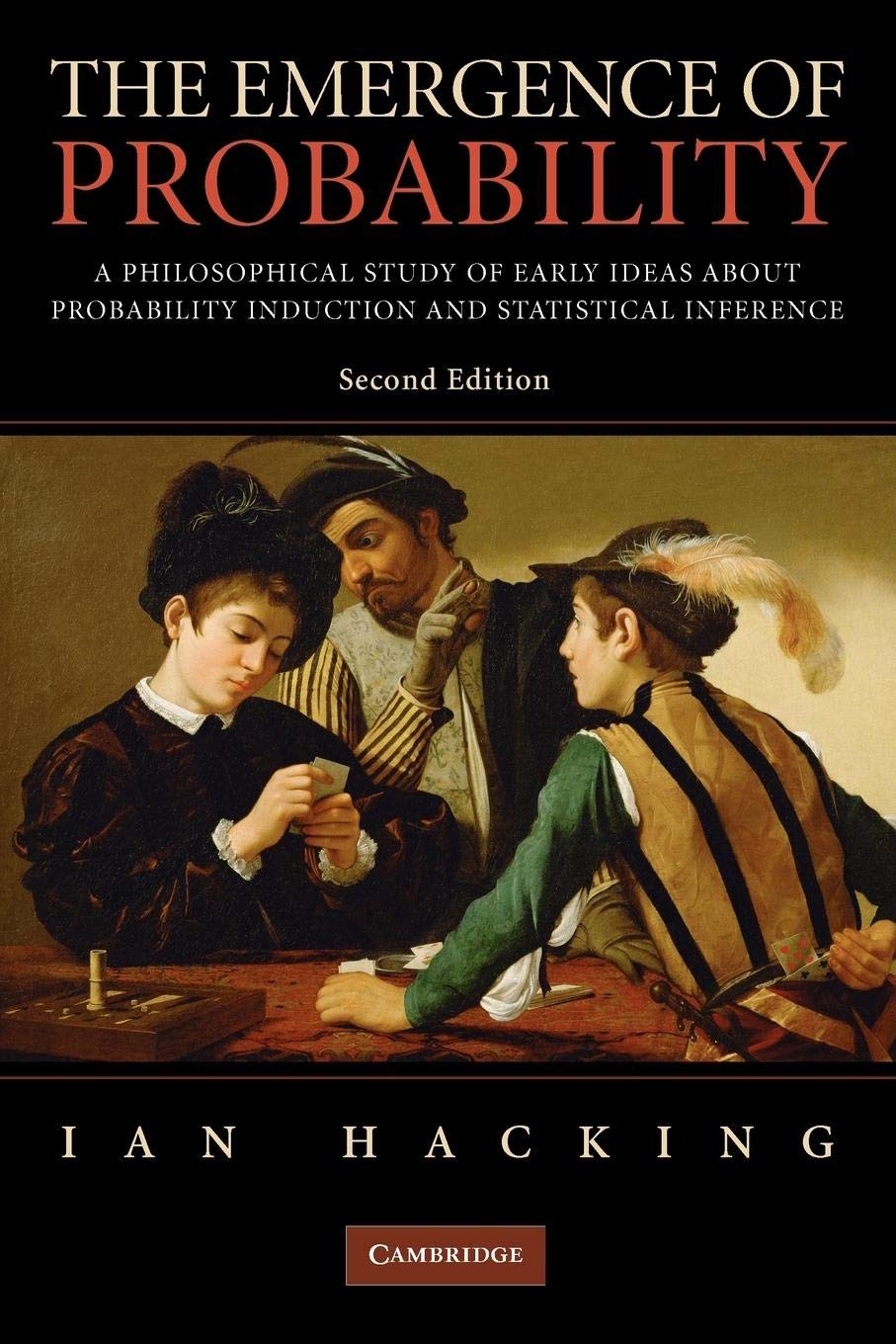
Historical records show that there was no real concept of probability in Europe before the midseventeenth century, although the use of dice and other randomizing objects was commonplace. Ian Hacking presents a philosophical critique of early ideas about probability, induction, and statistical inference and the growth of this new family of ideas in the fifteenth, sixteenth, and seventeenth centuries. Hacking invokes a wide intellectual framework involving the growth of science, economics, and the theology of the period. He argues that the transformations that made it possible for probability concepts to emerge have constrained all subsequent development of probability theory and determine the space within which philosophical debate on the subject is still conducted. First published in 1975, this edition includes an introduction that contextualizes his book in light of developing philosophical trends. Ian Hacking is the winner of the Holberg International Memorial Prize 2009.
⚠️ WARNING (California Proposition 65):
This product may contain chemicals known to the State of California to cause cancer, birth defects, or other reproductive harm.
For more information, please visit www.P65Warnings.ca.gov.
- Q: How many pages does this book have? A: This book has two hundred and forty-six pages. It provides a comprehensive exploration of early probability concepts.
- Q: What is the binding type of this book? A: The binding type is paperback. This makes it lightweight and easy to handle for reading.
- Q: What are the dimensions of the book? A: The book measures six inches in length, zero point six one inches in width, and nine point zero two inches in height. These dimensions make it a convenient size for shelf storage.
- Q: Who is the author of this book? A: The author is Ian Hacking. He is known for his work in the philosophy of science and mathematics.
- Q: What category does this book belong to? A: This book falls under the category of History and Philosophy. It specifically examines early ideas about probability.
- Q: What is the main theme of the book? A: The main theme revolves around the philosophical critique of early concepts of probability and statistical inference. It discusses the evolution of these ideas during the fifteenth to seventeenth centuries.
- Q: Is this book suitable for beginners in philosophy? A: Yes, this book is suitable for beginners interested in philosophy. It presents complex ideas in an accessible manner.
- Q: What reading level is this book appropriate for? A: This book is appropriate for adult readers and advanced students. It requires a basic understanding of philosophical concepts.
- Q: How should I store this book to keep it in good condition? A: Store the book upright in a cool, dry place away from direct sunlight. This will help preserve its quality and prevent damage.
- Q: Can I clean the book if it gets dirty? A: Yes, you can clean the book gently with a soft, dry cloth. Avoid using liquids as they may damage the pages.
- Q: What should I do if the book arrives damaged? A: If the book arrives damaged, contact the seller for return or replacement options. Most sellers have policies in place for such issues.
- Q: Is there a warranty on this book? A: No, typically books do not come with a warranty. However, check with the seller for their specific return policy.
- Q: How does this book compare to other books on probability? A: This book offers a unique philosophical perspective compared to other texts that may focus more on mathematical applications. It's ideal for those interested in theory.
- Q: Is this book suitable for academic study? A: Yes, this book is suitable for academic study. It is often used in philosophy and mathematics courses.
- Q: What is the publication date of this edition? A: This edition was first published in nineteen seventy-five. It includes an introduction contextualizing the work within modern philosophical trends.
- Q: Are there any illustrations in the book? A: No, the book does not include illustrations. It focuses on text to convey its philosophical arguments.