
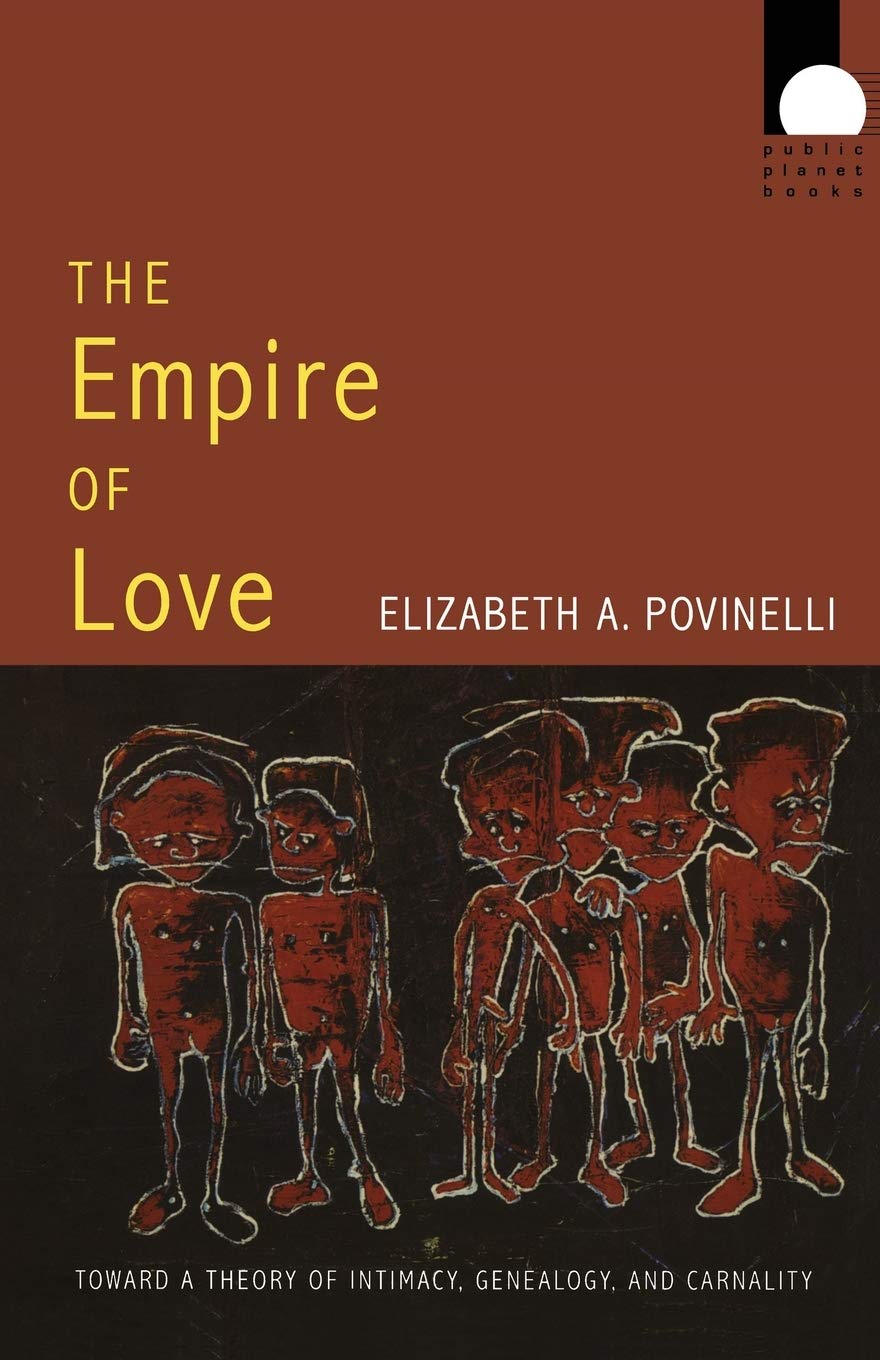
Title
The Empire Of Love: Toward A Theory Of Intimacy, Genealogy, And Carnality (Public Planet Books),Used
Sold by Ergodebooks, an authorized reseller.
Returns accepted within 30 days | support@ergodebooks.com
Shipping Information
- Free Standard Shipping — United States only
- Processing Time: 3–5 business days
- Estimated Delivery: 6–10 business days after dispatch
- Double-boxed, fully insured & discreetly packaged
- Tracking number sent via email once dispatched
Returns & Refund
Returns accepted within 30 days of delivery.
Damaged or Defective Item
Free return shipping + replacement or full refund
Wrong Item Received
Free return shipping + replacement or full refund
Change of Mind
Return shipping at customer's expense · 25% restocking fee applies
Payment Option

In The Empire of Love anthropologist Elizabeth A. Povinelli reflects on a set of ethical and normative claims about the governance of love, sociality, and the body that circulates in liberal settler colonies such as the United States and Australia. She boldly theorizes intimate relations as pivotal sites where liberal logics and aspirations absorbed through settler imperialism are manifest, where discourses of selfsovereignty, social constraint, and value converge.For more than twenty years, Povinelli has traveled to the social worlds of indigenous men and women living at Belyuen, a small community in the Northern Territory of Australia. More recently she has moved across communities of alternative progressive queer movements in the United States, particularly those who identify as radical faeries. In this book she traces how liberal binary concepts of individual freedom and social constraint influence understandings of intimacy in these two worlds. At the same time, she describes alternative models of social relations within each group in order to highlight modes of intimacy that transcend a reductive choice between freedom and constraint.Shifting focus away from identities toward the social matrices out of which identities and divisions emerge, Povinelli offers a framework for thinking through such issues as what counts as sexuality and which forms of intimate social relations result in the distribution of rights, recognition, and resources, and which do not. In The Empire of Love Povinelli calls for, and begins to formulate, a politics of thick life, a way of representing social life nuanced enough to meet the density and variation of actual social worlds.
⚠️ WARNING (California Proposition 65):
This product may contain chemicals known to the State of California to cause cancer, birth defects, or other reproductive harm.
For more information, please visit www.P65Warnings.ca.gov.
- Q: What is the main theme of 'The Empire of Love'? A: The main theme of 'The Empire of Love' revolves around the ethical and normative claims about love, sociality, and the body within liberal settler colonies, exploring how intimate relations are influenced by liberal logics and settler imperialism.
- Q: Who is the author of 'The Empire of Love'? A: The author of 'The Empire of Love' is Elizabeth A. Povinelli, an anthropologist known for her work in social relations and intimacy.
- Q: What type of book is 'The Empire of Love'? A: 'The Empire of Love' is an academic book that examines intimacy, genealogy, and carnal relations, making it suitable for readers interested in anthropology and social theories.
- Q: How many pages does 'The Empire of Love' have? A: 'The Empire of Love' contains 328 pages, providing an in-depth exploration of its themes.
- Q: What is the publication date of 'The Empire of Love'? A: 'The Empire of Love' was published on August 30, 2006.
- Q: Is 'The Empire of Love' a new or used book? A: 'The Empire of Love' is available as a new paperback book.
- Q: What category does 'The Empire of Love' fall under? A: 'The Empire of Love' falls under the category of Sexuality, addressing themes related to intimate relations and social constructs.
- Q: What unique perspectives does Povinelli offer in the book? A: Povinelli offers unique perspectives by tracing alternative models of social relations and intimacy, focusing on how identities and social matrices influence understandings of sexuality.
- Q: What are the key features of 'The Empire of Love'? A: Key features of 'The Empire of Love' include its academic analysis of intimacy, its reflection on indigenous communities, and its critique of liberal concepts of freedom and social constraint.
- Q: Can 'The Empire of Love' be useful for understanding modern intimacy? A: Yes, 'The Empire of Love' can be useful for understanding modern intimacy as it investigates how contemporary social relations are shaped by historical and cultural contexts.