
Title
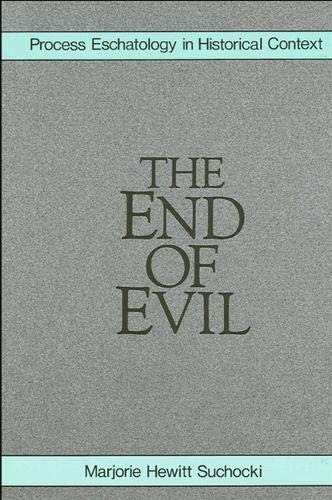
The End of Evil: Process Eschatology in Historical Context (Suny Series in Philosophy),New
Sold by Ergodebooks, an authorized reseller.
Returns accepted within 30 days | support@ergodebooks.com
Shipping Information
- Free Standard Shipping — United States only
- Processing Time: 3–5 business days
- Estimated Delivery: 6–10 business days after dispatch
- Double-boxed, fully insured & discreetly packaged
- Tracking number sent via email once dispatched
Returns & Refund
Returns accepted within 30 days of delivery.
Damaged or Defective Item
Free return shipping + replacement or full refund
Wrong Item Received
Free return shipping + replacement or full refund
Change of Mind
Return shipping at customer's expense · 25% restocking fee applies
Payment Option

Product DescriptionSuchocki, MarjorieReview'This is a major piece of scholarship. It is clearly and gracefully written. Far from merely summarizing existing process approaches to eschatology, Suchocki intricately works out, for the first time, a systematic treatment of the source and end of evil. The topics of evil, of theodicy, of eschatology, central concerns of Christian theology, receive a systematic treatment here from both an historical and a philosophical perspective. This makes the book more than a theological exercise. At the same time, it rises above much current philosophical literature by focusing on categories of existence (rather than language) such as freedom and finitude, treated in terms of a unified theory. I believe her explication of the Whiteheadian basis for this particular process eschatology will be an important (not to say popular) interpretation.' Nancy Frankenberry'I particularly admire Suchocki's historical sense. She lodges the problem of evil in the development of the western tradition, and treats a variety of extremely different contextsfrom Augustine to Nietzschewith care and competence. As her own view, which is of course an extension of Whitehead's, begins to unfold in the second half of the book, it is enriched and clarified by her account of the background out of which she understands it to have emerged. I was also impressed by Suchocki's ability to maintain a successful tension between her own religious commitmentsfrankly stated in the introduction and a rigorous, disinterested philosophical analysis.' Brian J. MartineAbout the AuthorMarjorie Hewitt Suchocki is Academic Dean and Professor of Theology at Wesley Theological Seminary in Washington, D.C.
⚠️ WARNING (California Proposition 65):
This product may contain chemicals known to the State of California to cause cancer, birth defects, or other reproductive harm.
For more information, please visit www.P65Warnings.ca.gov.