
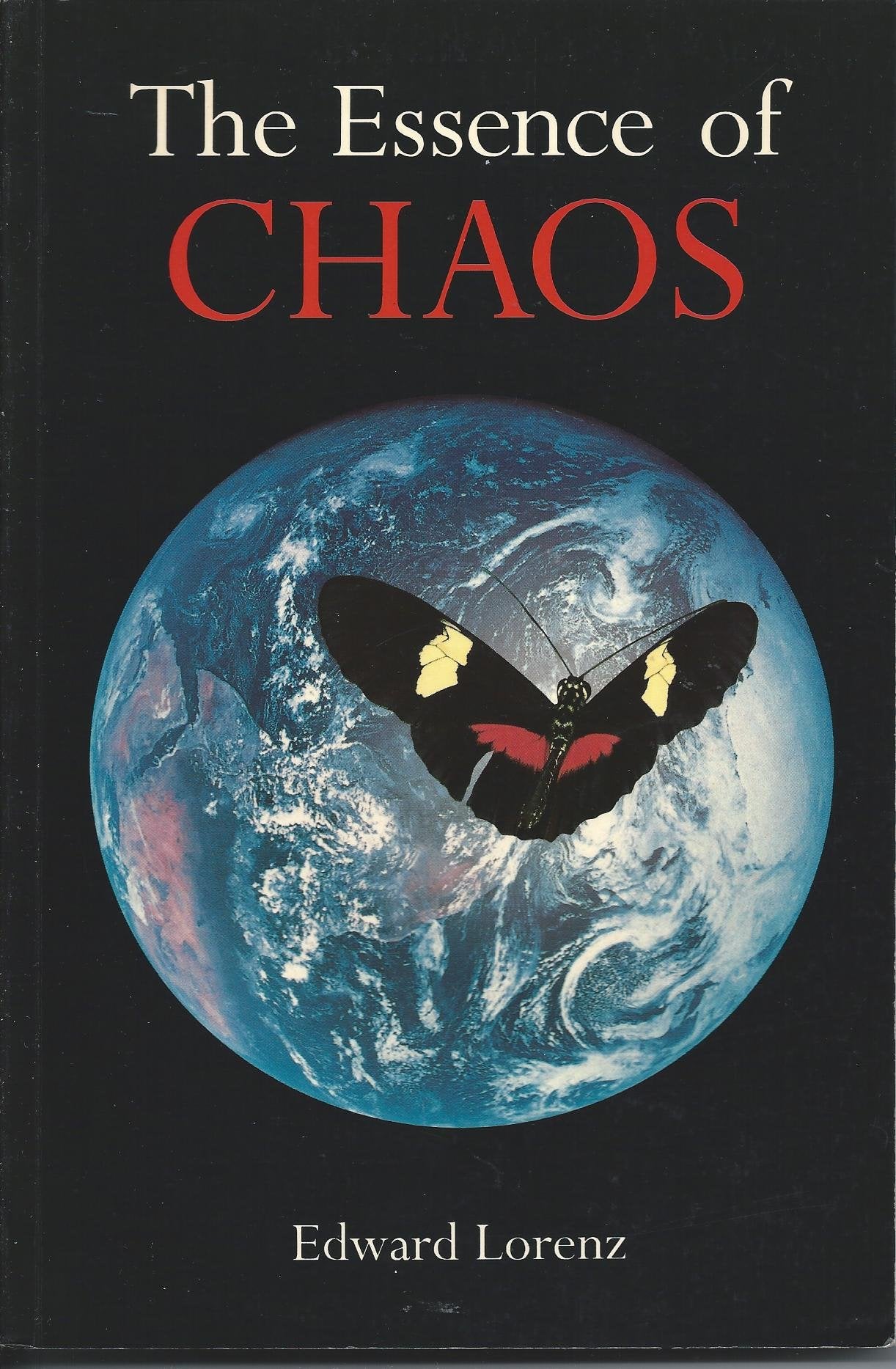
Title
The Essence of Chaos (Jessie and John Danz Lectures),New
Sold by Ergodebooks, an authorized reseller.
Returns accepted within 30 days | support@ergodebooks.com
Shipping Information
- Free Standard Shipping — United States only
- Processing Time: 3–5 business days
- Estimated Delivery: 6–10 business days after dispatch
- Double-boxed, fully insured & discreetly packaged
- Tracking number sent via email once dispatched
Returns & Refund
Returns accepted within 30 days of delivery.
Damaged or Defective Item
Free return shipping + replacement or full refund
Wrong Item Received
Free return shipping + replacement or full refund
Change of Mind
Return shipping at customer's expense · 25% restocking fee applies
Payment Option

Chaos surrounds us. Seemingly random events the flapping of a flag, a stormdriven wave striking the shore, a pinball's path often appear to have no order, no rational pattern. Explicating the theory of chaos and the consequences of its principal findings that actual, precise rules may govern such apparently random behavior has been a major part of the work of Edward N. Lorenz. In The Essence of Chaos, Lorenz presents to the general reader the features of this 'new science,' with its farreaching implications for much of modern life, from weather prediction to philosophy, and he describes its considerable impact on emerging scientific fields.Unlike the phenomena dealt with in relativity theory and quantum mechanics, systems that are now described as 'chaotic' can be observed without telescopes or microscopes. They range from the simplest happenings, such as the falling of a leaf, to the most complex processes, like the fluctuations of climate. Each process that qualifies, however, has certain quantifiable characteristics: how it unfolds depends very sensitively upon its present state, so that, even though it is not random, it seems to be. Lorenz uses examples from everyday life, and simple calculations, to show how the essential nature of chaotic systems can be understood. In order to expedite this task, he has constructed a mathematical model of a board sliding down a ski slope as his primary illustrative example. With this model as his base, he explains various chaotic phenomena, including some associated concepts such as strange attractors and bifurcations.As a meteorologist, Lorenz initially became interested in the field of chaos because of its implications for weather forecasting. In a chapter ranging through the history of weather prediction and meteorology to a brief picture of our current understanding of climate, he introduces many of the researchers who conceived the experiments and theories, and he describes his own initial encounter with chaos.A further discussion invites readers to make their own chaos. Still others debate the nature of randomness and its relationship to chaotic systems, and describe three related fields of scientific thought: nonlinearity, complexity, and fractality. Appendixes present the first publication of Lorenz's seminal paper 'Does the Flap of a Butterfly's Wing in Brazil Set Off a Tornado in Texas?'; the mathematical equations from which the copious illustrations were derived; and a glossary.
⚠️ WARNING (California Proposition 65):
This product may contain chemicals known to the State of California to cause cancer, birth defects, or other reproductive harm.
For more information, please visit www.P65Warnings.ca.gov.
- Q: What is 'The Essence of Chaos' about? A: 'The Essence of Chaos' by Edward N. Lorenz explores the theory of chaos, explaining how seemingly random events have underlying patterns governed by precise rules. It discusses implications for various fields, including weather prediction and philosophy.
- Q: Who is the author of 'The Essence of Chaos'? A: The author of 'The Essence of Chaos' is Edward N. Lorenz, a renowned meteorologist who significantly contributed to the field of chaos theory.
- Q: What can I learn from this book? A: Readers will learn about the characteristics of chaotic systems, how they differ from random occurrences, and the mathematical models that describe their behavior, including concepts like strange attractors and bifurcations.
- Q: Is this book suitable for beginners? A: 'The Essence of Chaos' is written for a general audience, making it accessible to beginners interested in understanding chaos theory without requiring advanced mathematical knowledge.
- Q: How many pages does 'The Essence of Chaos' have? A: 'The Essence of Chaos' contains 240 pages, providing a comprehensive overview of chaos theory and its applications.
- Q: What is the binding type of this book? A: 'The Essence of Chaos' is available in paperback binding, making it durable and easy to handle.
- Q: When was 'The Essence of Chaos' published? A: 'The Essence of Chaos' was published on October 1, 1995.
- Q: Does the book include any illustrations or models? A: Yes, 'The Essence of Chaos' includes illustrations and mathematical models that help explain the concepts discussed in the book, enhancing reader understanding.
- Q: Are there any appendices in the book? A: Yes, the book features appendices that include Lorenz's seminal paper on chaos, mathematical equations, and a glossary of terms related to chaos theory.
- Q: What category does this book fall under? A: 'The Essence of Chaos' is categorized under Climatology, highlighting its relevance to weather forecasting and environmental sciences.