
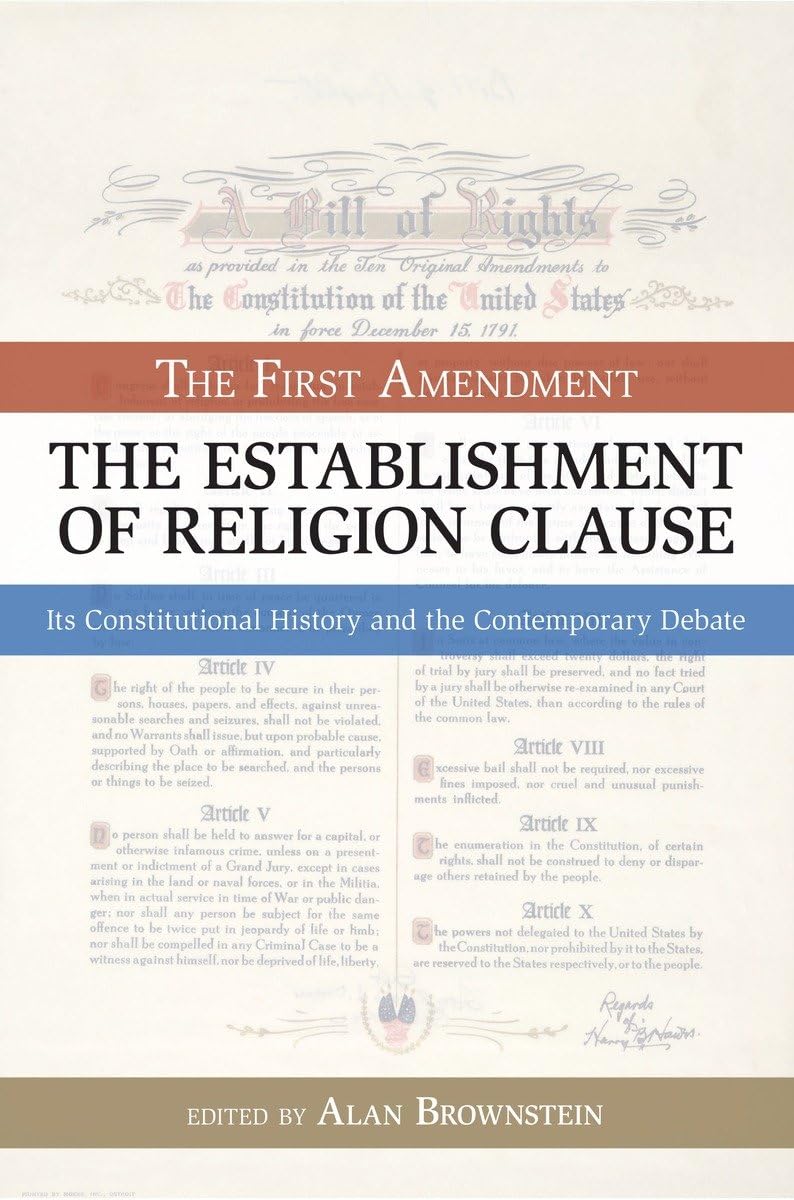
Title
The Establishment of Religion Clause: The First Amendment (Bill of Rights Series),Used
Sold by Ergodebooks, an authorized reseller.
Returns accepted within 30 days | support@ergodebooks.com
Shipping Information
- Free Standard Shipping — United States only
- Processing Time: 3–5 business days
- Estimated Delivery: 6–10 business days after dispatch
- Double-boxed, fully insured & discreetly packaged
- Tracking number sent via email once dispatched
Returns & Refund
Returns accepted within 30 days of delivery.
Damaged or Defective Item
Free return shipping + replacement or full refund
Wrong Item Received
Free return shipping + replacement or full refund
Change of Mind
Return shipping at customer's expense · 25% restocking fee applies
Payment Option

Unlike many areas of constitutional law, there is very little settled doctrine interpreting the Establishment Clause. Not only is the case law in flux and inconsistent, but scholars disagree on virtually every issue addressed in legal commentary. Put simply, there is no consensus on what the Establishment Clause means. Because this is such a contested area of constitutional law, most books addressing the Establishment Clause present a particular point of view, theory of interpretation, or doctrinal approach. Editor Alan Brownstein adopts a different approach in this excellent anthology of essays on this important clause of the First Amendment. Recognizing the range and depth of intellectual tension that underlies this constitutional mandate, Brownstein addresses both the historical debate surrounding the original understanding of this constitutional provision as well as current controversies regarding its interpretation and application by the courts. The reader will thus find a balanced account of the competing perspectives on core questions.The book is organized around three central areas. First, several articles provide divergent accounts of the history of the Establishment Clause from preConstitutional colonial America to the adoption of the Fourteenth Amendment. Second, various perspectives are presented on government endorsement of religious messages, typically through state sponsored religious displays (such as a Christmas crche) or state directed prayer. Third, a range of viewpoints addresses the issue of government funding of religious institutions providing educational or social services, either through indirect aid (vouchers) or direct grants. An introduction to each section provides a concise overview of the development of the case law so that readers will be familiar with key rulings and legal tests the courts have employed. With a focus on broad themes and core ideas, this excellent collection of articles will be of great use to both undergraduate and law students (and their professors), as well as lay readers interested in the history of the Constitution, Establishment Clause, and current debates surrounding its interpretation.
⚠️ WARNING (California Proposition 65):
This product may contain chemicals known to the State of California to cause cancer, birth defects, or other reproductive harm.
For more information, please visit www.P65Warnings.ca.gov.