
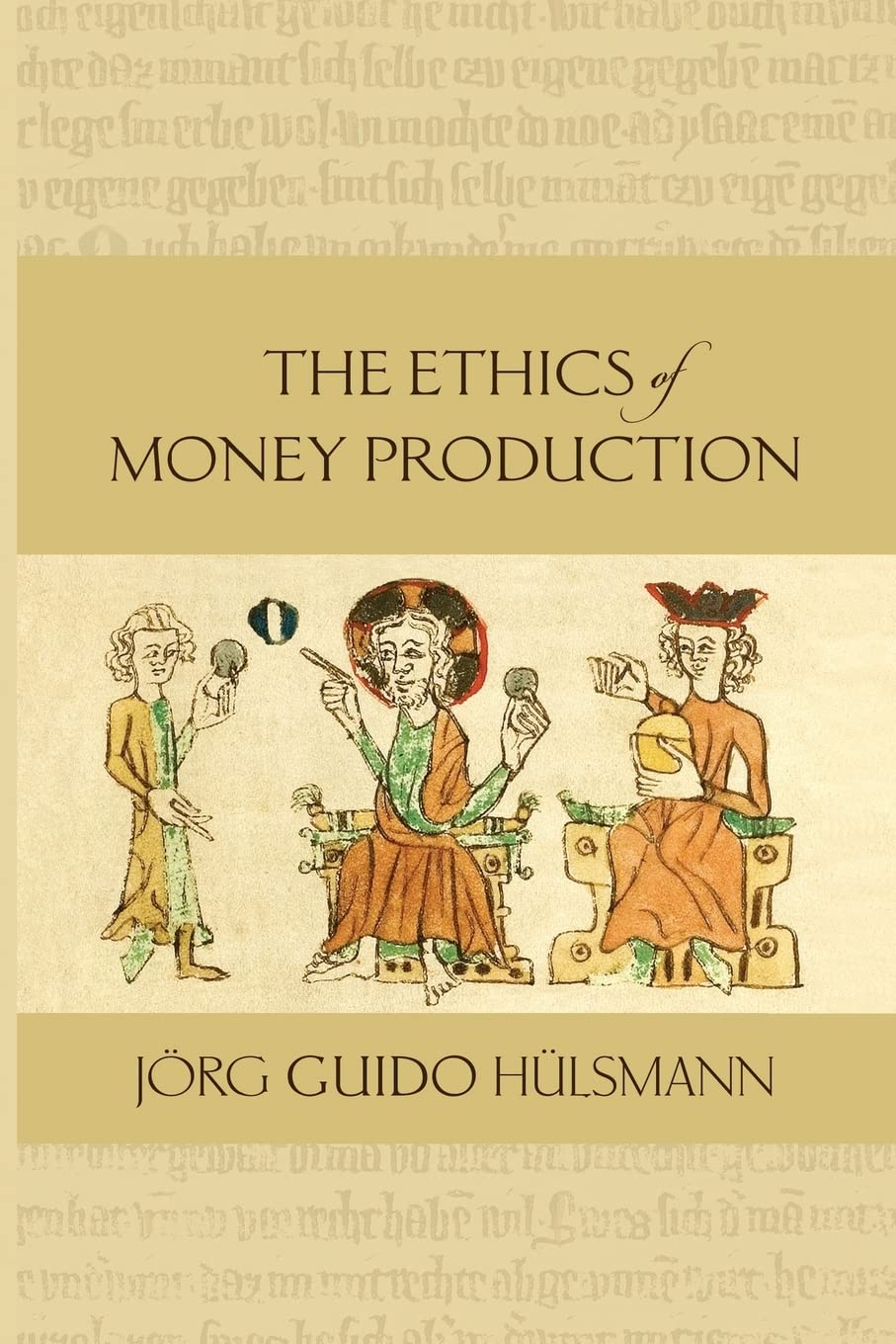
Title
The Ethics Of Money Production
Sold by Ergodebooks, an authorized reseller.
Returns accepted within 30 days | support@ergodebooks.com
Shipping Information
- Free Standard Shipping — United States only
- Processing Time: 3–5 business days
- Estimated Delivery: 6–10 business days after dispatch
- Double-boxed, fully insured & discreetly packaged
- Tracking number sent via email once dispatched
Returns & Refund
Returns accepted within 30 days of delivery.
Damaged or Defective Item
Free return shipping + replacement or full refund
Wrong Item Received
Free return shipping + replacement or full refund
Change of Mind
Return shipping at customer's expense · 25% restocking fee applies
Payment Option

This Pioneering Work, In Hardback, By Jrg Guido Hlsmann, Professor Of Economics At The University Of Angers In France And The Author Of Mises: The Last Knight Of Liberalism, Is The First Full Study Of A Critically Important Issue Today: The Ethics Of Money Production.There Is A Reason That This Book Has Been Translated To Chinese, German, Spanish, Czech, And There Are Many More On The Way. This Book Hits The Intellectual Sweet Spot, Speaking To The Issues That Are Driving Economic Events Right Now. We Must Deal With The Money Problem In A Principled Way, Else We Never Get Back On The Course Of Sustainable Prosperity.By Money Production, The Author Is Speaking Not In The Colloquial Sense Of The Phrase Making Money, But Rather The Actual Production Of Money As A Commodity In The Whole Economic Life. The Choice Of The Money We Use In Exchange Is Not Something That Needs To Be Established And Fixed By Government.In Fact, His Thesis Is That A Government Monopoly On Money Production And Management Has No Ethical Or Economic Grounding At All. Legal Tender Laws, Bailout Guarantees, Taxbacked Deposit Insurance, And The Entire Apparatus That Sustains National Monetary Systems, Has Been Wholly Unjustified. Money, He Argues, Should Be A Privately Produced Good Like Any Other, Such As Clothing Or Food.In Arguing This Way, He Is Disputing Centuries Of Assumptions About Money For Which An Argument Is Rarely Offered. People Just Assume That Government Or Central Banks Operating Under Government Control Should Manage Money. Hulsmann Explores Monetary Thought From The Ancient World Through The Middle Ages To Modern Times To Show That The Monopolists Are Wrong. There Is A Strong Case In Both Economic And Ethical Terms For The Idea That Money Production Should Be Wholly Private.He Takes On The Stabilization Advocates To Show That Government Management Doesn'T Lead To Stability But To Inflation And Instability. He Goes Further To Argue Against Even The Theoretical Case For Stabilization, To Say That Money'S Value Should Be Governed By The Market, And That The Costs Associated With Private Production Are Actually An Advantage. He Chronicles The Decline Of Money Once Nationalized, From Legally Sanctioned Counterfeiting To The Creation Of Paper Money All The Way To Hyperinflation.In His Normative Analysis, The Author Depends Heavily On The Monetary Writings Of 14Thcentury Bishop Nicole Oresme, Whose Monetary Writings Have Been Overlooked Even By Historians Of Economic Thought. He Makes A Strong Case That Paper Money Has Never Been Introduced Through Voluntary Cooperation. In All Known Cases It Has Been Introduced Through Coercion And Compulsion, Sometimes With The Threat Of The Death Penalty. . . . Paper Money By Its Very Nature Involves The Violation Of Property Rights Through Monopoly And Legaltender Privileges.The Book Is Also Eerily Prophetic Of Our Times:Consider The Current U.S. Realestate Boom. Many Americans Are Utterly Convinced That American Real Estate Is The One Sure Bet In Economic Life. No Matter What Happens On The Stock Market Or In Other Strata Of The Economy, Real Estate Will Rise. They Believe Themselves To Have Found A Bonanza, And The Historical Figures Confirm This. Of Course This Belief Is An Illusion, But The Characteristic Feature Of A Boom Is Precisely That People Throw Any Critical Considerations Overboard. They Do Not Realize That Their Money Producerthe Fedhas Possibly Already Entered The Early Stages Of Hyperinflation, And That The Only Reason Why This Has Been Largely Invisible Was That Most Of The New Money Has Been Exported Outside Of The U.S . . . Because A Papermoney Producer Can Bail Out Virtually Anybody, The Citizens Become Reckless In Their Speculations; They Count On Him To Bail Them Out, Especially When Many Other People Do The Same Thing. To Fight Such Behavior Effectively, One Must Abolish Paper Money. Regulations Merely Drive The Reckless Behavior Into New Channels.
⚠️ WARNING (California Proposition 65):
This product may contain chemicals known to the State of California to cause cancer, birth defects, or other reproductive harm.
For more information, please visit www.P65Warnings.ca.gov.
- Q: How many pages does The Ethics of Money Production have? A: This book has two hundred ninety-two pages. It provides a comprehensive exploration of the ethics surrounding money production.
- Q: What is the binding type of this book? A: The binding type is paperback. This makes it flexible and easier to handle for reading.
- Q: Who is the author of The Ethics of Money Production? A: The author is Jörg Guido Hülsmann. He is a professor of economics at the University of Angers in France.
- Q: What is the main topic covered in this book? A: The main topic is the ethics of money production. It critically examines the implications of government control over money.
- Q: Is The Ethics of Money Production suitable for beginners? A: Yes, it is suitable for beginners. The book addresses complex economic ideas in a way that is accessible to general readers.
- Q: What age group is The Ethics of Money Production appropriate for? A: The book is appropriate for adults and older teens. It discusses intricate economic theories that require a mature understanding.
- Q: How should I store The Ethics of Money Production? A: Store the book in a dry and cool place. Keeping it upright on a shelf will help maintain its condition.
- Q: Can I read The Ethics of Money Production in one sitting? A: Yes, you can read it in one sitting if you have enough time. However, it may be beneficial to break it into sections for deeper understanding.
- Q: What should I do if The Ethics of Money Production arrives damaged? A: If the book arrives damaged, you should contact the seller for a return or replacement. Make sure to have your order details ready.
- Q: Does this book have any illustrations or images? A: No, The Ethics of Money Production does not contain illustrations or images. It focuses on text to convey its arguments.
- Q: What makes The Ethics of Money Production unique? A: The book uniquely critiques government monopoly on money production. It challenges widely held assumptions about monetary systems.
- Q: Is there a bibliography or references in The Ethics of Money Production? A: Yes, the book includes references. This allows readers to explore the sources of the author's arguments.
- Q: How does The Ethics of Money Production compare to other economics books? A: This book is more focused on ethical implications compared to traditional economics texts. It provides a distinct perspective on monetary policy.
- Q: Are there any notable quotes from The Ethics of Money Production? A: Yes, the book contains several notable quotes that emphasize its core arguments. Readers often find them thought-provoking.
- Q: What is the ISBN for The Ethics of Money Production? A: The ISBN is typically found on the book's copyright page. It is essential for identifying and ordering the book.
- Q: Does The Ethics of Money Production include a glossary or index? A: No, it does not include a glossary or index. Readers should be aware that terminology may need further research.