
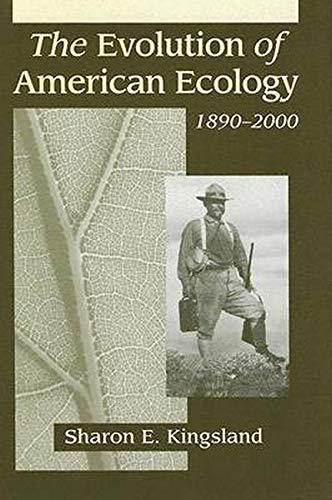
Title
The Evolution Of American Ecology, 18902000
Sold by Ergodebooks, an authorized reseller.
Returns accepted within 30 days | support@ergodebooks.com
Shipping Information
- Free Standard Shipping — United States only
- Processing Time: 3–5 business days
- Estimated Delivery: 6–10 business days after dispatch
- Double-boxed, fully insured & discreetly packaged
- Tracking number sent via email once dispatched
Returns & Refund
Returns accepted within 30 days of delivery.
Damaged or Defective Item
Free return shipping + replacement or full refund
Wrong Item Received
Free return shipping + replacement or full refund
Change of Mind
Return shipping at customer's expense · 25% restocking fee applies
Payment Option

In The 1890S, Several Initiatives In American Botany Converged. The Creation Of New Institutions, Such As The New York Botanical Garden, Coincided With Radical Reforms In Taxonomic Practice And The Emergence Of An Experimental Program Of Research On Evolutionary Problems. Sharon Kingsland Explores How These Changes Gave Impetus To The New Field Of Ecology That Was Defined At Exactly This Time. She Argues That The Creation Of Institutions And Research Laboratories, Coupled With New Intellectual Directions In Science, Were Crucial To The Development Of Ecology As A Discipline In The United States.The Main Concern Of Ecologythe Relationship Between Organisms And Environmentwas Central To Scientific Studies Aimed At Understanding And Controlling The Evolutionary Process. Kingsland Considers The Evolutionary Context In Which Ecology Arose, Especially Neolamarckian Ideas And The New Mutation Theory, And Explores The Relationship Between Scientific Research And Broader Theories About Social Progress And The Evolution Of Human Civilization.By Midcentury, American Ecologists Were Leading The Rapid Development Of Ecosystem Ecology. At The Same Time, Scientists Articulated A Sharp Critique Of Modern Science And Society In The Postwar Context, Foreshadowing The Environmental Critiques Of The 1960S. As The Ecosystem Concept Evolved, So Too Did Debates About How Human Ecology Should Be Incorporated Into The Biological Sciences. Kingsland Concludes With An Examination Of Ecology In The Modern Urban Environment, Reflecting On How Scientists Are Now Being Challenged To Overcome Disciplinary Constraints And Produce Innovative Responses To Pressing Problems.The Evolution Of American Ecology, 18902000 Offers An Innovative Study Not Only Of The Scientific Landscape In Turnofthecentury America, But Of Current Questions In Ecological Science.
⚠️ WARNING (California Proposition 65):
This product may contain chemicals known to the State of California to cause cancer, birth defects, or other reproductive harm.
For more information, please visit www.P65Warnings.ca.gov.
- Q: What is the page count of 'The Evolution of American Ecology, 1890–2000'? A: The book contains three hundred twenty-eight pages. This length allows for an in-depth exploration of the subject matter.
- Q: What are the dimensions of this book? A: The book measures six inches in length, one point one inches in width, and nine point zero two inches in height. These dimensions make it a suitable size for both reading and display.
- Q: What type of binding does this book have? A: The book is bound in hardcover. This type of binding adds durability and a professional appearance.
- Q: Who is the author of this book? A: The author is Sharon E. Kingsland. She is known for her contributions to the field of ecology and its history.
- Q: What is the focus of this book? A: The book focuses on the evolution of ecology in America from eighteen ninety to two thousand. It explores the relationship between organisms and their environment.
- Q: Is this book suitable for beginners in ecology? A: Yes, the book is suitable for beginners. It provides a comprehensive overview of the development of ecology as a discipline.
- Q: What themes does the book cover? A: The book covers themes such as the relationship between organisms and their environment, the history of ecological research, and critiques of modern science. It contextualizes ecology within broader societal issues.
- Q: Can I use this book for academic purposes? A: Yes, this book is suitable for academic use. It offers insights and historical context valuable for students and researchers in ecology.
- Q: How should I store this book to keep it in good condition? A: Store the book in a cool, dry place away from direct sunlight. Keeping it upright on a shelf will help prevent damage to the spine.
- Q: What are the care instructions for this book? A: To care for this book, avoid exposing it to moisture and handle it with clean hands. Dust the cover gently with a soft cloth.
- Q: What if the book arrives damaged? A: If the book arrives damaged, contact the retailer for a return or exchange. Most retailers have policies to address such issues.
- Q: What is the return policy for this book? A: The return policy typically allows returns within thirty days of purchase. Check with the retailer for specific details.
- Q: Is this book available in other formats? A: No, this book is only available in hardcover format. This choice emphasizes its durability and aesthetic appeal.
- Q: How does this book compare to other ecology books? A: This book uniquely combines historical context with scientific analysis, making it stand out among other ecology texts. It provides a thorough examination of American ecology's evolution.
- Q: Who would benefit from reading this book? A: Students, educators, and anyone interested in ecology and its history would benefit from this book. It offers valuable insights into ecological science.
- Q: Is this book appropriate for children? A: No, this book is not specifically targeted at children. It covers complex themes that are more suitable for an adult audience.