
Title
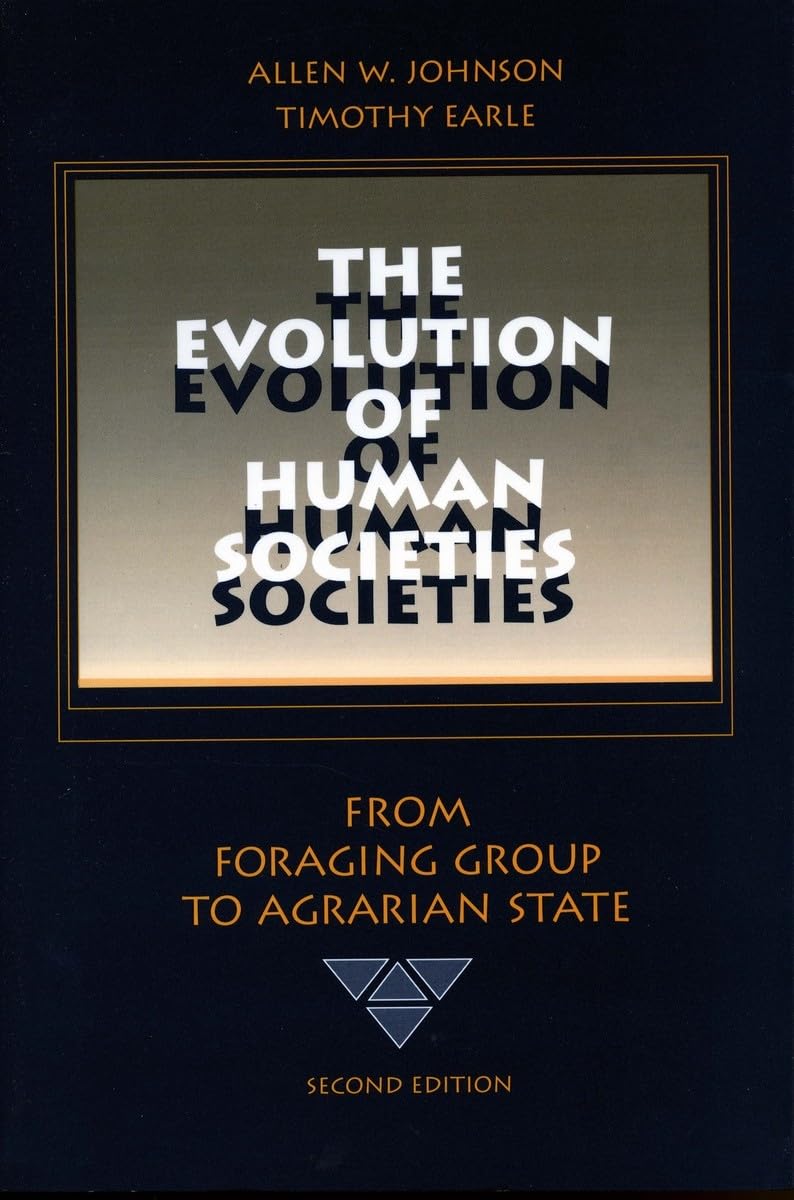
The Evolution of Human Societies: From Foraging Group to Agrarian State, Second Edition,Used
Sold by Ergodebooks, an authorized reseller.
Returns accepted within 30 days | support@ergodebooks.com
Shipping Information
- Free Standard Shipping — United States only
- Processing Time: 3–5 business days
- Estimated Delivery: 6–10 business days after dispatch
- Double-boxed, fully insured & discreetly packaged
- Tracking number sent via email once dispatched
Returns & Refund
Returns accepted within 30 days of delivery.
Damaged or Defective Item
Free return shipping + replacement or full refund
Wrong Item Received
Free return shipping + replacement or full refund
Change of Mind
Return shipping at customer's expense · 25% restocking fee applies
Payment Option

By combining an original thesis and a representative body of ethnographic data, this ambitious work seeks to describe and explain the growth in complexity of human societies.Its emphasis is on the causes, mechanisms, and patterns of cultural evolution, which the authors explain in terms of a coherent theory of political economydefined as the mobilization and exchange of goods and services between families. The authors show that the interconnected processes of technological change and population growth are the motor of social change, resulting in three related processesintensification, integration, and stratificationthat transform human societies over time. The validity of their theory rests on evidence drawn from 19 case studies that range widely over time and space.For this new edition, the authors have thoroughly rewritten the theoretical argument for greater clarity, updated the case materials to incorporate new research, and added a new chapter that applies their theoretical perspective to the problems of change since the industrial revolution and the globalization of trade and political influence.Reviews of the First Edition'In a book full of perceptive observations and persuasive arguments . . . Johnson and Earle show in masterly detail how societies articulate to their environments and . . . how they evolve.'Ethnohistory'A major contribution. . . . The book is a marvelous synthesis of ethnographic and historical data.'American Journal of Sociology'A large amount of research and thought has produced sensible and illuminating specific analyses of the mechanisms of evolutionary change. Another plus is that the writing is clear and the argument is neatly conceived.'American Anthropologist
⚠️ WARNING (California Proposition 65):
This product may contain chemicals known to the State of California to cause cancer, birth defects, or other reproductive harm.
For more information, please visit www.P65Warnings.ca.gov.
- Q: What is the main thesis of 'The Evolution of Human Societies'? A: The main thesis of the book is to describe and explain the growth in complexity of human societies through the lens of political economy, emphasizing the causes and mechanisms of cultural evolution.
- Q: Who are the authors of this book? A: The book is authored by Allen Johnson and Timothy Earle.
- Q: What key topics are covered in the second edition of this book? A: The second edition covers the interconnected processes of technological change and population growth, and how they drive social change, including intensification, integration, and stratification.
- Q: How many case studies are included in the book? A: The book includes 19 case studies that provide evidence for the authors' theories on societal evolution.
- Q: What is the publication date of the second edition? A: The second edition was published on December 1, 2000.
- Q: Is this book suitable for academic use? A: Yes, this book is suitable for academic use, particularly in fields related to anthropology, sociology, and social sciences.
- Q: What is the condition of the book being sold? A: The book is listed as a 'Used Book in Good Condition'.
- Q: Can this book provide insights on modern globalization? A: Yes, the new chapter in the second edition applies the authors' theoretical perspective to the problems of change since the industrial revolution and globalization.
- Q: What type of binding does this book have? A: The book is available in paperback binding.
- Q: How many pages does the book contain? A: The book contains 454 pages.