
Title
The Exact Sciences In Antiquity,Used
Sold by Ergodebooks, an authorized reseller.
Returns accepted within 30 days | support@ergodebooks.com
Shipping Information
- Free Standard Shipping — United States only
- Processing Time: 3–5 business days
- Estimated Delivery: 6–10 business days after dispatch
- Double-boxed, fully insured & discreetly packaged
- Tracking number sent via email once dispatched
Returns & Refund
Returns accepted within 30 days of delivery.
Damaged or Defective Item
Free return shipping + replacement or full refund
Wrong Item Received
Free return shipping + replacement or full refund
Change of Mind
Return shipping at customer's expense · 25% restocking fee applies
Payment Option

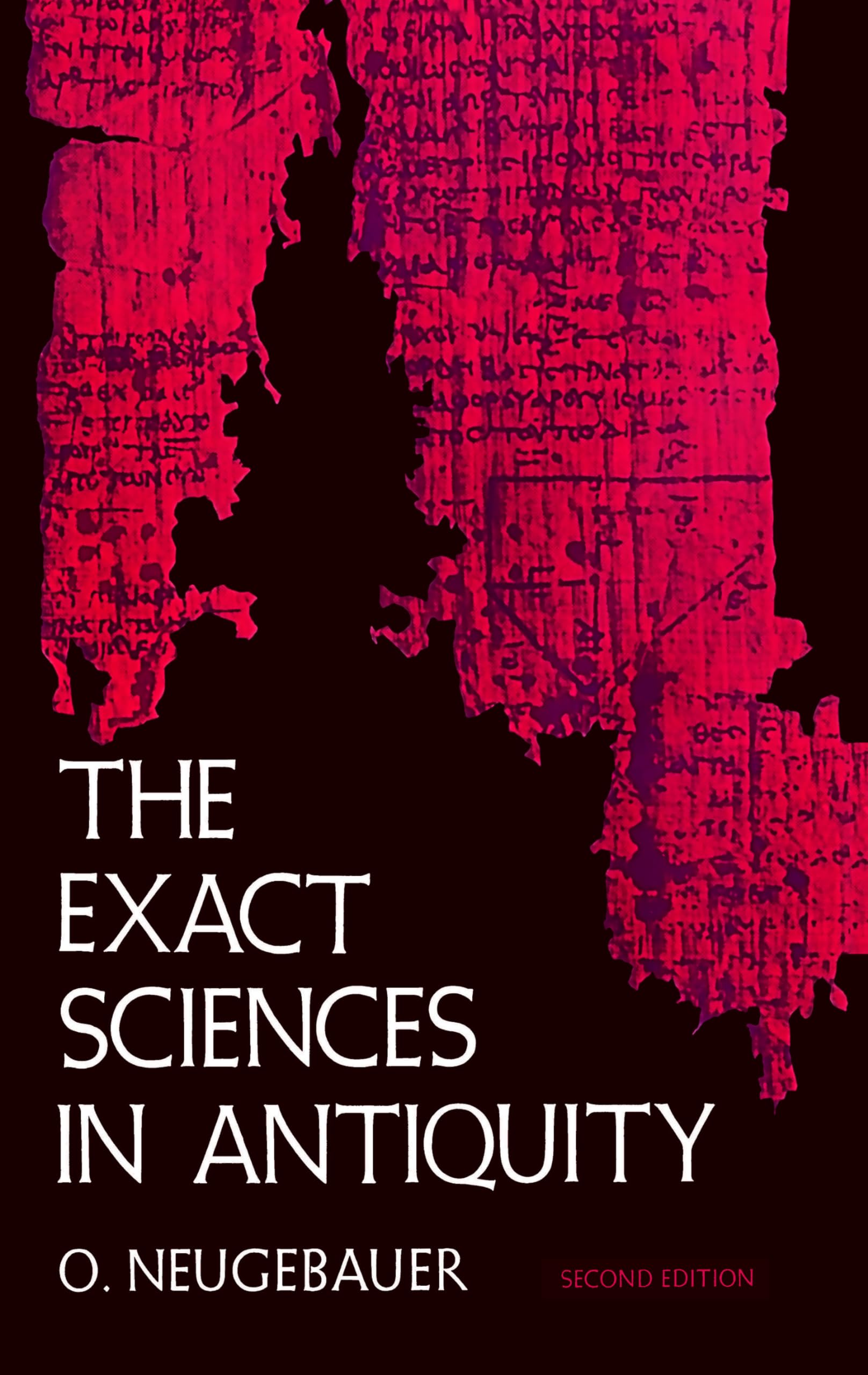
Based On A Series Of Lectures Delivered At Cornell University In The Fall Of 1949, And Since Revised, This Is The Standard Nontechnical Coverage Of Egyptian And Babylonian Mathematics And Astronomy, And Their Transmission To The Hellenistic World. Entirely Modern In Its Data And Conclusions, It Reveals The Surprising Sophistication Of Certain Areas Of Early Science, Particularly Babylonian Mathematics.After A Discussion Of The Number Systems Used In The Ancient Near East (Contrasting The Egyptian Method Of Additive Computations With Unit Fractions And Babylonian Place Values), Dr. Neugebauer Covers Babylonian Tables For Numerical Computation, Approximations Of The Square Root Of 2 (With Implications That The Pythagorean Theorem Was Known More Than A Thousand Years Before Pythagoras), Pythagorean Numbers, Quadratic Equations With Two Unknowns, Special Cases Of Logarithms And Various Other Algebraic And Geometric Cases. Babylonian Strength In Algebraic And Numerical Work Reveals A Level Of Mathematical Development In Many Aspects Comparable To The Mathematics Of The Early Renaissance In Europe. This Is In Contrast To The Relatively Primitive Egyptian Mathematics. In The Realm Of Astronomy, Too, Dr. Neugebauer Describes An Unexpected Sophistication, Which Is Interpreted Less As The Result Of Millennia Of Observations (As Used To Be The Interpretation) Than As A Competent Mathematical Apparatus. The Transmission Of This Early Science And Its Further Development In Hellenistic Times Is Also Described. An Appendix Discusses Certain Aspects Of Greek Astronomy And The Indebtedness Of The Copernican System To Ptolemaic And Islamic Methods.Dr. Neugebauer Has Long Enjoyed An International Reputation As One Of The Foremost Workers In The Area Of Premodern Science. Many Of His Discoveries Have Revolutionized Earlier Understandings. In This Volume He Presents A Nontechnical Survey, With Much Material Unique On This Level, Which Can Be Read With Great Profit By All Interested In The History Of Science Or History Of Culture.
⚠️ WARNING (California Proposition 65):
This product may contain chemicals known to the State of California to cause cancer, birth defects, or other reproductive harm.
For more information, please visit www.P65Warnings.ca.gov.
- Q: What is the page count of 'The Exact Sciences in Antiquity'? A: The book has two hundred eighty-eight pages. It provides an in-depth exploration of ancient mathematics and astronomy.
- Q: What are the dimensions of this book? A: The book measures five point four three inches in length, zero point five five inches in width, and eight point four six inches in height. These dimensions make it a compact and portable read.
- Q: What type of binding does the book have? A: This book features a paperback binding. Paperback editions are typically lightweight and flexible, making them easy to handle.
- Q: How do I read 'The Exact Sciences in Antiquity'? A: You can read this book like any traditional printed book. It is designed for individuals interested in the history of science and can be enjoyed by readers of various backgrounds.
- Q: Is this book suitable for beginners? A: Yes, it is suitable for beginners. The author presents complex topics in a non-technical manner, making it accessible to readers without a strong background in science.
- Q: What age group is this book appropriate for? A: This book is appropriate for teenagers and adults. It covers historical concepts that may interest older students and adults alike.
- Q: How should I care for this paperback book? A: To keep the book in good condition, store it in a dry place, away from direct sunlight. Avoid bending the cover or pages to prevent damage.
- Q: Can I clean the book if it gets dirty? A: Yes, you can clean the book gently. Use a soft, dry cloth to wipe away any dust or smudges on the cover.
- Q: Does this book contain any adult content? A: No, this book does not contain adult content. It is focused on historical and scientific discussions that are suitable for a general audience.
- Q: How does this book compare to others in its genre? A: This book offers a unique non-technical perspective on ancient sciences, unlike many other texts that focus heavily on technical details. It is particularly noted for its clarity and accessibility.
- Q: Is this book a good choice for someone interested in mathematics? A: Yes, it is a great choice for those interested in mathematics. It explores ancient mathematical concepts and their development, making it fascinating for math enthusiasts.
- Q: What if the book arrives damaged? A: If the book arrives damaged, you should contact the retailer for a return or replacement. Most sellers have policies in place for such situations.
- Q: Is there a warranty on this book? A: No, books typically do not come with a warranty. However, check with your retailer for their return policy.
- Q: What should I do if I have issues with my order? A: If you have issues with your order, reach out to the customer service of the retailer you purchased from for assistance.
- Q: Can I share this book with others? A: Yes, you can share this book with others. It is a great resource for anyone interested in the history of science.