
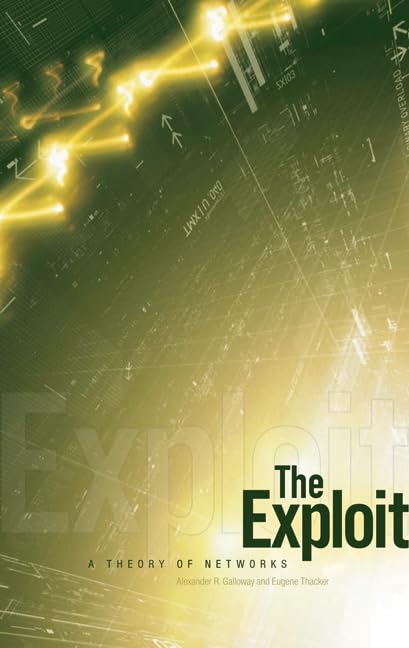
Title
The Exploit: A Theory Of Networks (Volume 21) (Electronic Mediations),New
Sold by Ergodebooks, an authorized reseller.
Returns accepted within 30 days | support@ergodebooks.com
Shipping Information
- Free Standard Shipping — United States only
- Processing Time: 3–5 business days
- Estimated Delivery: 6–10 business days after dispatch
- Double-boxed, fully insured & discreetly packaged
- Tracking number sent via email once dispatched
Returns & Refund
Returns accepted within 30 days of delivery.
Damaged or Defective Item
Free return shipping + replacement or full refund
Wrong Item Received
Free return shipping + replacement or full refund
Change of Mind
Return shipping at customer's expense · 25% restocking fee applies
Payment Option

The Exploit is that rare thing: a book with a clear grasp of how networks operate that also understands the political implications of this emerging form of power. It cuts through the nonsense about how 'free' and 'democratic' networks supposedly are, and it offers a rich analysis of how network protocols create a new kind of control. Essential reading for all theorists, artists, activists, techheads, and hackers of the Net.' McKenzie Wark, author of A Hacker ManifestoThe network has become the core organizational structure for postmodern politics, culture, and life, replacing the modern era's hierarchical systems. From peertopeer file sharing and massive multiplayer online games to contagion vectors of digital or biological viruses and global affiliations of terrorist organizations, the network form has become so invasive that nearly every aspect of contemporary society can be located within it.Borrowing their title from the hacker term for a program that takes advantage of a flaw in a network system, Alexander R. Galloway and Eugene Thacker challenge the widespread assumption that networks are inherently egalitarian. Instead, they contend that there exist new modes of control entirely native to networks, modes that are at once highly centralized and dispersed, corporate and subversive.In this provocative booklength essay, Galloway and Thacker argue that a whole new topology must be invented to resist and reshape the network form, one that is as asymmetrical in relationship to networks as the network is in relation to hierarchy.Alexander R. Galloway is professor of culture and communications at New York University and the author of Gaming: Essays on Algorithmic Culture (Minnesota, 2006) and Protocol: How Control Exists after Decentralization.Eugene Thacker is professor at The New School and the author of Biomedia (Minnesota, 2004) and In the Dust of This Planet.
⚠️ WARNING (California Proposition 65):
This product may contain chemicals known to the State of California to cause cancer, birth defects, or other reproductive harm.
For more information, please visit www.P65Warnings.ca.gov.