
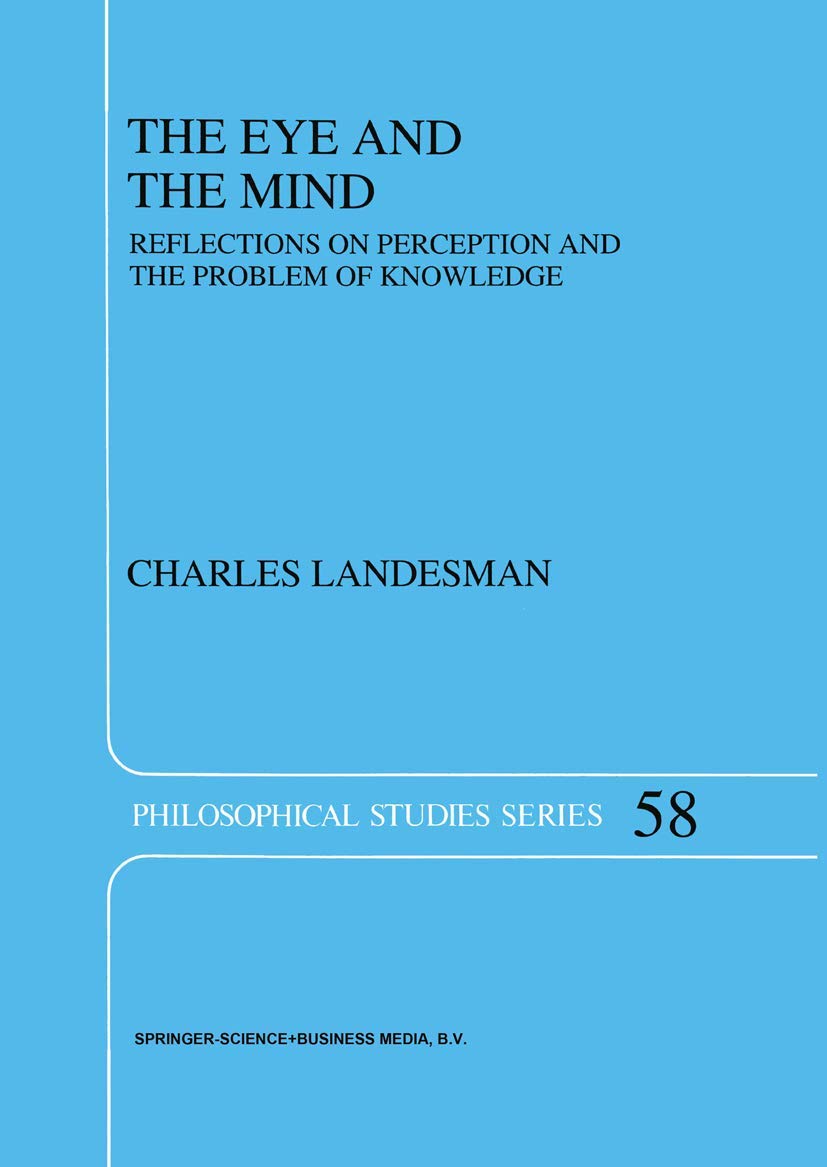
Title
The Eye and the Mind: Reflections on Perception and the Problem of Knowledge (Philosophical Studies Series, 58),Used
Sold by Ergodebooks, an authorized reseller.
Returns accepted within 30 days | support@ergodebooks.com
Shipping Information
- Free Standard Shipping — United States only
- Processing Time: 3–5 business days
- Estimated Delivery: 6–10 business days after dispatch
- Double-boxed, fully insured & discreetly packaged
- Tracking number sent via email once dispatched
Returns & Refund
Returns accepted within 30 days of delivery.
Damaged or Defective Item
Free return shipping + replacement or full refund
Wrong Item Received
Free return shipping + replacement or full refund
Change of Mind
Return shipping at customer's expense · 25% restocking fee applies
Payment Option

This book is a discussion of some of the major philosophical problems centering around the topic of sense perception and the foundations of human knowledge. It begins with a characterization of our common sense understanding of the role of the senses in the acquisition of belief, and it argues that scientific accounts of the processes of perception undermine salient parts of this understanding. The naive point of view of direct realism cannot be sustained in the light of a scientifically instructed understanding of perception. This critique of direct realism points to the correctness of the representative theory of perception characteristic of such early modem philosophers as Descartes and Locke, and it also endorses the subjective tum that they defended. It argues that these positions do not require introducing sense data into the picture, and thus it avoids the intractable problems that the sense datum philosophy introduces. In addition, several versions of cognitive accounts of sense perception are criticized with the result that it is unnecessary to characterize sensory processes in intentional terms. The book then turns to a leading question introduced into modem philosophy by Descartes and Locke, the question of the accuracy of the information delivered by the senses to our faculty of belief. In particular, how accurate are our representations of the secondary qualities? The case of color is considered in detail.
⚠️ WARNING (California Proposition 65):
This product may contain chemicals known to the State of California to cause cancer, birth defects, or other reproductive harm.
For more information, please visit www.P65Warnings.ca.gov.