
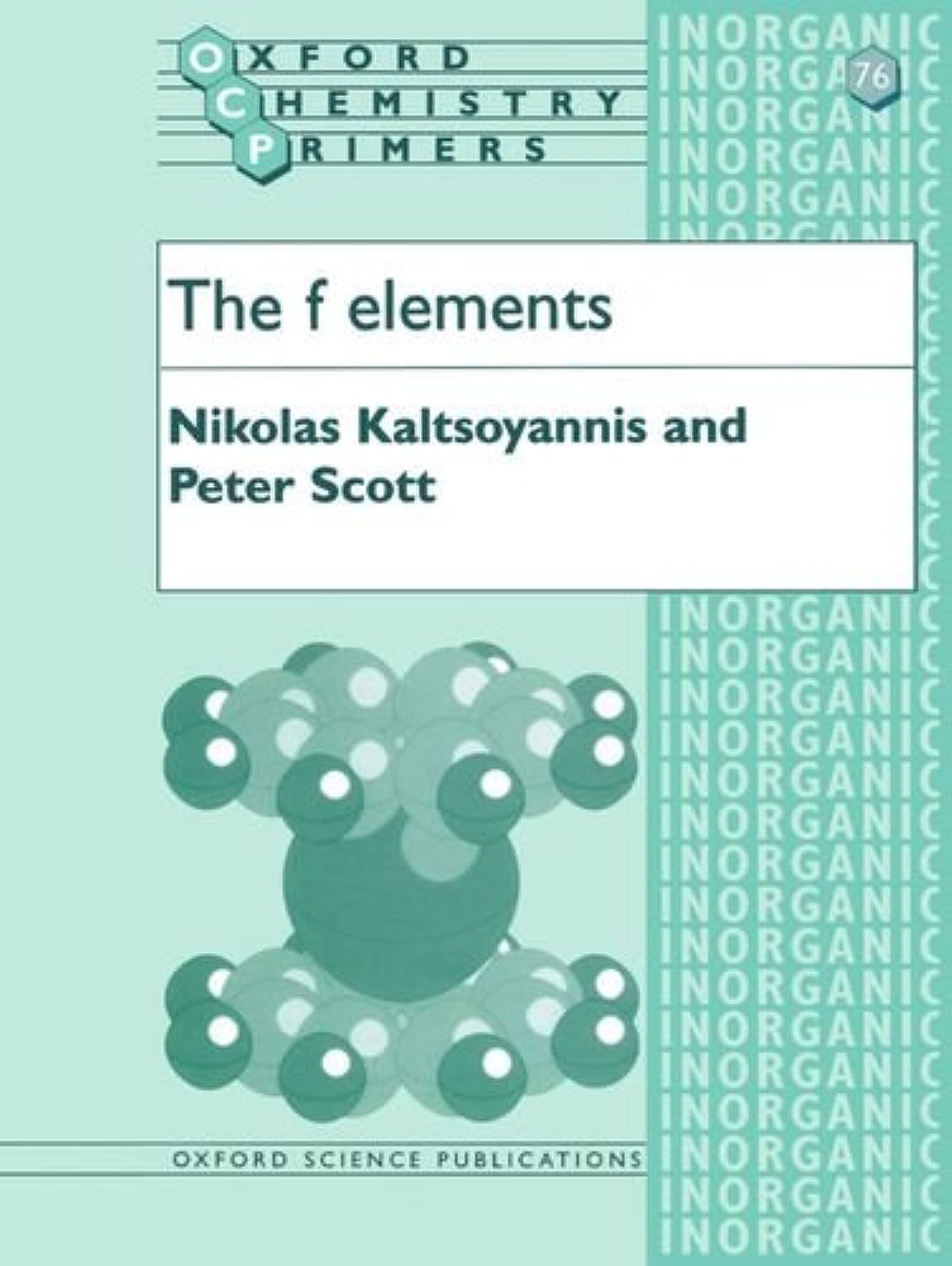
Title
The F Elements (Oxford Chemistry Primers),New
Sold by Ergodebooks, an authorized reseller.
Returns accepted within 30 days | support@ergodebooks.com
Shipping Information
- Free Standard Shipping — United States only
- Processing Time: 3–5 business days
- Estimated Delivery: 6–10 business days after dispatch
- Double-boxed, fully insured & discreetly packaged
- Tracking number sent via email once dispatched
Returns & Refund
Returns accepted within 30 days of delivery.
Damaged or Defective Item
Free return shipping + replacement or full refund
Wrong Item Received
Free return shipping + replacement or full refund
Change of Mind
Return shipping at customer's expense · 25% restocking fee applies
Payment Option

The Lanthanides And Actinides (The F Elements) Are Rarely Studied In Detail By Chemistry Undergraduates. More Often They Appear As An Afterthought In Bonding, Spectroscopy, Magnetism, Coordination Chemistry, And Organometallics Courses. This Is Largely Because Of A Lack Of An Accessible Text Treating The Chemistry Of These Elements In One Cover. Moreover, The Placement Of Lanthanides And Actinides In The Closing Pages Of Standard Inorganic Chemistry Text Books Serves To Marginalise These Elements Further. The F Elements Has Therefore Been Written To Fill A Gap In The Undergraduate Chemistry Textbook Market. It Covers Much Of The Fundamental Chemistry Of The Lanthanide And Actinide Elements, Including Coordination Chemistry, Solid State Compounds, Organometallic Chemistry, Electronic Spectroscopy, And Magnetism. Many Comparisons Are Made Between The Chemistry Of The Lanthanides And Actinides And That Of The Transition Elements, Which Is Generally Much More Familiar To Undergraduate Chemistry Students. The Book Uses The Chemistry Of The F Elements As A Vehicle For The Communication Of Several Important Chemical Concepts That Are Not Usually Discussed In Detail In Undergraduate Courses, For Example The Chemical Consequences Of Relativity And The Lanthanide And Actinide Contractions. Many Important Modern Applications Of F Element Chemistry, E.G. The Use Of Actinides In Nuclear Power Generation And Of The Lanthanides In Magnetic Resonance Imaging And Catalytic Converters In Motor Vehicle Exhausts, Are Also Discussed In Depth.
⚠️ WARNING (California Proposition 65):
This product may contain chemicals known to the State of California to cause cancer, birth defects, or other reproductive harm.
For more information, please visit www.P65Warnings.ca.gov.
- Q: What is the page count of The f Elements? A: The f Elements contains eighty-five pages. This compact size makes it a concise resource for understanding lanthanides and actinides.
- Q: What is the binding type of this book? A: The binding type is paperback. This makes it lightweight and easy to handle for students.
- Q: What are the dimensions of The f Elements? A: The dimensions are zero point four inches in depth, nine point five inches in width, and seven point three inches in height. These dimensions make it easy to store on a bookshelf.
- Q: Who is the author of The f Elements? A: The author is Nikolas Kaltsoyannis. He brings expertise in chemistry, particularly related to the f elements.
- Q: What category does this book fall under? A: This book falls under the Inorganic category. It focuses on the chemistry of lanthanides and actinides.
- Q: What topics are covered in The f Elements? A: The f Elements covers coordination chemistry, solid state compounds, and electronic spectroscopy. It provides a comprehensive overview of both lanthanides and actinides.
- Q: Is The f Elements suitable for undergraduate students? A: Yes, it is specifically designed for undergraduate chemistry students. The content aims to fill the knowledge gap regarding f elements.
- Q: How does The f Elements help in understanding complex concepts? A: The book uses the chemistry of f elements to explain concepts like relativity and chemical contractions. This approach makes complex ideas more accessible.
- Q: Can I use The f Elements for self-study? A: Yes, this book is suitable for self-study. Its clear explanations and structured content make it ideal for independent learners.
- Q: What modern applications of f element chemistry are discussed? A: The book discusses applications in nuclear power generation and magnetic resonance imaging. These examples highlight the relevance of f element chemistry.
- Q: How do I care for my copy of The f Elements? A: To care for your book, store it in a cool, dry place. Avoid exposing it to direct sunlight to prevent fading.
- Q: Is The f Elements safe for all readers? A: Yes, it is safe for all readers, including undergraduate students. The content is educational and appropriate for academic study.
- Q: What if I receive a damaged copy of The f Elements? A: If you receive a damaged copy, you should contact the seller for a return or exchange. Most retailers offer a satisfaction guarantee.
- Q: Is there a glossary of terms in The f Elements? A: No, there is no specific glossary included. However, key terms are explained within the text for clarity.
- Q: Does The f Elements include illustrations or diagrams? A: Yes, it includes illustrations to enhance understanding of complex topics. Visual aids are beneficial for grasping chemical concepts.
- Q: What level of knowledge is required to read The f Elements? A: A basic understanding of chemistry is recommended. This book is tailored for those already familiar with undergraduate chemistry principles.