
Title
The f Elements (Oxford Chemistry Primers),Used
Sold by Ergodebooks, an authorized reseller.
Returns accepted within 30 days | support@ergodebooks.com
Shipping Information
- Free Standard Shipping — United States only
- Processing Time: 3–5 business days
- Estimated Delivery: 6–10 business days after dispatch
- Double-boxed, fully insured & discreetly packaged
- Tracking number sent via email once dispatched
Returns & Refund
Returns accepted within 30 days of delivery.
Damaged or Defective Item
Free return shipping + replacement or full refund
Wrong Item Received
Free return shipping + replacement or full refund
Change of Mind
Return shipping at customer's expense · 25% restocking fee applies
Payment Option

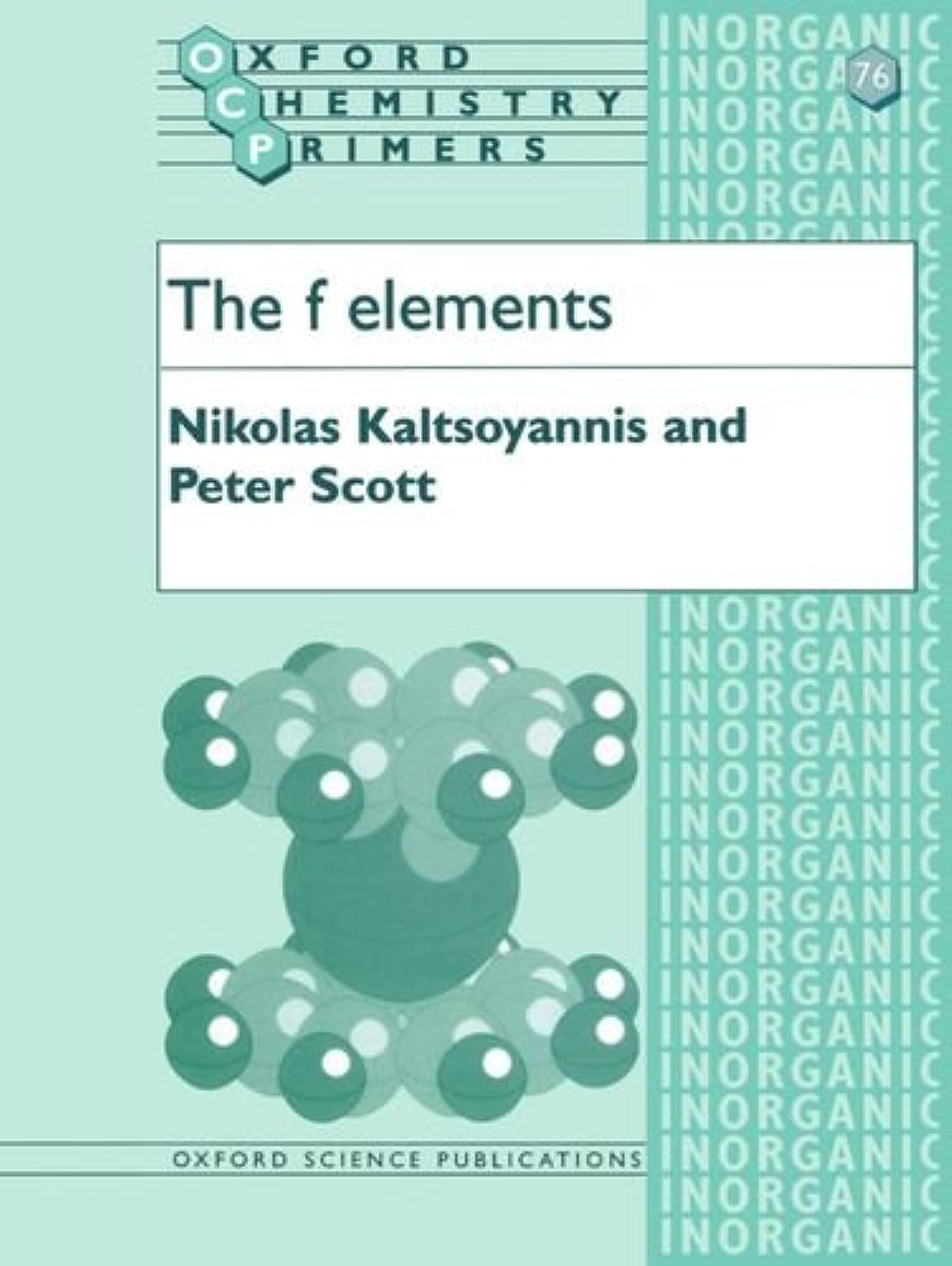
The lanthanides and actinides (the f elements) are rarely studied in detail by chemistry undergraduates. More often they appear as an afterthought in bonding, spectroscopy, magnetism, coordination chemistry, and organometallics courses. This is largely because of a lack of an accessible text treating the chemistry of these elements in one cover. Moreover, the placement of lanthanides and actinides in the closing pages of standard inorganic chemistry text books serves to marginalise these elements further. The f elements has therefore been written to fill a gap in the undergraduate chemistry textbook market. It covers much of the fundamental chemistry of the lanthanide and actinide elements, including coordination chemistry, solid state compounds, organometallic chemistry, electronic spectroscopy, and magnetism. Many comparisons are made between the chemistry of the lanthanides and actinides and that of the transition elements, which is generally much more familiar to undergraduate chemistry students. The book uses the chemistry of the f elements as a vehicle for the communication of several important chemical concepts that are not usually discussed in detail in undergraduate courses, for example the chemical consequences of relativity and the lanthanide and actinide contractions. Many important modern applications of f element chemistry, e.g. the use of actinides in nuclear power generation and of the lanthanides in magnetic resonance imaging and catalytic converters in motor vehicle exhausts, are also discussed in depth.
⚠️ WARNING (California Proposition 65):
This product may contain chemicals known to the State of California to cause cancer, birth defects, or other reproductive harm.
For more information, please visit www.P65Warnings.ca.gov.
- Q: What is the main focus of 'The f Elements (Oxford Chemistry Primers)'? A: The book primarily focuses on the chemistry of lanthanides and actinides, covering aspects such as coordination chemistry, solid state compounds, organometallic chemistry, electronic spectroscopy, and magnetism.
- Q: Who is the author of 'The f Elements'? A: The author of 'The f Elements (Oxford Chemistry Primers)' is Nikolas Kaltsoyannis.
- Q: How many pages does 'The f Elements' contain? A: 'The f Elements' contains a total of 85 pages.
- Q: What is the publication date of this book? A: 'The f Elements' was published on September 23, 1999.
- Q: What condition is the book in? A: 'The f Elements (Oxford Chemistry Primers)' is available in brand new condition.
- Q: Is this book suitable for undergraduate chemistry students? A: Yes, 'The f Elements' is specifically written to fill a gap in the undergraduate chemistry textbook market, making it suitable for chemistry undergraduates.
- Q: What topics are compared in 'The f Elements'? A: The book makes comparisons between the chemistry of lanthanides and actinides and that of transition elements, which are generally more familiar to undergraduate students.
- Q: What type of binding does 'The f Elements' have? A: 'The f Elements' is published in paperback binding.
- Q: Does 'The f Elements' cover modern applications of f element chemistry? A: Yes, the book discusses important modern applications of f element chemistry, including the use of actinides in nuclear power generation and lanthanides in magnetic resonance imaging and catalytic converters.
- Q: What edition of the book is available? A: 'The f Elements (Oxford Chemistry Primers)' is available in its first edition.