If you have any questions, you are always welcome to contact us. We'll get back to you as soon as possible, withing 24 hours on weekdays.
Customer service
All questions about your order, return and delivery must be sent to our customer service team by e-mail at yourstore@yourdomain.com
Sale & Press
If you are interested in selling our products, need more information about our brand or wish to make a collaboration, please contact us at press@yourdomain.com
Help
If you have any questions, you are always welcome to contact us. We'll get back to you as soon as possible, withing 24 hours on weekdays.
Customer service
All questions about your order, return and delivery must be sent to our customer service team by e-mail at yourstore@yourdomain.com
Sale & Press
If you are interested in selling our products, need more information about our brand or wish to make a collaboration, please contact us at press@yourdomain.com
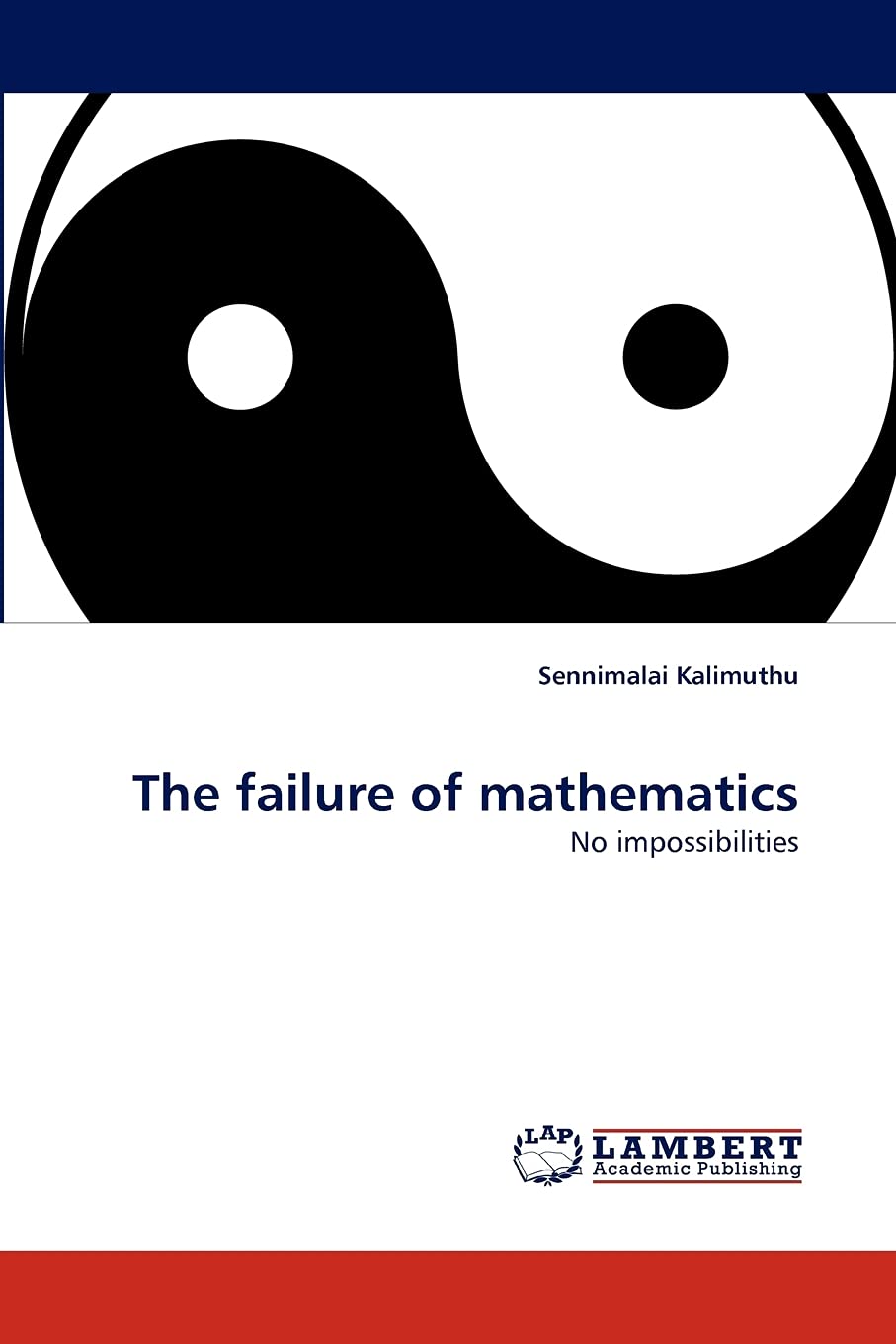
In the late nineteenth century mathematicians established that it is not merely difficult but impossible to deduce Euclid I from Euclid I to IV. The square root of two is not rational but irrational, the sum of two odd numbers is always an even number , a polynomial quadratic equations cannot have more than two roots , it is not possible to trisect the general given angle , it is impossible to square a circle and duplicate a cube and it is not possible to draw a regular heptagon. These are all famous mathematical impossibilities. But the mathematical variation of liar's paradox says that ?In any logical system one can construct statements that are neither true nor false.? [Gdel's first incompleteness theorem] In this work, the author re ? probed the parallel postulate problem and found sixteen new consistent findings which may give birth to a new field of science. Also, the author's findings establish the above mentioned theorem.
⚠️ WARNING (California Proposition 65):
This product may contain chemicals known to the State of California to cause cancer,
birth defects, or other reproductive harm.
For MAP (Minimum Advertised Price) violations and Intellectual Property (IP) or Trademark concerns, please contact:
support@ergodebooks.com
⚠️ California Proposition 65 Warning: Some products sold on this website may expose you to chemicals known to the State of California to cause cancer, birth defects, or other reproductive harm. For more information, visit www.P65Warnings.ca.gov.