
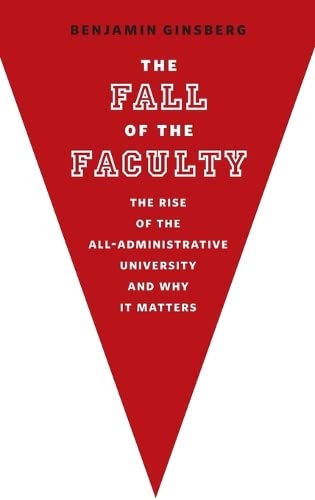
Title
The Fall of the Faculty: The Rise of the AllAdministrative University and Why it Matters,New
Sold by Ergodebooks, an authorized reseller.
Returns accepted within 30 days | support@ergodebooks.com
Shipping Information
- Free Standard Shipping — United States only
- Processing Time: 3–5 business days
- Estimated Delivery: 6–10 business days after dispatch
- Double-boxed, fully insured & discreetly packaged
- Tracking number sent via email once dispatched
Returns & Refund
Returns accepted within 30 days of delivery.
Damaged or Defective Item
Free return shipping + replacement or full refund
Wrong Item Received
Free return shipping + replacement or full refund
Change of Mind
Return shipping at customer's expense · 25% restocking fee applies
Payment Option

Until very recently, American universities were led mainly by their faculties, which viewed intellectual production and pedagogy as the core missions of higher education. Today, as Benjamin Ginsberg warns in this eyeopening, controversial book, 'deanlets'administrators and staffers often without serious academic backgrounds or experienceare setting the educational agenda.The Fall of the Faculty examines the fallout of rampant administrative blight that now plagues the nation's universities. In the past decade, universities have added layers of administrators and staffers to their payrolls every year even while laying off fulltime faculty in increasing numbersostensibly because of budget cuts. In a further irony, many of the newly mintedand nonacademicadministrators are career managers who downplay the importance of teaching and research, as evidenced by their tireless advocacy for a banal 'life skills' curriculum. Consequently, students are denied a more enriching educational experienceone defined by intellectual rigor. Ginsberg also reveals how the legitimate grievances of minority groups and liberal activists, which were traditionally championed by faculty members, have, in the hands of administrators, been reduced to chess pieces in a game of power politics. By embracing initiatives such as affirmative action, the administration gainedfavor with these groups and legitimized a thinly cloaked gambit to bolster their power over the faculty.As troubling as this trend has become, there are ways to reverse it. The Fall of the Faculty outlines how we can revamp the system so that real educators can regain their voice in curriculum policy.
⚠️ WARNING (California Proposition 65):
This product may contain chemicals known to the State of California to cause cancer, birth defects, or other reproductive harm.
For more information, please visit www.P65Warnings.ca.gov.
- Q: What is the main topic of 'The Fall of the Faculty'? A: 'The Fall of the Faculty' discusses the shift in leadership within American universities from faculty members to administrators, highlighting the impact this change has on education.
- Q: Who is the author of this book? A: The book is authored by Benjamin Ginsberg.
- Q: When was 'The Fall of the Faculty' published? A: 'The Fall of the Faculty' was published on August 12, 2011.
- Q: What type of binding does this book have? A: This book is available in hardcover binding.
- Q: How many pages does 'The Fall of the Faculty' contain? A: 'The Fall of the Faculty' contains 264 pages.
- Q: What condition is this book in? A: The book is in new condition.
- Q: What is the edition of this book? A: This is the first edition of 'The Fall of the Faculty'.
- Q: What are the key themes discussed in the book? A: Key themes include the rise of administrative roles in universities, the effects on curriculum and faculty power, and potential solutions to restore faculty influence.
- Q: Is there a specific audience for this book? A: 'The Fall of the Faculty' is aimed at educators, administrators, and anyone interested in higher education policy and reform.
- Q: Does the book provide solutions to the issues it raises? A: Yes, Benjamin Ginsberg outlines ways to revamp the current system to empower educators in curriculum decisions.