
Title
The Federal Judiciary and Institutional Change,Used
Sold by Ergodebooks, an authorized reseller.
Returns accepted within 30 days | support@ergodebooks.com
Shipping Information
- Free Standard Shipping — United States only
- Processing Time: 3–5 business days
- Estimated Delivery: 6–10 business days after dispatch
- Double-boxed, fully insured & discreetly packaged
- Tracking number sent via email once dispatched
Returns & Refund
Returns accepted within 30 days of delivery.
Damaged or Defective Item
Free return shipping + replacement or full refund
Wrong Item Received
Free return shipping + replacement or full refund
Change of Mind
Return shipping at customer's expense · 25% restocking fee applies
Payment Option

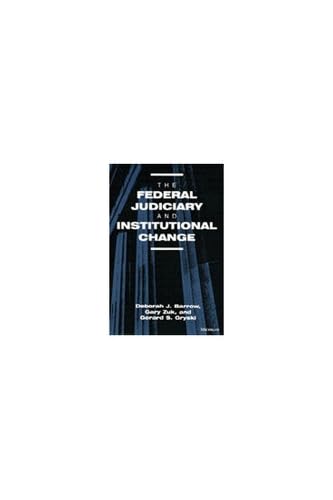
This work focuses on the staffing of the federal district and appellate courts from 18691992. Using a large data set that includes information on appointments and voluntary departures, the importance of government control (unified versus divided) to institutional change is showcased.The analysis is divided into three eras (18691932, 193368, and 196992), each of which was dominated by one of the two parties. The nature of partisan transformation of the judiciary in each era is examined, and comparisons across eras are made. The authors scrutinize the approaches of individual presidents to judicial staffing and describe the politics of bench expansion. In addition, they present an intriguing analysis of how judges contribute to change in the partisan complexion of the bench by timing retirements to favor their parties.The Federal Judiciary and Institutional Change is written in the theoretical tradition of neoinstitutionalism. The authors find that the nature of partisan transformation of the Third Branch is very much a function of changes in the institutional environment.This work will be of interest to judicial scholars, especially in political science, as well as legal historians and specialists in American politics drawn to the theme of the importance of unified government.Deborah J. Barrow, Gary Zuk, and Gerard S. Gryski are Associate Professors, Department of Political Science, Auburn University.
⚠️ WARNING (California Proposition 65):
This product may contain chemicals known to the State of California to cause cancer, birth defects, or other reproductive harm.
For more information, please visit www.P65Warnings.ca.gov.