
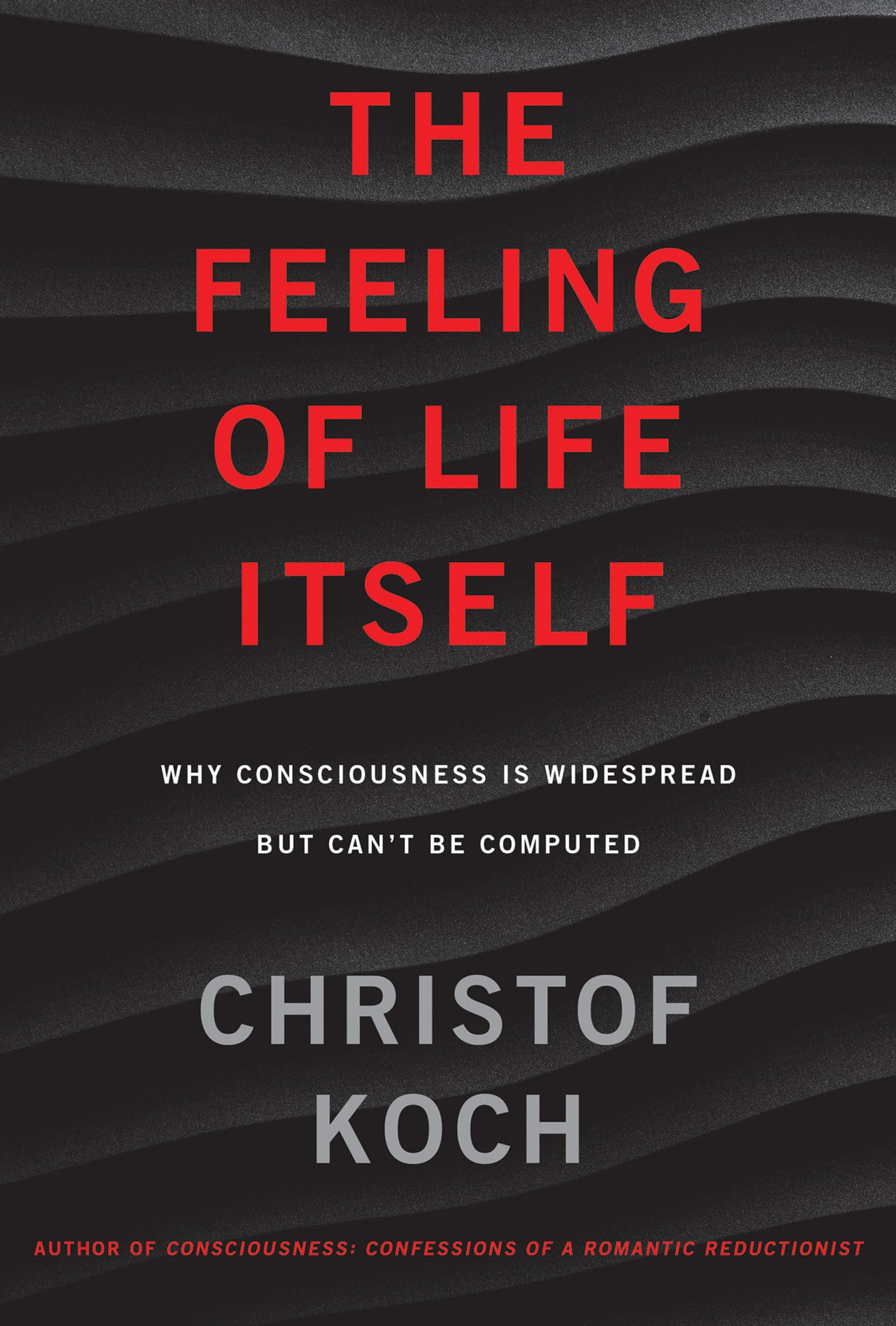
Title
The Feeling of Life Itself: Why Consciousness Is Widespread but Can't Be Computed,Used
Sold by Ergodebooks, an authorized reseller.
Returns accepted within 30 days | support@ergodebooks.com
Shipping Information
- Free Standard Shipping — United States only
- Processing Time: 3–5 business days
- Estimated Delivery: 6–10 business days after dispatch
- Double-boxed, fully insured & discreetly packaged
- Tracking number sent via email once dispatched
Returns & Refund
Returns accepted within 30 days of delivery.
Damaged or Defective Item
Free return shipping + replacement or full refund
Wrong Item Received
Free return shipping + replacement or full refund
Change of Mind
Return shipping at customer's expense · 25% restocking fee applies
Payment Option

A thoughtprovoking argument that consciousnessmore widespread than previously assumedis the feeling of being alive, not a type of computation or a clever hackIn The Feeling of Life Itself, Christof Koch offers a straightforward definition of consciousness as any subjective experience, from the most mundane to the most exaltedthe feeling of being alive. Psychologists study which cognitive operations underpin a given conscious perception. Neuroscientists track the neural correlates of consciousness in the brain, the organ of the mind. But why the brain and not, say, the liver? How can the brainthree pounds of highly excitable matter, a piece of furniture in the universe, subject to the same laws of physics as any other piecegive rise to subjective experience? Koch argues that what is needed to answer these questions is a quantitative theory that starts with experience and proceeds to the brain. In The Feeling of Life Itself, Koch outlines such a theory, based on integrated information.Koch describes how the theory explains many facts about the neurology of consciousness and how it has been used to build a clinically useful consciousness meter. The theory predicts that many, and perhaps all, animals experience the sights and sounds of life; consciousness is much more widespread than conventionally assumed. Contrary to received wisdom, however, Koch argues that programmable computers will not have consciousness. Even a perfect software model of the brain is not conscious. Its simulation is fake consciousness. Consciousness is not a special type of computationit is not a clever hack. Consciousness is about being.
⚠️ WARNING (California Proposition 65):
This product may contain chemicals known to the State of California to cause cancer, birth defects, or other reproductive harm.
For more information, please visit www.P65Warnings.ca.gov.
- Q: What is the main argument of 'The Feeling of Life Itself'? A: 'The Feeling of Life Itself' argues that consciousness is a widespread phenomenon and defines it as the feeling of being alive rather than a computational process.
- Q: Who is the author of this book? A: The author of 'The Feeling of Life Itself' is Christof Koch, a prominent neuroscientist known for his work on consciousness.
- Q: What is the publication date of this book? A: 'The Feeling of Life Itself' was published on September 24, 2019.
- Q: What is the format of this book? A: This book is available in a hardcover format.
- Q: How many pages does the book have? A: 'The Feeling of Life Itself' contains 280 pages.
- Q: What is the main focus of the book? A: The main focus of the book is to provide a quantitative theory of consciousness based on integrated information and explore its implications for understanding subjective experiences.
- Q: Does the book discuss the neuroscience behind consciousness? A: Yes, the book discusses the neurological aspects of consciousness and how it relates to cognitive operations and neural correlates in the brain.
- Q: Is this book suitable for someone new to cognitive psychology? A: Yes, the book is thought-provoking and accessible, making it suitable for readers new to cognitive psychology while also offering depth for those familiar with the subject.
- Q: What are some key concepts covered in the book? A: Key concepts in the book include the definition of consciousness, the relationship between the brain and experience, and the implications of consciousness for different animal species.
- Q: Does the author believe that computers can achieve consciousness? A: No, Christof Koch argues that programmable computers will not have consciousness and that their simulations are not equivalent to genuine conscious experience.