If you have any questions, you are always welcome to contact us. We'll get back to you as soon as possible, withing 24 hours on weekdays.
Customer service
All questions about your order, return and delivery must be sent to our customer service team by e-mail at yourstore@yourdomain.com
Sale & Press
If you are interested in selling our products, need more information about our brand or wish to make a collaboration, please contact us at press@yourdomain.com
Help
If you have any questions, you are always welcome to contact us. We'll get back to you as soon as possible, withing 24 hours on weekdays.
Customer service
All questions about your order, return and delivery must be sent to our customer service team by e-mail at yourstore@yourdomain.com
Sale & Press
If you are interested in selling our products, need more information about our brand or wish to make a collaboration, please contact us at press@yourdomain.com
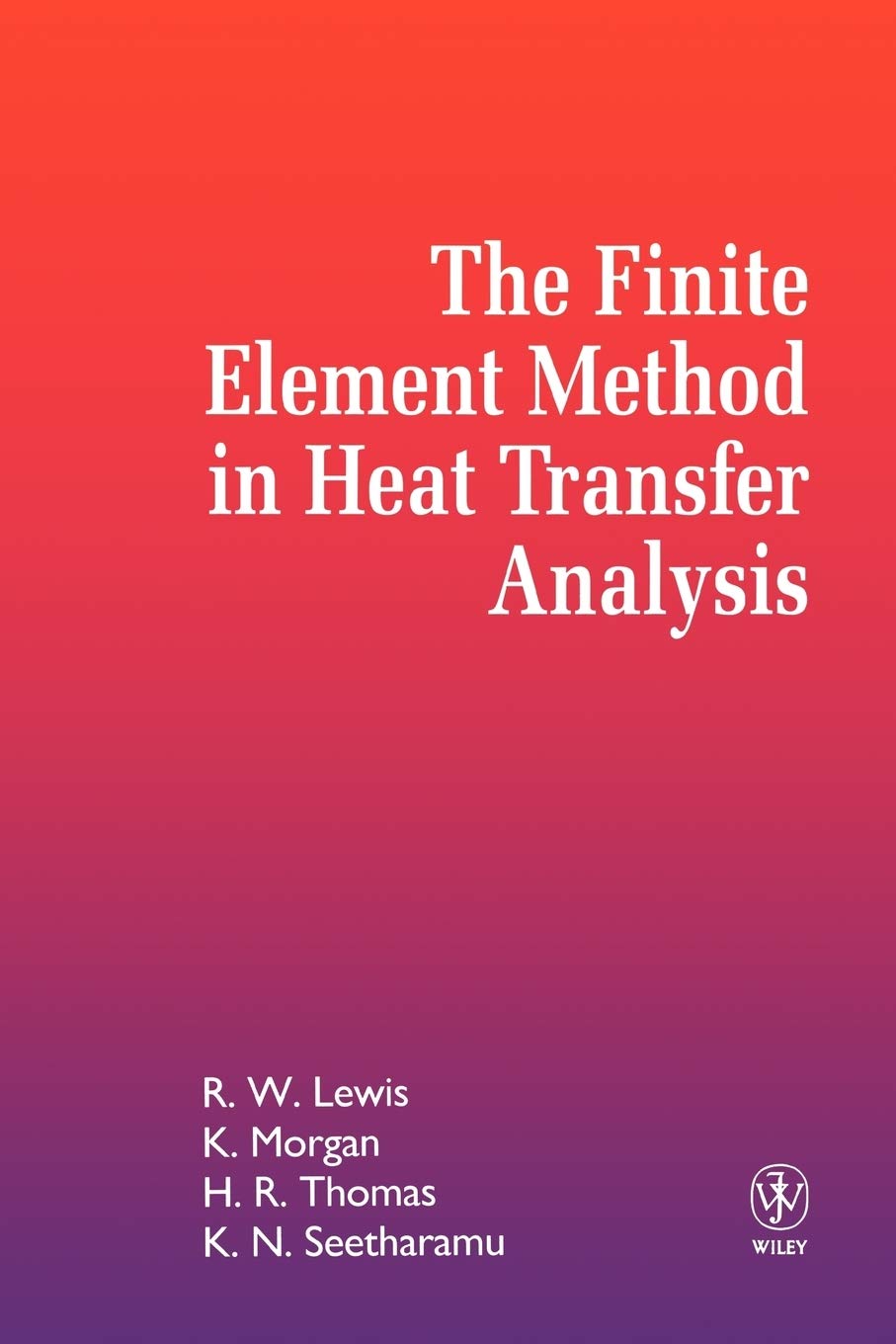
Heat transfer analysis is a problem of major significance in a vast range of industrial applications. These extend over the fields of mechanical engineering, aeronautical engineering, chemical engineering and numerous applications in civil and electrical engineering. If one considers the heat conduction equation alone the number of practical problems amenable to solution is extensive. Expansion of the work to include features such as phase change, coupled heat and mass transfer, and thermal stress analysis provides the engineer with the capability to address a further series of key engineering problems. The complexity of practical problems is such that closed form solutions are not generally possible. The use of numerical techniques to solve such problems is therefore considered essential, and this book presents the use of the powerful finite element method in heat transfer analysis. Starting with the fundamental general heat conduction equation, the book moves on to consider the solution of linear steady state heat conduction problems, transient analyses and nonlinear examples. Problems of melting and solidification are then considered at length followed by a chapter on convection. The application of heat and mass transfer to drying problems and the calculation of both thermal and shrinkage stresses conclude the book. Numerical examples are used to illustrate the basic concepts introduced. This book is the outcome of the teaching and research experience of the authors over a period of more than 20 years.
⚠️ WARNING (California Proposition 65):
This product may contain chemicals known to the State of California to cause cancer,
birth defects, or other reproductive harm.
For MAP (Minimum Advertised Price) violations and Intellectual Property (IP) or Trademark concerns, please contact:
support@ergodebooks.com
⚠️ California Proposition 65 Warning: Some products sold on this website may expose you to chemicals known to the State of California to cause cancer, birth defects, or other reproductive harm. For more information, visit www.P65Warnings.ca.gov.