
Title
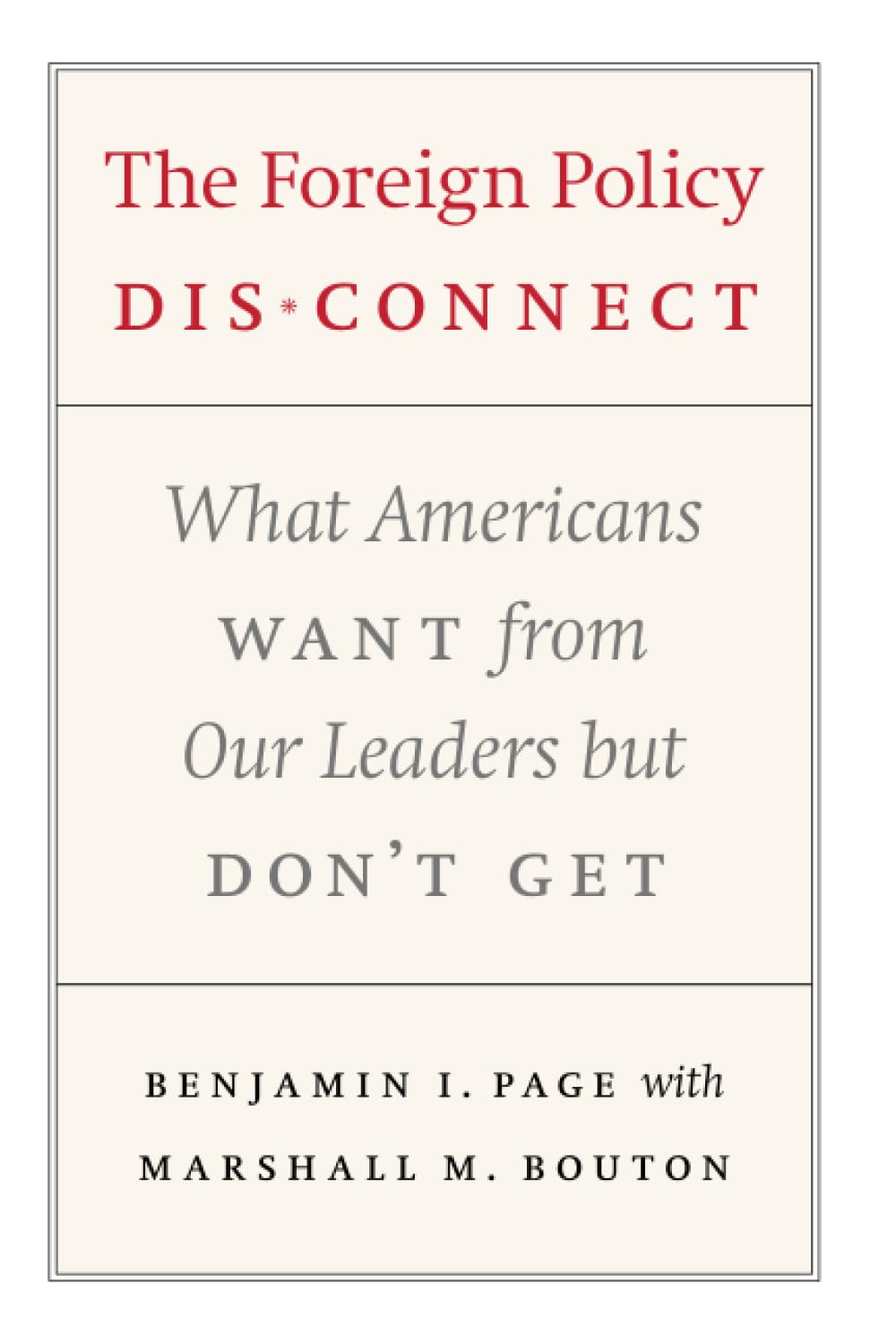
The Foreign Policy Disconnect: What Americans Want from Our Leaders but Don't Get (American Politics and Political Economy Serie,New
Sold by Ergodebooks, an authorized reseller.
Returns accepted within 30 days | support@ergodebooks.com
Shipping Information
- Free Standard Shipping — United States only
- Processing Time: 3–5 business days
- Estimated Delivery: 6–10 business days after dispatch
- Double-boxed, fully insured & discreetly packaged
- Tracking number sent via email once dispatched
Returns & Refund
Returns accepted within 30 days of delivery.
Damaged or Defective Item
Free return shipping + replacement or full refund
Wrong Item Received
Free return shipping + replacement or full refund
Change of Mind
Return shipping at customer's expense · 25% restocking fee applies
Payment Option

With world affairs so troubled, what kind of foreign policy should the United States pursue? Benjamin Page and Marshall Bouton look for answers in a surprising place: among the American people. Drawing on a series of national surveys conducted between 1974 and 2004, Page and Bouton reveal thatcontrary to conventional wisdomAmericans generally hold durable, coherent, and sensible opinions about foreign policy. Nonetheless, their opinions often stand in opposition to those of policymakers, usually because of different interests and values, rather than superior wisdom among the elite. The Foreign Policy Disconnect argues that these gaps between leaders and the public are harmful, and that by using public opinion as a guideline policymakers could craft a more effective, sustainable, and democratic foreign policy.Page and Bouton support this argument by painting a uniquely comprehensive portrait of the military, diplomatic, and economic foreign policies Americans favor. They show, for example, that protecting American jobs is just as important to the public as security from attack, a goal the current administration seems to pursue singlemindedly. And contrary to some officials unilateral tendencies, the public consistently and overwhelmingly favors cooperative multilateral policy and participation in international treaties. Moreover, Americans foreign policy opinions are seldom divided along the usual lines: majorities of virtually all social, ideological, and partisan groups seek a policy that pursues the goals of security and justice through cooperative means. Written in a clear and engaging style, The Foreign Policy Disconnect calls, in an original voice, for a more democratic approach to creating such a policy.
⚠️ WARNING (California Proposition 65):
This product may contain chemicals known to the State of California to cause cancer, birth defects, or other reproductive harm.
For more information, please visit www.P65Warnings.ca.gov.