
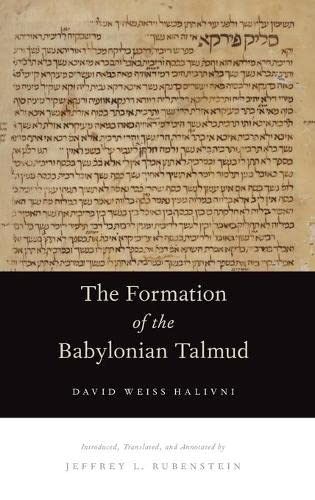
Title
The Formation of the Babylonian Talmud,Used
Sold by Ergodebooks, an authorized reseller.
Returns accepted within 30 days | support@ergodebooks.com
Shipping Information
- Free Standard Shipping — United States only
- Processing Time: 3–5 business days
- Estimated Delivery: 6–10 business days after dispatch
- Double-boxed, fully insured & discreetly packaged
- Tracking number sent via email once dispatched
Returns & Refund
Returns accepted within 30 days of delivery.
Damaged or Defective Item
Free return shipping + replacement or full refund
Wrong Item Received
Free return shipping + replacement or full refund
Change of Mind
Return shipping at customer's expense · 25% restocking fee applies
Payment Option

David Weiss Halivni's The Formation of the Babylonian Talmud, originally published in Hebrew and here translated by Jeffrey L. Rubenstein, is widely regarded as the most comprehensive scholarly examination of the processes of composition and editing of the Babylonian Talmud.Halivni presents the summation of a lifetime of scholarship and the conclusions of his multivolume Talmudic commentary, Sources and Traditions (Meqorot umesorot). Arguing against the traditional view that the Talmud was composed c. 450 CE by the last of the named sages in the Talmud, the Amoraim, Halivni proposes that its formation took place over a much longer period of time, not reaching its final form until about 750 CE. The Talmud consists of many literary strata or layers, with later layers commenting upon and reinterpreting earlier layers. The later layers differ qualitatively from the earlier layers, and were composed by anonymous sages whom Halivni calls Stammaim. These sages were the true authoreditors of the Talmud. They reconstructed the reasons underpinning earlier rulings, created the dialectical argumentation characteristic of the Talmud, and formulated the literary units that make up the Talmudic text.Halivni also discusses the history and development of rabbinic tradition from the Mishnah through the postTalmudic legal codes, the types of dialectical analysis found in the different rabbinic works, and the roles of reciters, transmitters, compilers, and editors in the composition of the Talmud. This volume contains an introduction and annotations by Jeffrey L. Rubenstein.
⚠️ WARNING (California Proposition 65):
This product may contain chemicals known to the State of California to cause cancer, birth defects, or other reproductive harm.
For more information, please visit www.P65Warnings.ca.gov.