
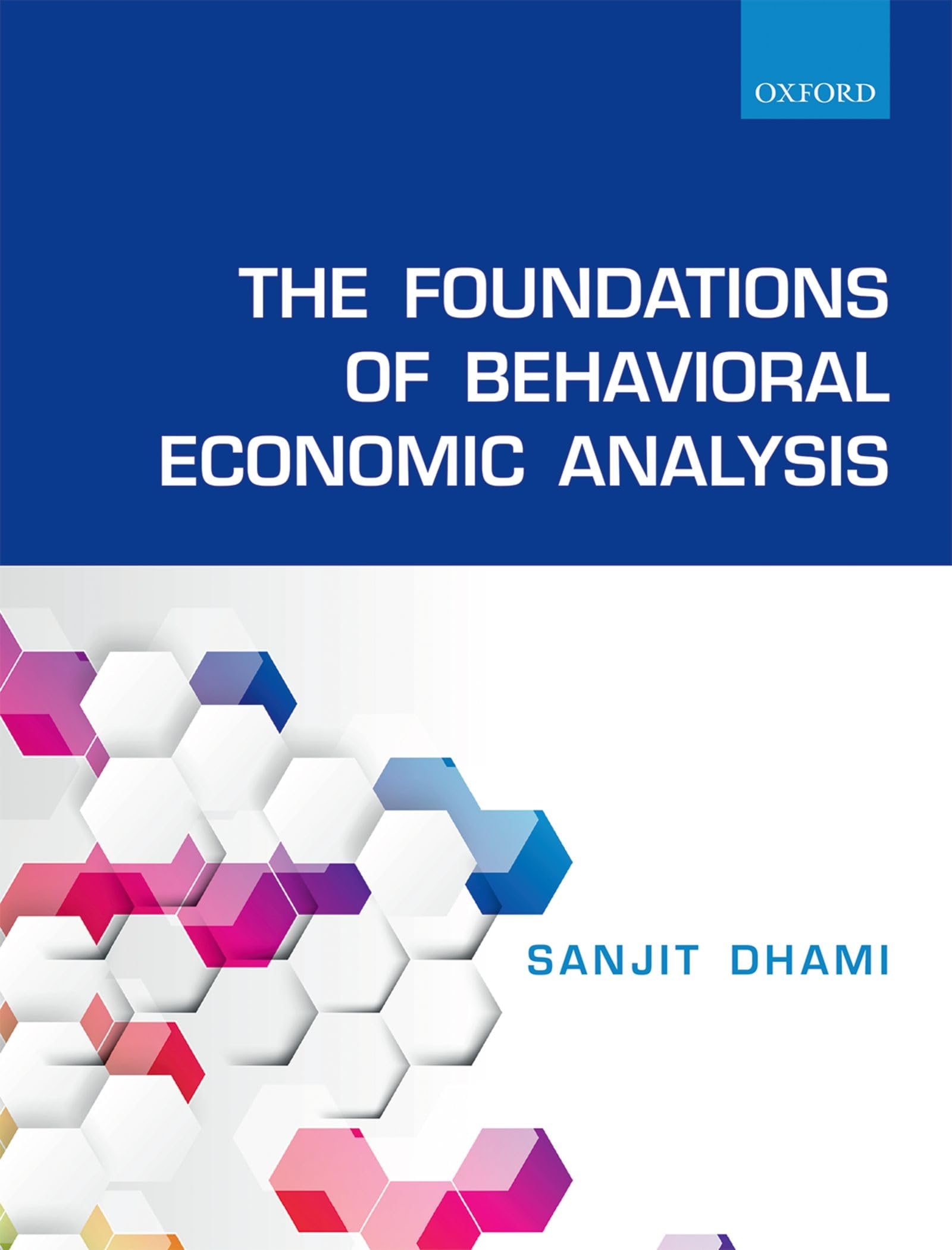
Title
The Foundations of Behavioral Economic Analysis,Used
Sold by Ergodebooks, an authorized reseller.
Returns accepted within 30 days | support@ergodebooks.com
Shipping Information
- Free Standard Shipping — United States only
- Processing Time: 3–5 business days
- Estimated Delivery: 6–10 business days after dispatch
- Double-boxed, fully insured & discreetly packaged
- Tracking number sent via email once dispatched
Returns & Refund
Returns accepted within 30 days of delivery.
Damaged or Defective Item
Free return shipping + replacement or full refund
Wrong Item Received
Free return shipping + replacement or full refund
Change of Mind
Return shipping at customer's expense · 25% restocking fee applies
Payment Option

This is the first definitive introduction to behavioral economics aimed at advanced undergraduate and postgraduate students. Authoritative, cutting edge, yet accessible, it guides the reader through theory and evidence, providing engaging and relevant applications throughout. It is divided into nine parts and 24 chapters:Part I is on behavioral economics of risk, uncertainty, and ambiguity. The evidence against expected utility theory is examined, and the behavioral response is outlined; the best empirically supported theory is prospect theory.Part II considers otherregarding preferences. The evidence from experimental games on human sociality is given, followed by models and applications of inequity aversion, intentions based reciprocity, conditional cooperation, human virtues, and social identity.Part III is on time discounting. It considers the evidence against the exponential discounted utility model and describes several behavioral models such as hyperbolic discounting, attribute based models and the reference time theory.Part IV describes the evidence on classical game theory and considers several models of behavioral game theory, including levelk and cognitive hierarchy models, quantal response equilibrium, and psychological game theory.Part V considers behavioral models of learning that include evolutionary game theory, classical models of learning, experience weighted attraction model, learning direction theory, and stochastic social dynamics.Part VI studies the role of emotions; among other topics it considers projection bias, temptation preferences, happiness economics, and interaction between emotions and cognition.Part VII considers bounded rationality. The three main topics considered are judgment heuristics and biases, mental accounting, and behavioral finance.Part VIII considers behavioral welfare economics; the main topics are soft paternalism, and choicebased measures of welfare. Finally, Part IX gives an abbreviated taster course in neuroeconomics.
⚠️ WARNING (California Proposition 65):
This product may contain chemicals known to the State of California to cause cancer, birth defects, or other reproductive harm.
For more information, please visit www.P65Warnings.ca.gov.