
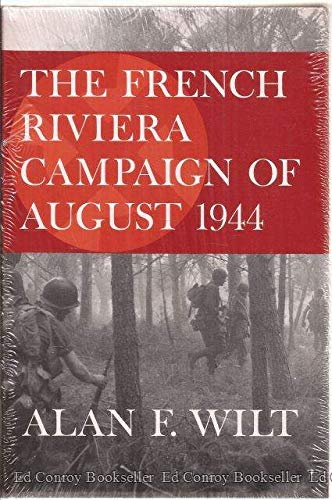
Title
The French Riviera Campaign of August 1944,Used
Sold by Ergodebooks, an authorized reseller.
Returns accepted within 30 days | support@ergodebooks.com
Shipping Information
- Free Standard Shipping — United States only
- Processing Time: 3–5 business days
- Estimated Delivery: 6–10 business days after dispatch
- Double-boxed, fully insured & discreetly packaged
- Tracking number sent via email once dispatched
Returns & Refund
Returns accepted within 30 days of delivery.
Damaged or Defective Item
Free return shipping + replacement or full refund
Wrong Item Received
Free return shipping + replacement or full refund
Change of Mind
Return shipping at customer's expense · 25% restocking fee applies
Payment Option

The Allies scored a spectacular victory when they invaded the French Riviera on August 15, 1944,but even today, three and a half decades later, British and American historians continue to debate whether the campaign represented brilliant strategy or meaningless waste of men and materials.Churchill and the British, explains Alan F. Wilt in this first fulllength account of that controversial invasion, consistently opposed the Riviera assault (code named Anvil, later Dragoon). Churchill saw Italy, not southern France, as the logical target for a major offensive action. Barely two weeks before Dragoon was to begin, Churchill tried to divert the assault from the Riviera to the Brittany peninsula. By this time America made all command decisions, however; the Allies launched Dragoon in spite of Churchills many machinations against it.Roosevelt and the Americans staunchly favored the Riviera campaign. In their view Dragoon would engage large numbers of Axis troops , release numerous French formations for combat on French soil , open up the possibility of capturing major ports , and increase pressure even more on Germany from the West.In this study, Wilt strikes a balance between the military and the diplomatic aspects of the Riviera campaign. Because he bases his study on German as well as British and American archival sourcesincluding the important Ultra intelligence documentsWilt presents his subject from the perspective of both the Allied and the Axis powers. He describes and documents a spirited exchange between British and American leaders, an amphibious invasion of considerable proportions, a swift allied advance led by colorful, yet competent commanders, and a German retreat led by capable, imaginative officers.
⚠️ WARNING (California Proposition 65):
This product may contain chemicals known to the State of California to cause cancer, birth defects, or other reproductive harm.
For more information, please visit www.P65Warnings.ca.gov.