
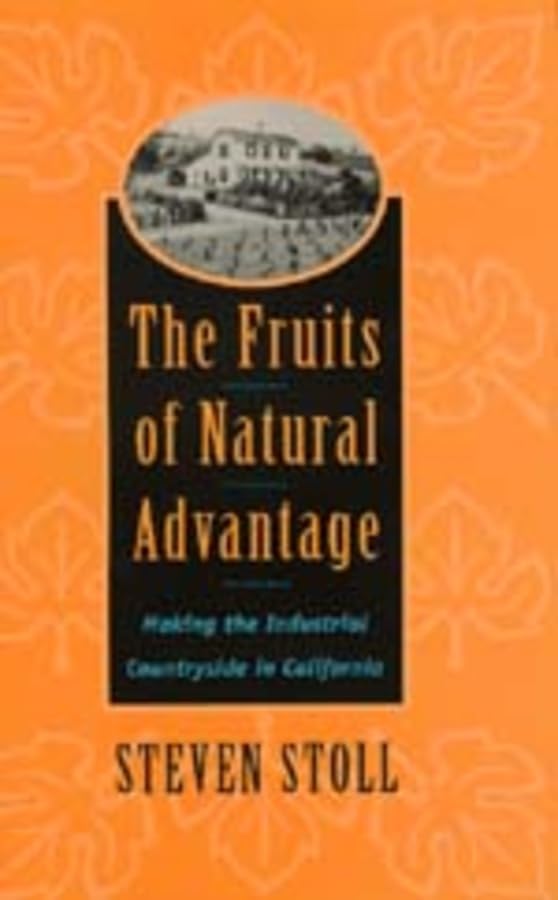
Title
The Fruits Of Natural Advantage: Making The Industrial Countryside In California,New
Sold by Ergodebooks, an authorized reseller.
Returns accepted within 30 days | support@ergodebooks.com
Shipping Information
- Free Standard Shipping — United States only
- Processing Time: 3–5 business days
- Estimated Delivery: 6–10 business days after dispatch
- Double-boxed, fully insured & discreetly packaged
- Tracking number sent via email once dispatched
Returns & Refund
Returns accepted within 30 days of delivery.
Damaged or Defective Item
Free return shipping + replacement or full refund
Wrong Item Received
Free return shipping + replacement or full refund
Change of Mind
Return shipping at customer's expense · 25% restocking fee applies
Payment Option

The Once Arid Valleys And Isolated Coastal Plains Of California Are Today The Center Of Fruit Production In The United States. Steven Stoll Explains How A Class Of Capitalist Farmers Made California The Nation'S Leading Producer Of Fruit And Created The First Industrial Countryside In America. This Brilliant Portrayal Of California From 1880 To 1930 Traces The Origins, Evolution, And Implications Of The Fruit Industry While Providing A Window Through Which To View The Entire History Of California.Stoll Shows How California Growers Assembled Chemicals, Corporations, And Political Influence To Bring The Most Perishable Products From The Most Distant State To The Great Urban Markets Of North America. But What Began As A Compromise Between A Beneficent Environment And Intensive Cultivation Ultimately Became Threatening To The Soil And Exploitative Of The People Who Worked It.Invoking History, Economics, Sociology, Agriculture, And Environmental Studies, Stoll Traces The Often Tragic Repercussions Of Fruit Farming And Shows How Central This Story Is To The Development Of The Industrial Countryside In The Twentieth Century.
⚠️ WARNING (California Proposition 65):
This product may contain chemicals known to the State of California to cause cancer, birth defects, or other reproductive harm.
For more information, please visit www.P65Warnings.ca.gov.
- Q: What is the binding type of this book? A: The binding type is hardcover. Hardcover bindings are durable and provide a quality feel, making this book suitable for long-term use.
- Q: How many pages does this book have? A: This book has three hundred two pages. This length allows for an in-depth exploration of the industrial countryside in California.
- Q: What are the dimensions of the book? A: The dimensions are six point fourteen inches in length, one point two inches in width, and nine point thirty-eight inches in height. These measurements make it a manageable size for reading.
- Q: Who is the author of this book? A: The author is Steven Stoll. He is known for his expertise in economic history and environmental studies, providing valuable insights in this work.
- Q: What genre does this book belong to? A: This book belongs to the genre of Economic History. It delves into the historical development of fruit production and its impact on California.
- Q: Is this book suitable for students studying economics? A: Yes, this book is suitable for students studying economics. It offers a detailed analysis of the intersection between agriculture and economic development.
- Q: Can this book be used as a reference for environmental studies? A: Yes, it can be used as a reference for environmental studies. The book discusses the implications of agricultural practices on the environment.
- Q: What time period does the book cover? A: The book covers the time period from eighteen eighty to nineteen thirty. This era was significant for the transformation of California's agricultural landscape.
- Q: How does this book approach the topic of industrial agriculture? A: The book approaches industrial agriculture by examining its historical roots and socio-economic impacts. It critiques the practices that shaped fruit production in California.
- Q: What themes are explored in this book? A: The themes explored include capitalism, environmental sustainability, and the socio-economic impacts of agriculture. These themes provide a holistic view of the industrial countryside.
- Q: How should I store this hardcover book? A: Store the hardcover book in an upright position on a shelf. Avoid exposure to direct sunlight to prevent fading and damage to the cover.
- Q: What is the recommended care for this book? A: The recommended care is to handle it gently and keep it away from moisture. This helps preserve the integrity of the binding and pages.
- Q: Is there a warranty for this book? A: No, there is no warranty for this book. Books typically do not come with warranties, but you can check the return policy if purchased from a retailer.
- Q: What do I do if the book arrives damaged? A: If the book arrives damaged, contact the retailer for return or exchange options. Most retailers have a policy in place for damaged items.
- Q: Is this book suitable for casual readers? A: Yes, this book is suitable for casual readers interested in history. Its engaging narrative makes it accessible for a general audience.
- Q: How does this book compare to other histories of California? A: This book offers a unique perspective by focusing specifically on the fruit industry. It differs from other histories that may cover broader topics without this specific focus.